
A new Scrum Master at the home-robot company schedules a two-hour 'Backlog Refinement' meeting every other Friday and tells the Scrum Team refinement only happens there. A Developer asks whether that's really how refinement is supposed to work. What should the Developer be told?
Select an answer to reveal the explanation.
Short Explanation
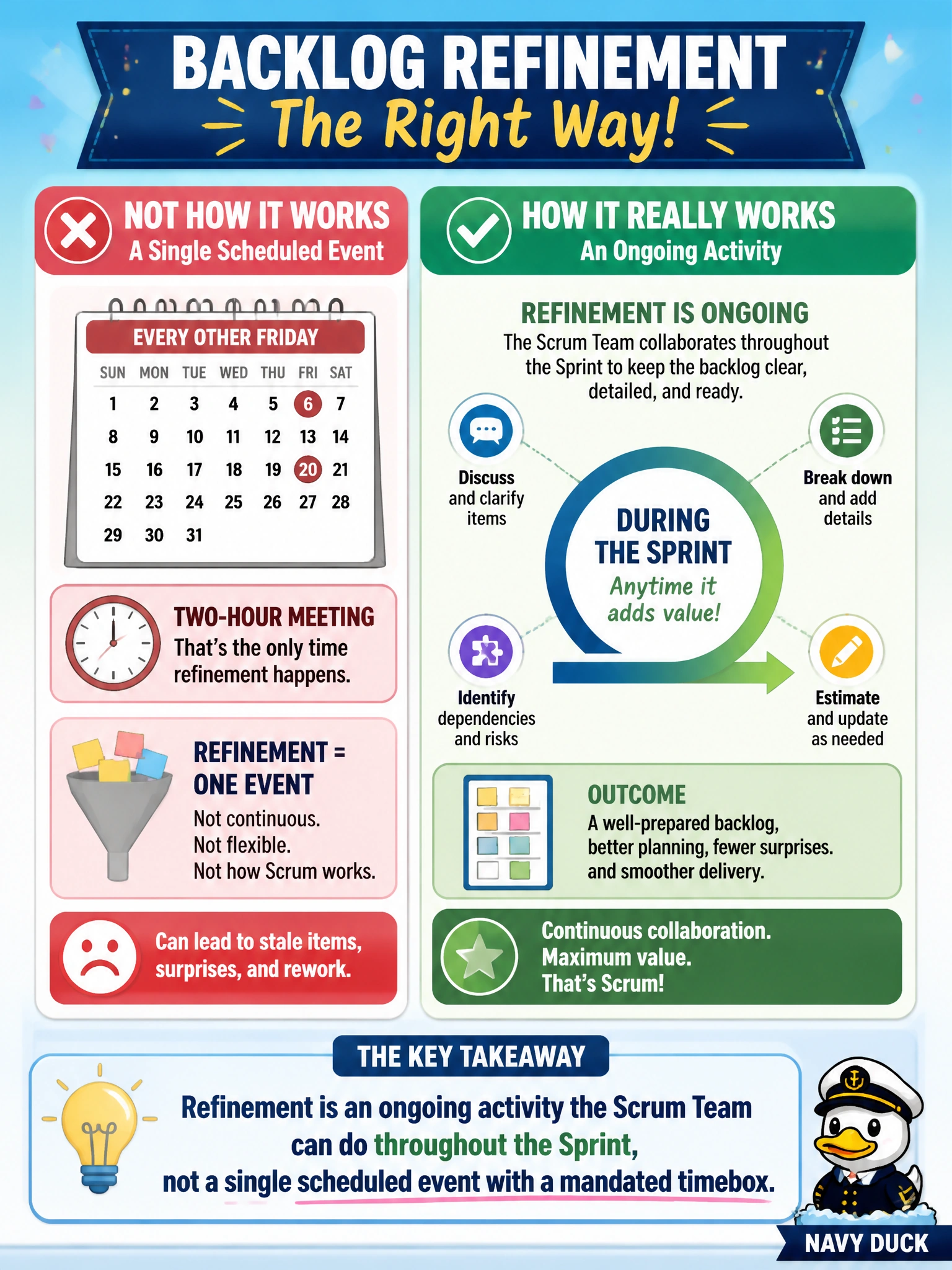
Refinement isn't a box you check every other Friday — it's more like tidying your workshop a little each day instead of once a month. The 2020 Scrum Guide describes it as an ongoing activity that adds detail, estimates, and order to Product Backlog items, whenever the Scrum Team decides to do it.
Full Explanation
The 2020 Scrum Guide names five formal events — Sprint, Sprint Planning, Daily Scrum, Sprint Review, Sprint Retrospective — and refinement is not one of them. It carries no prescribed timebox, frequency, or attendee list; the Guide simply says the Product Backlog is refined on an ongoing basis, and the Scrum Team decides how and when that happens. Locking it into a single recurring two-hour meeting isn't wrong to attempt as a practice, but presenting it as the only place refinement can happen misrepresents the framework — a firmware team might refine an upcoming certification-related item in a short hallway conversation the same day new test results arrive, without waiting for the scheduled slot. Treating it as mandatory-and-only-there also risks starving refinement between sessions, leaving Sprint Planning to absorb work that should already be reasonably well understood. The other two options both smuggle in false constraints Scrum doesn't impose: refinement isn't confined to Sprint Planning, and skipping it entirely isn't a real option either, since an unrefined backlog makes forecasting and Sprint Planning harder. A good check: can the Scrum Team point to refinement conversations happening at more than one point across a Sprint, not just in one meeting?