
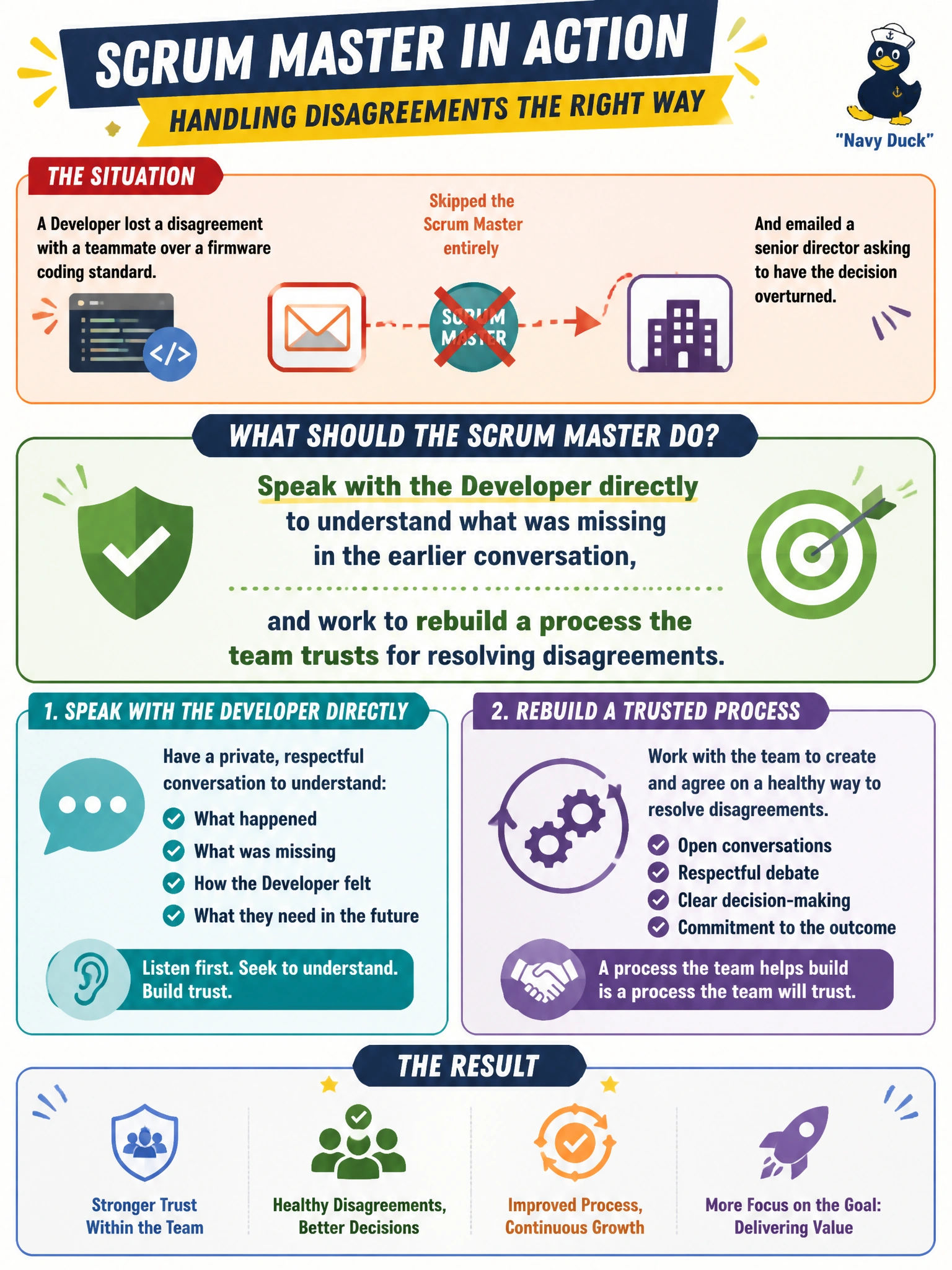
A Developer who lost a disagreement with a teammate over a firmware coding standard skips the Scrum Master entirely and emails a senior director asking to have the decision overturned. What should the Scrum Master do?
Select an answer to reveal the explanation.
Short Explanation
An email over your head is usually a sign the in-team process for working through disagreement didn't feel like enough, not just someone being difficult. The useful response is curiosity, not punishment — find out what broke down and rebuild a way for the team to resolve things themselves.
Full Explanation
The underlying issue is that a Developer felt the only path to resolution was escalating outside the team, which signals a gap in how conflict gets resolved internally — the Scrum Master's job is to understand and address that gap, since a self-managing team needs a trusted process for working through disagreement without going over each other's heads. Reporting the Developer for skipping the chain of command treats the symptom punitively and does nothing to fix why escalation felt necessary, likely making the Developer even less willing to raise concerns through normal channels next time. Ignoring the situation because it happened outside the Scrum Team abandons the Scrum Master's responsibility to the health of the team's working relationships, which doesn't stop mattering just because an email left the team's usual space. Asking the director to simply enforce the original decision resolves the immediate dispute but skips the more important question of why the Developer didn't trust the team's own process, leaving the same failure mode ready to repeat. A useful check: ask the Developer, a few weeks later, whether a similar disagreement would go to the team first this time — that answer shows whether trust was actually rebuilt.