
The home-robot product's app Developers work from one office and the firmware Developers work from another office in a different country, and the two groups rarely interact outside formal meetings, leading to slow, indirect communication. What is the most appropriate Scrum Master action?
Select an answer to reveal the explanation.
Short Explanation
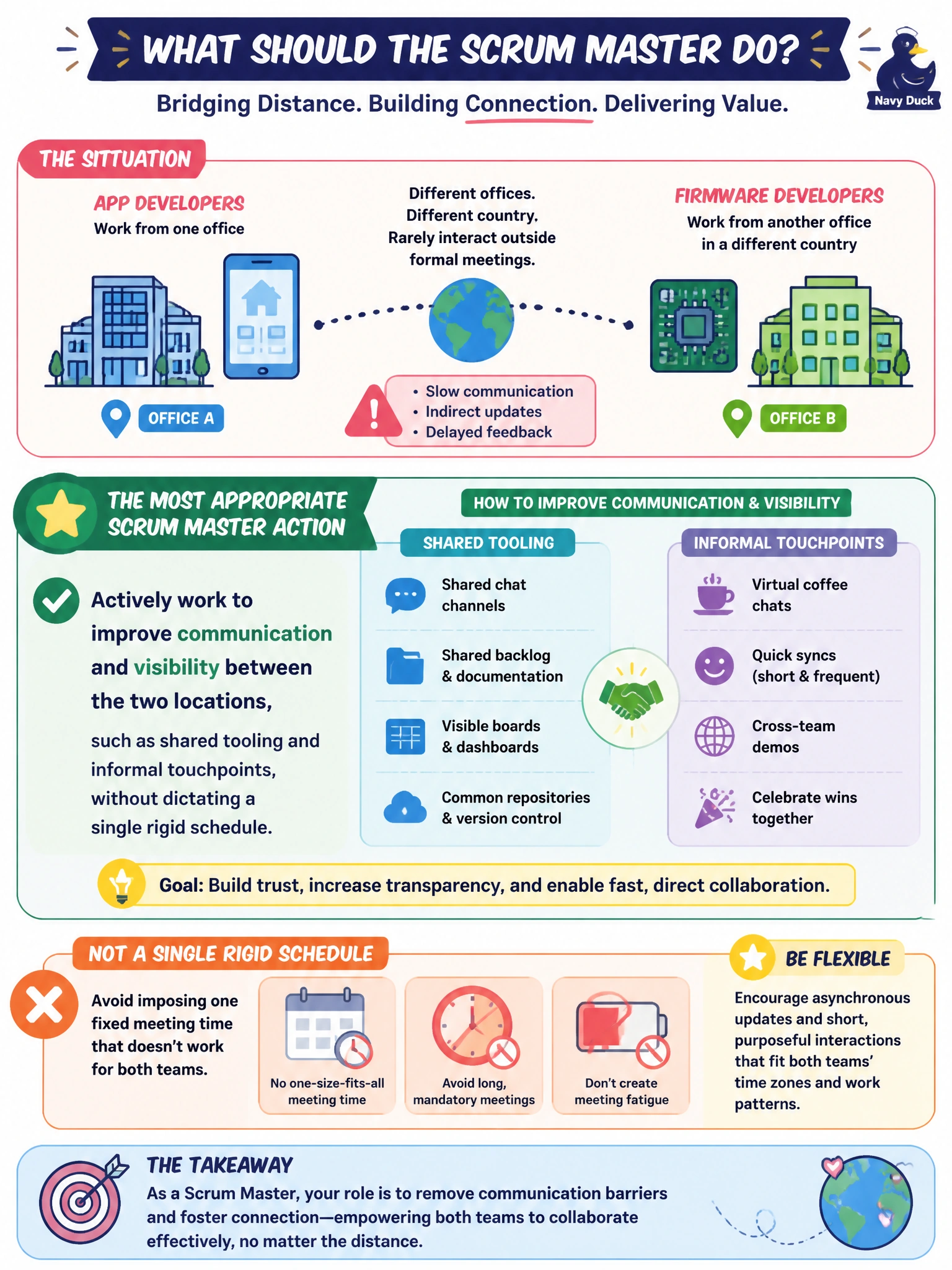
Distance doesn't have to mean distance in how people actually work together — a shared dashboard, a standing informal chat, or a slightly overlapping window can shrink that gap without forcing everyone onto identical clocks. That's the kind of practical, low-friction fix a Scrum Master should be reaching for.
Full Explanation
The Scrum Master's accountability includes helping the Scrum Team and stakeholders understand and enact Scrum's empirical approach, which includes maintaining transparency and effective communication however the team is physically arranged — the mechanism here is removing friction, not forcing sameness. Mandating identical hours ignores real constraints like time zones and personal circumstances, and rigid scheduling isn't required by the Guide, which leaves format decisions to the people doing the work. Recommending closing an office is a drastic, business-level restructuring decision entirely outside Scrum accountabilities and unjustified by a communication problem that has much lighter fixes. Treating the geographic gap as none of the Scrum Master's concern misreads the role — serving the Scrum Team explicitly includes helping remove barriers between the Scrum Team and its stakeholders and, by extension, between parts of a distributed team. A concrete check: after introducing shared tooling or touchpoints, see whether cross-location questions get answered in hours instead of days — that's a measurable sign the friction actually eased.