
One Developer on the home-robot cloud-services team works remotely from a timezone six hours off from the rest of the team, making the usual Daily Scrum time land at midnight for that Developer. Who should decide how to adjust the Daily Scrum, and how?
Select an answer to reveal the explanation.
Short Explanation
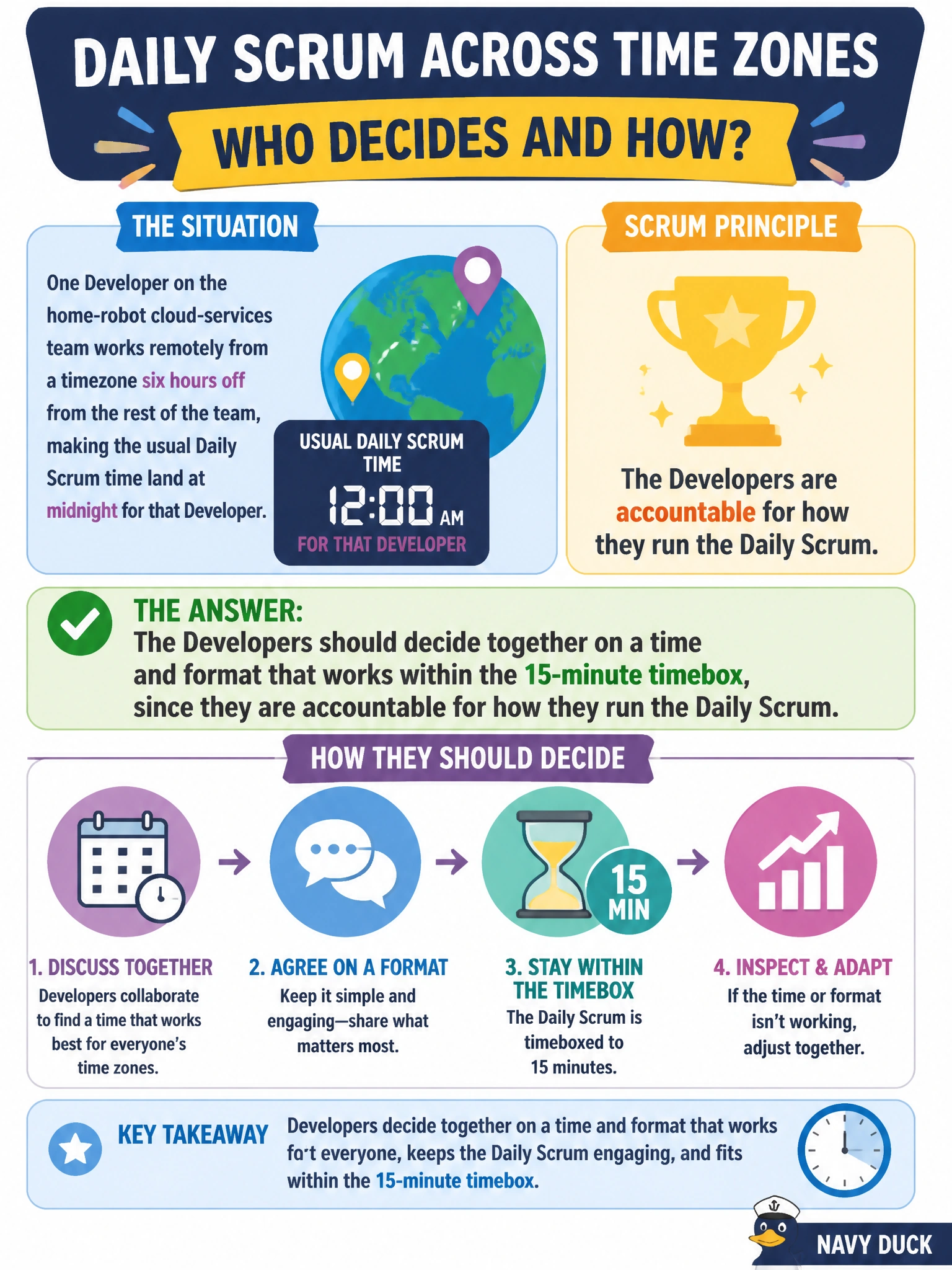
The Daily Scrum belongs to the Developers, full stop — it's their tool for planning the next 24 hours, so it makes sense that they're the ones who pick the time that actually works. Think of the Scrum Master here less as a scheduler and more as someone who makes sure the conversation happens, however the team decides to shape it.
Full Explanation
The Scrum Guide places accountability for the Daily Scrum squarely with the Developers, and that includes structural choices like timing and format as long as the 15-minute timebox and daily cadence are preserved — so the mechanism here is self-management, not top-down scheduling. A Scrum Master unilaterally picking a convenient time bypasses that accountability and turns an event the Developers should own into something imposed on them. A blanket HR policy standardizing meeting times across every distributed team ignores that each team's context differs and isn't something the Scrum Guide assigns to HR at all — this is a team-level decision, not an enterprise one. Having the Product Owner set the time confuses accountabilities: the Product Owner manages the Product Backlog and value, not the internal mechanics of how Developers coordinate their daily work. A practical check: after the team picks a new time or format — say, an asynchronous written update supplementing a shorter live sync — confirm they're still actually planning the next day's work, not just checking a box, since that inspection-and-adaptation purpose is what makes the event worth keeping.