
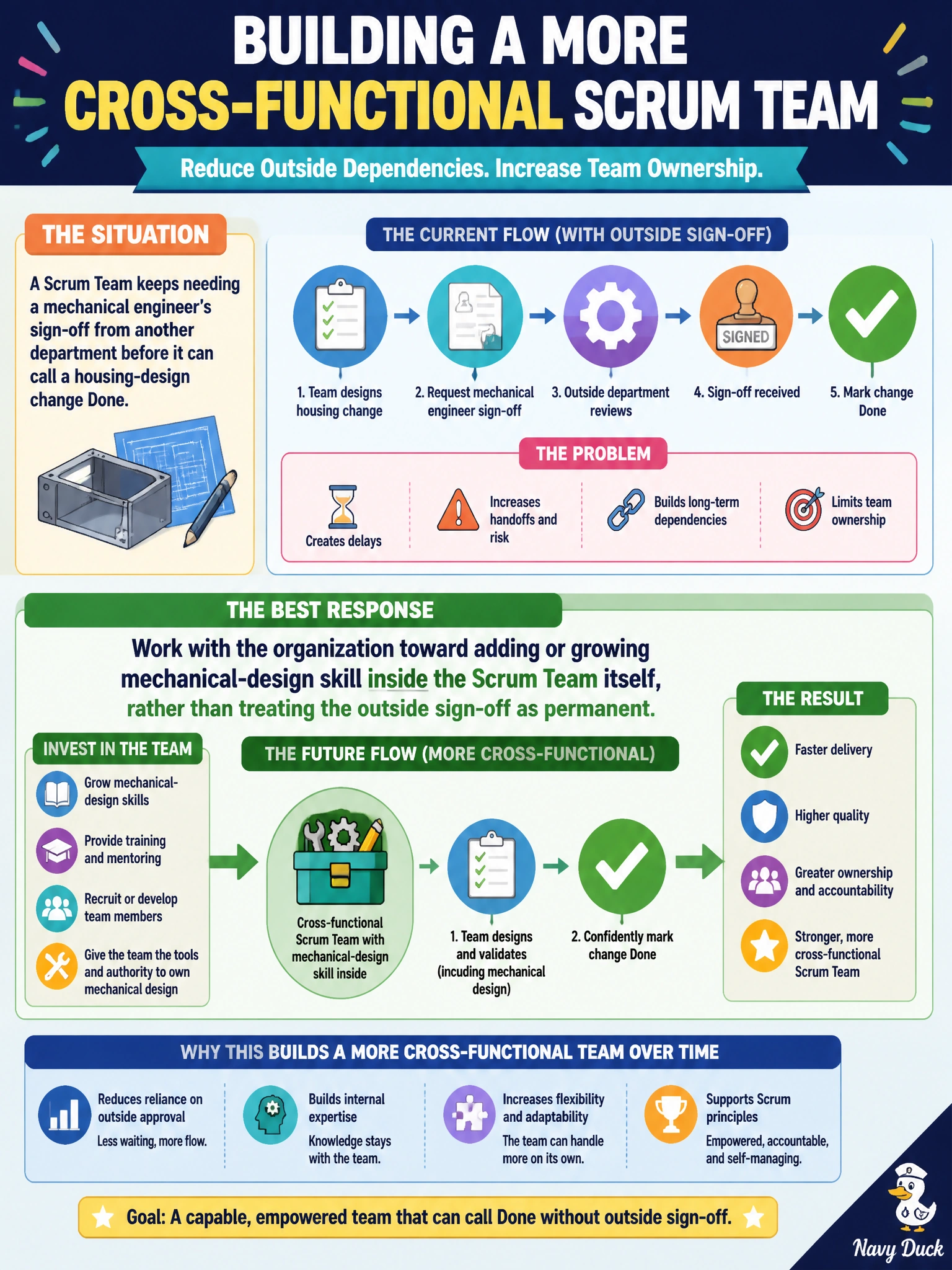
A Scrum Team keeps needing a mechanical engineer's sign-off from another department before it can call a housing-design change Done. Which response best supports the team becoming more cross-functional over time?
Select an answer to reveal the explanation.
Short Explanation
A dependency you can never resolve isn't cross-functionality, it's a permanent detour. The long-term fix isn't to make peace with the detour or hide it from stakeholders — it's to build the missing skill into the team so the detour eventually disappears.
Full Explanation
Cross-functionality is a direction to keep moving toward, not a box a team checks once. When a team has a standing dependency on a skill that sits outside it, the constructive response is to work — often over multiple Sprints, and often needing organizational support like training or hiring — toward bringing that skill inside the team, so the team can eventually produce a Done Increment on its own. Treating the outside sign-off as permanently acceptable abandons that goal and locks in the very dependency the Scrum Team should be trying to reduce. Inviting the other department to Sprint Review addresses visibility, which is a fine and even useful step, but it doesn't touch the underlying skill gap — the dependency still blocks Done every Sprint regardless of who's aware of it. Removing housing-design work from the Product Backlog avoids the symptom without fixing anything; it just relocates the work rather than resolving the team's incompleteness, and may not even be a decision the Scrum Master or Developers can make unilaterally since it affects product scope. An operational check: track whether the frequency or severity of the outside dependency is trending down Sprint over Sprint — if it's flat or growing, the cross-functionality gap isn't actually being addressed.