
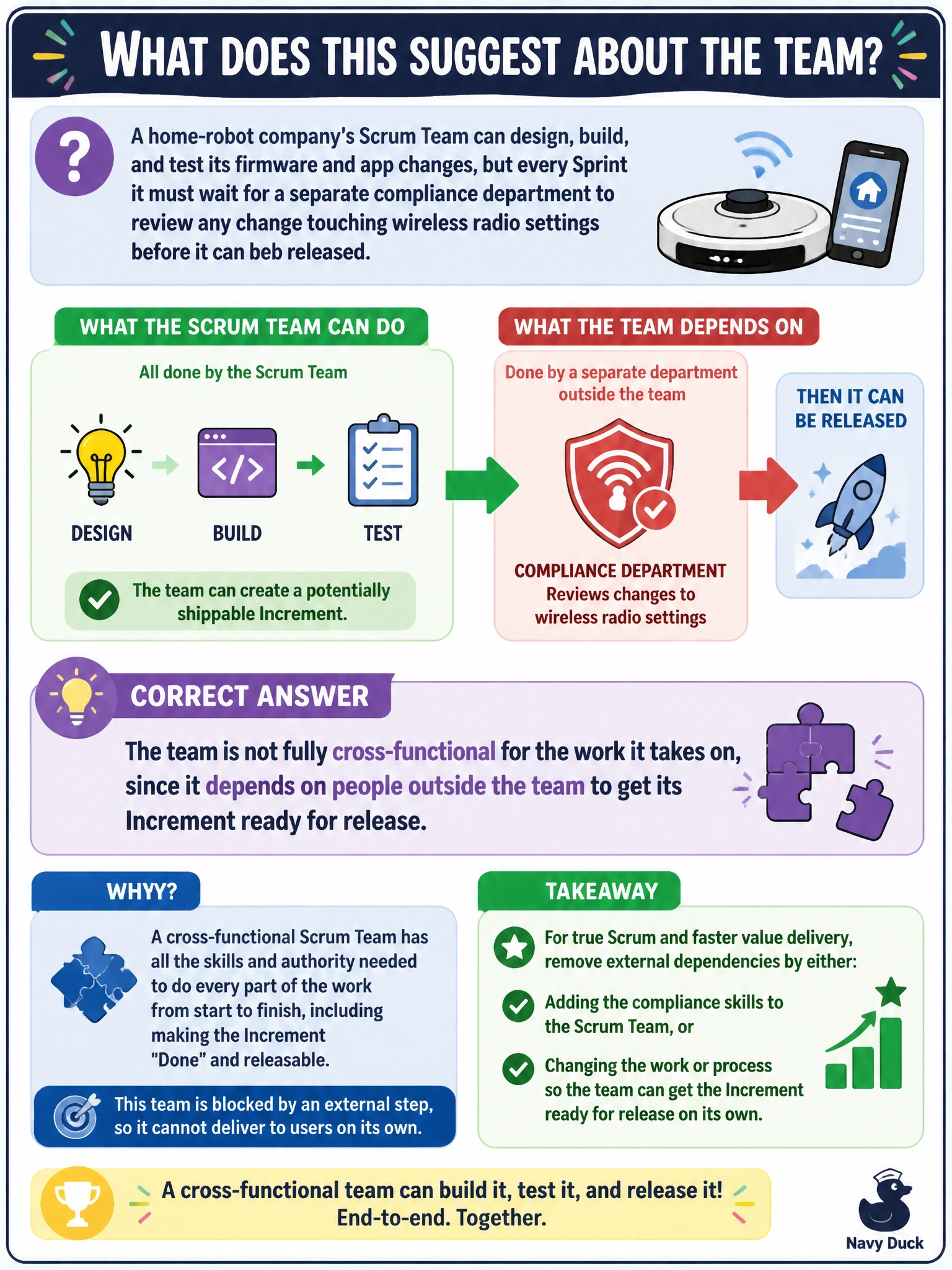
A home-robot company's Scrum Team can design, build, and test its firmware and app changes, but every Sprint it must wait for a separate compliance department to review any change touching wireless radio settings before it can be released. What does this suggest about the team?
Select an answer to reveal the explanation.
Short Explanation
Cross-functional doesn't mean everyone can do everyone else's job — it means the team, as a whole, has everything it needs to turn its work into a usable Increment without waiting on someone outside the room. If a required review lives outside the team every single Sprint, that dependency is the gap, not the specialists doing the actual building.
Full Explanation
A cross-functional Scrum Team holds all the skills necessary to create a valuable, usable Increment on its own, without a standing dependency on people outside the team. A recurring, mandatory step — like a wireless-compliance review — that must happen outside the team before work can be called Done is a structural sign the team's skill set is incomplete relative to its own Definition of Done. That doesn't mean the team must literally employ a compliance specialist forever, but the dependency is worth surfacing and, where feasible, resolving (embedding the skill, training a Developer, or adjusting scope). The first distractor mislabels a genuine cross-functionality gap as a scaling topic — scaling concerns how multiple Scrum Teams coordinate, not whether one team is self-sufficient. The second wrongly assumes compliance work is exempt from Done; if release requires it, it belongs in the Definition of Done and the dependency counts. The fourth confuses specialization with the opposite problem — having specialists is normal and even necessary, as long as the specialists sit inside the team; the issue here is the missing skill sits outside it. Operationally, a Scrum Master can track how many Sprints in a row an external gate blocked release and use that as evidence when raising it as an impediment.