
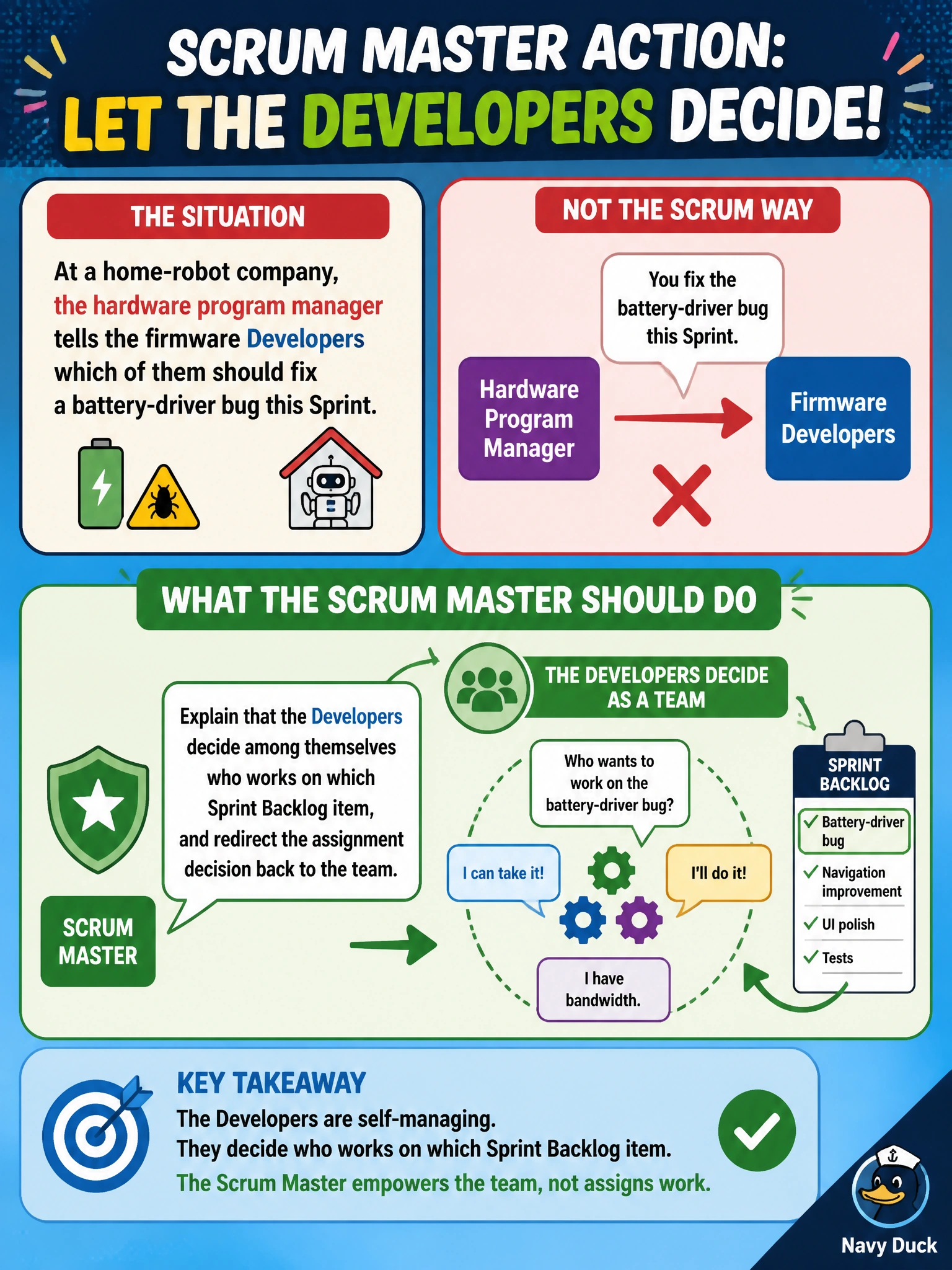
At a home-robot company, the hardware program manager tells the firmware Developers which of them should fix a battery-driver bug this Sprint. What should the Scrum Master do?
Select an answer to reveal the explanation.
Short Explanation
Think of the Developers as a pit crew, not a dispatch center someone else runs. Nobody outside the crew hands out the wrenches — the crew decides who grabs which one, because they're the ones who have to make the car finish the race.
Full Explanation
Self-management means the Developers — not a manager, not the Scrum Master, not the Product Owner — decide who does what, how, and when within the Sprint. A program manager assigning a specific person to a specific bug removes that decision from the people accountable for the outcome, which is exactly the boundary the 2020 Scrum Guide draws around the Developers' work. The Scrum Master's job here is to protect that boundary by naming it plainly and pointing the assignment question back to the team, not by ruling on the bug personally. Approving the assignment or picking a different Developer both still put the decision outside the team, just with a different name attached — the mechanism that's broken (an external party choosing who works on what) is unchanged either way. Escalating to the Product Owner is also off-target: the Product Owner owns Product Backlog value and ordering, not how the Developers organize their own work. A useful operational check: if a request to a Scrum Team names a specific person for a specific task, ask whether that request could instead be made to the team as a whole and let them route it — if yes, it belongs with the Developers.