
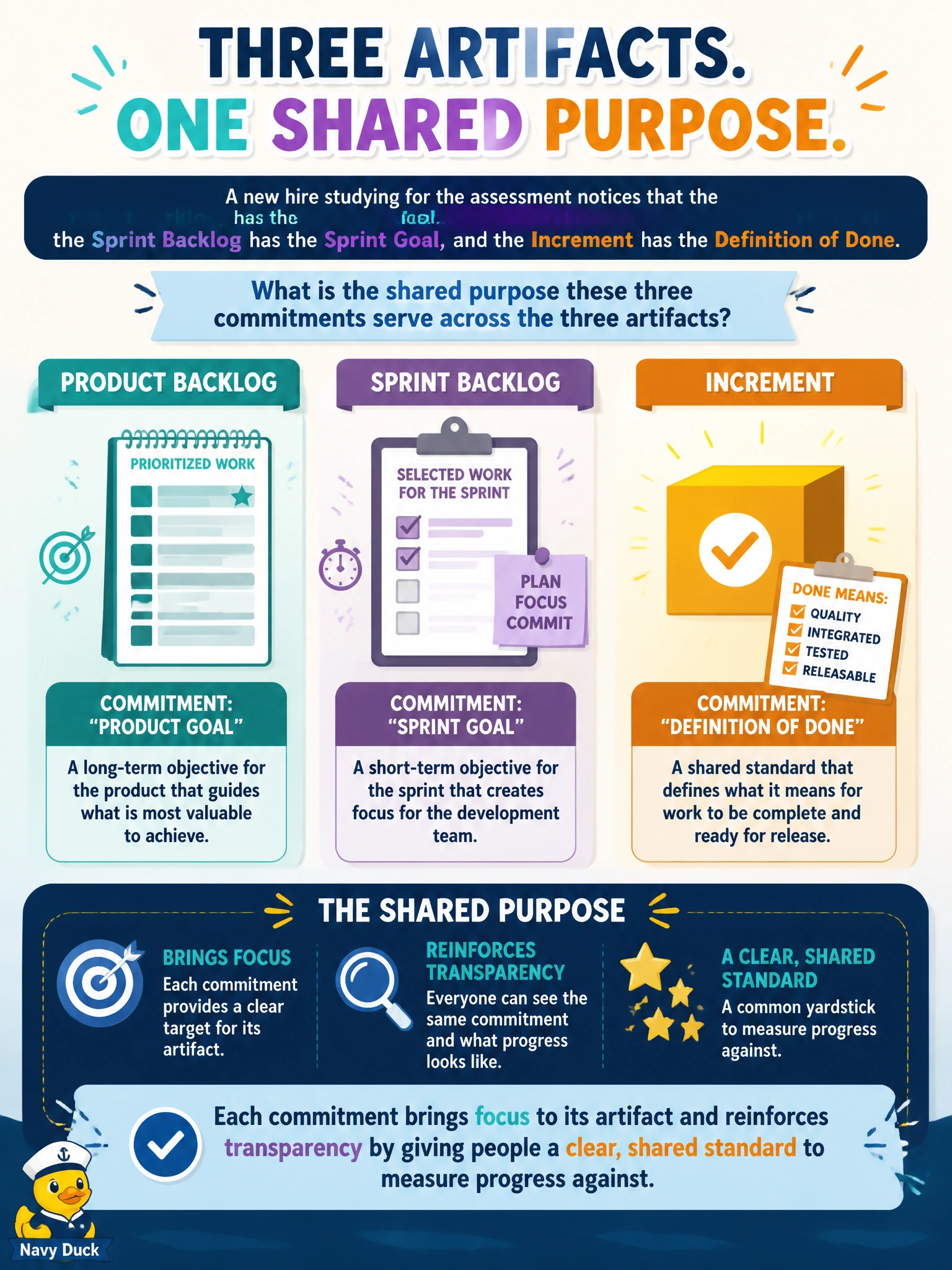
A new hire studying for the assessment notices that the Product Backlog has the Product Goal, the Sprint Backlog has the Sprint Goal, and the Increment has the Definition of Done. What is the shared purpose these three commitments serve across the three artifacts?
Select an answer to reveal the explanation.
Short Explanation
Three different artifacts, but the same trick each time: attach a commitment so people know what they're actually measuring against. The Product Goal, Sprint Goal, and Definition of Done each give their artifact focus and give everyone a shared, honest way to check progress. It's the same pattern solving the same underlying problem three times.
Full Explanation
Each Scrum artifact contains a commitment, the Product Goal for the Product Backlog, the Sprint Goal for the Sprint Backlog, and the Definition of Done for the Increment, and these commitments exist to reinforce empiricism and the Scrum values by giving each artifact focus and a concrete standard against which progress can be measured. That's the connective thread the new hire has correctly spotted: three different artifacts, one shared structural pattern. Calling these commitments legal deadlines misreads them as contractual obligations rather than as clarity-and-focus mechanisms; nothing in the Guide frames them as enforceable deadlines in that sense. Dismissing them as optional documentation badly understates their role, since without a Product Goal, Sprint Goal, or Definition of Done, their respective artifacts lose the very transparency the Guide relies on for inspection and adaptation to work. Suggesting they replace the Scrum Master's facilitation duties confuses a structural artifact feature with a person's active role; commitments don't run events or coach people, they give the artifacts something to be measured against. A study check for the new hire: for each artifact, be able to say in one sentence what its commitment lets someone measure progress toward.