
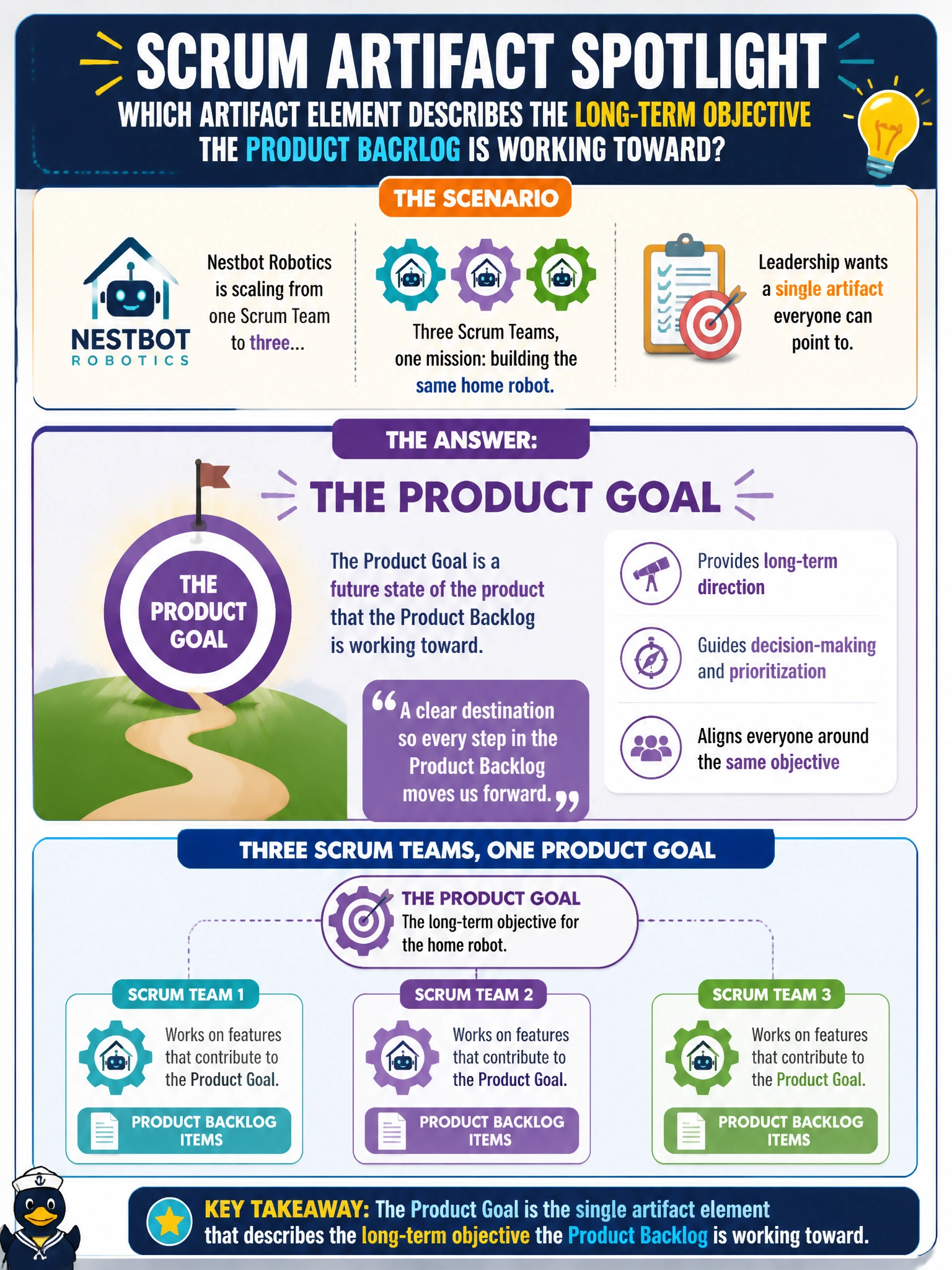
Nestbot Robotics is scaling from one Scrum Team to three, all building toward the same home robot. Leadership wants a single artifact everyone can point to that describes the long-term objective the Product Backlog is working toward. Which Scrum artifact element serves that purpose?
Select an answer to reveal the explanation.
Short Explanation
Picture the Product Goal as the lighthouse the whole Product Backlog is sailing toward, not the tide that changes every Sprint. It describes a future state of the product, and every Product Backlog item should be a step toward reaching it. It's what gives three separate Scrum Teams a shared destination even though they're each planning their own Sprints.
Full Explanation
The Product Goal is the commitment that lives in the Product Backlog: a single, long-term objective the Scrum Team plans against and must fulfill, or abandon, before taking on a new one. When several Scrum Teams work from one Product Backlog, as Nestbot's app, firmware, and cloud teams now do, the Product Goal is exactly the artifact that keeps their separate Sprint-by-Sprint work pointed at the same outcome. The Sprint Goal fails to fit because it's the commitment for the Sprint Backlog, refreshed every Sprint and necessarily short-lived, which is the opposite of the long-term horizon leadership is asking about. The Definition of Done describes a standard of quality applied to every Increment, not a target the product is moving toward. A quarterly roadmap slide might describe the same intent in prose, but it isn't a Scrum artifact commitment and carries no accountability tied to it. A concrete check: ask whether the item in question changes every Sprint (that's a Sprint Goal signal) or stays stable across many Sprints while individual Product Backlog items are pulled toward it (that's the Product Goal).