
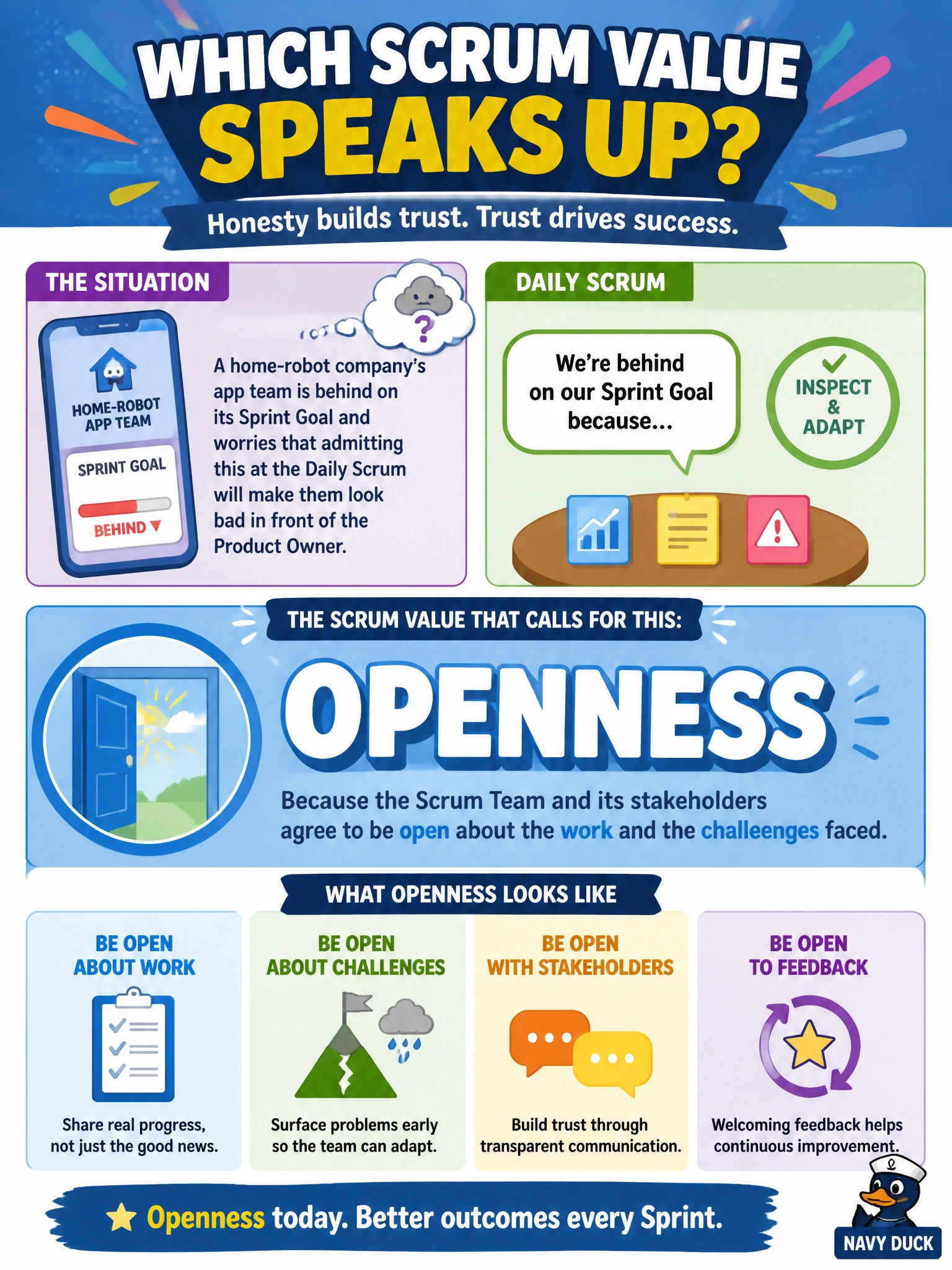
A home-robot company's app team is behind on its Sprint Goal and worries that admitting this at the Daily Scrum will make them look bad in front of the Product Owner. Which Scrum value most directly calls for the team to disclose this honestly anyway?
Select an answer to reveal the explanation.
Short Explanation
Hiding being behind doesn't make the Sprint Goal any closer — it just removes the one chance to adapt in time. Openness is the value that says the real state of things, good or bad, belongs out in the open, especially in a moment like the Daily Scrum built for exactly that kind of honesty.
Full Explanation
The Scrum Guide names Openness as one of the five Scrum values: the Scrum Team and its stakeholders agree to be open about the work and the challenges. A team hiding that it's behind on its Sprint Goal out of fear of looking bad is failing Openness directly, and the Daily Scrum exists precisely to surface exactly this kind of information early enough for the Developers to adapt their plan. Commitment is misapplied here — it means people personally commit to achieving the goals of the Scrum Team, not a guarantee that goals are always met on schedule; treating it as a promise of on-time completion invents an obligation the Guide never states, and Scrum openly anticipates that not every Sprint Goal is fully met. Focus concerns concentrating on the Sprint's work, but focusing harder doesn't substitute for the transparency needed to get help or adjust the plan — it's a different value addressing a different problem. Respect is also misapplied when it's used to justify withholding bad news; respecting the Product Owner as a capable, independent person means trusting them to handle real information, not shielding them from it. A concrete check: watch whether 'behind schedule' status actually gets said out loud at the Daily Scrum before it becomes an end-of-Sprint surprise — if it doesn't, Openness is breaking down.