
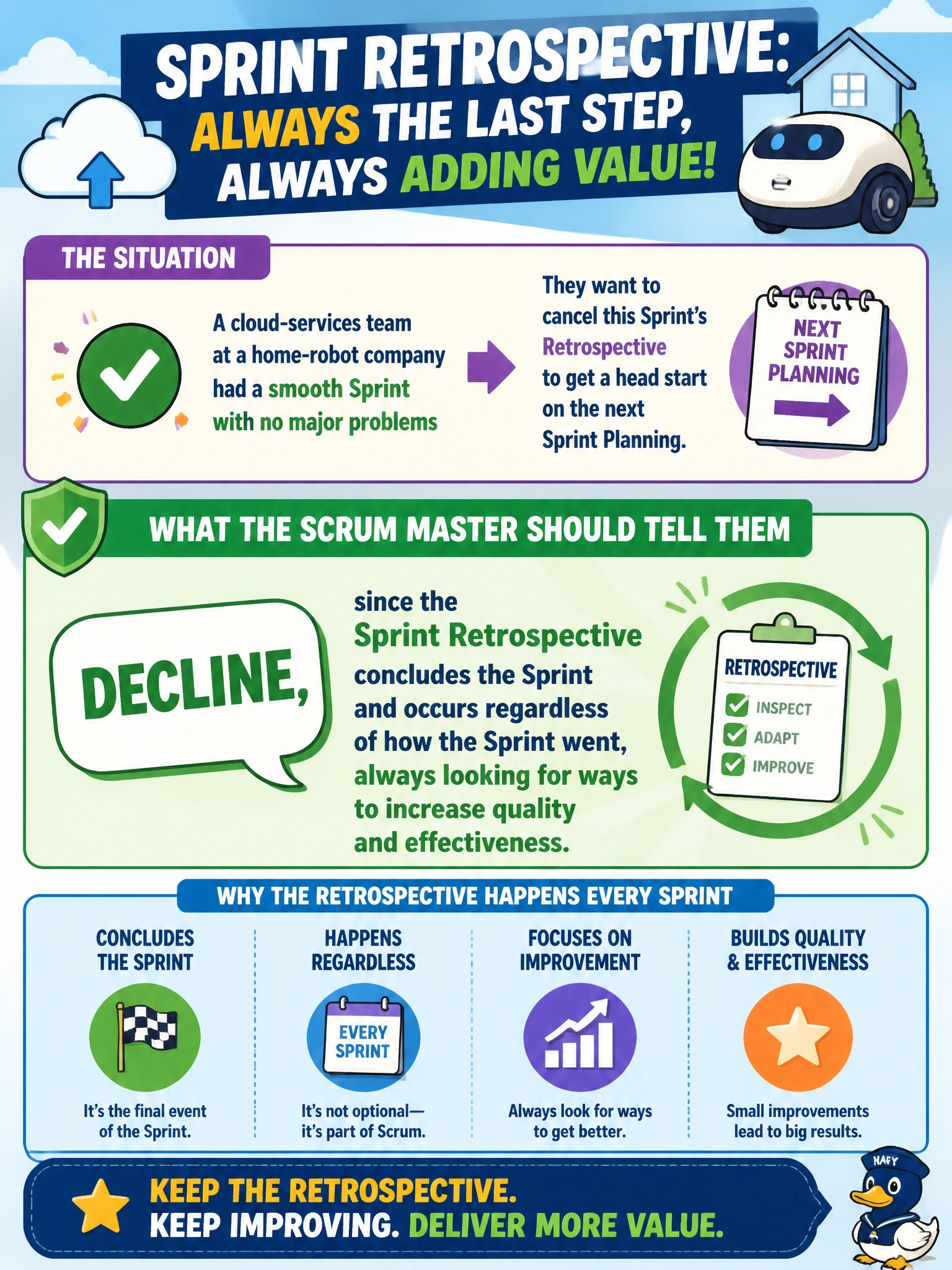
A cloud-services team at a home-robot company had a smooth Sprint with no major problems and wants to cancel this Sprint's Retrospective to get a head start on the next Sprint Planning. What should the Scrum Master tell them?
Select an answer to reveal the explanation.
Short Explanation
A smooth Sprint doesn't mean there's nothing to learn from — it means the team gets to ask 'what made this one go well, and can we do more of that?' The Retrospective isn't a fire drill for when things break; it's a standing checkpoint every single Sprint. Skipping it because things went fine trades a guaranteed improvement habit for a one-time head start.
Full Explanation
The Sprint Retrospective is one of the five Scrum events and, like the others, is required every Sprint — it concludes the Sprint, occurring after the Sprint Review and prior to the next Sprint Planning. Its purpose is to plan ways to increase quality and effectiveness regardless of outcome, which means a good Sprint still has room for the team to reinforce what worked or catch a smaller issue before it grows. Treating it as only useful for failures conflates 'nothing broke' with 'nothing to learn,' which the Guide doesn't support. Needing Product Owner approval to skip it misassigns authority — no single accountability can waive a Scrum event; the events exist as designed, and the Scrum Master's job is to ensure they happen, not to negotiate exceptions. Reducing frequency to once every few Sprints breaks the Sprint's fixed cadence entirely — every Sprint gets its own Retrospective, tied to that Sprint's own experience, not a periodic sampling. A concrete check: look at the team's calendar — if a Retrospective is missing for any completed Sprint, that is a process gap to raise immediately, not a scheduling convenience.