
A Scrum Master at a home-robot company explains empiricism to a new hire by naming its three pillars. Which set correctly names them as defined in the Scrum Guide?
Select an answer to reveal the explanation.
Short Explanation
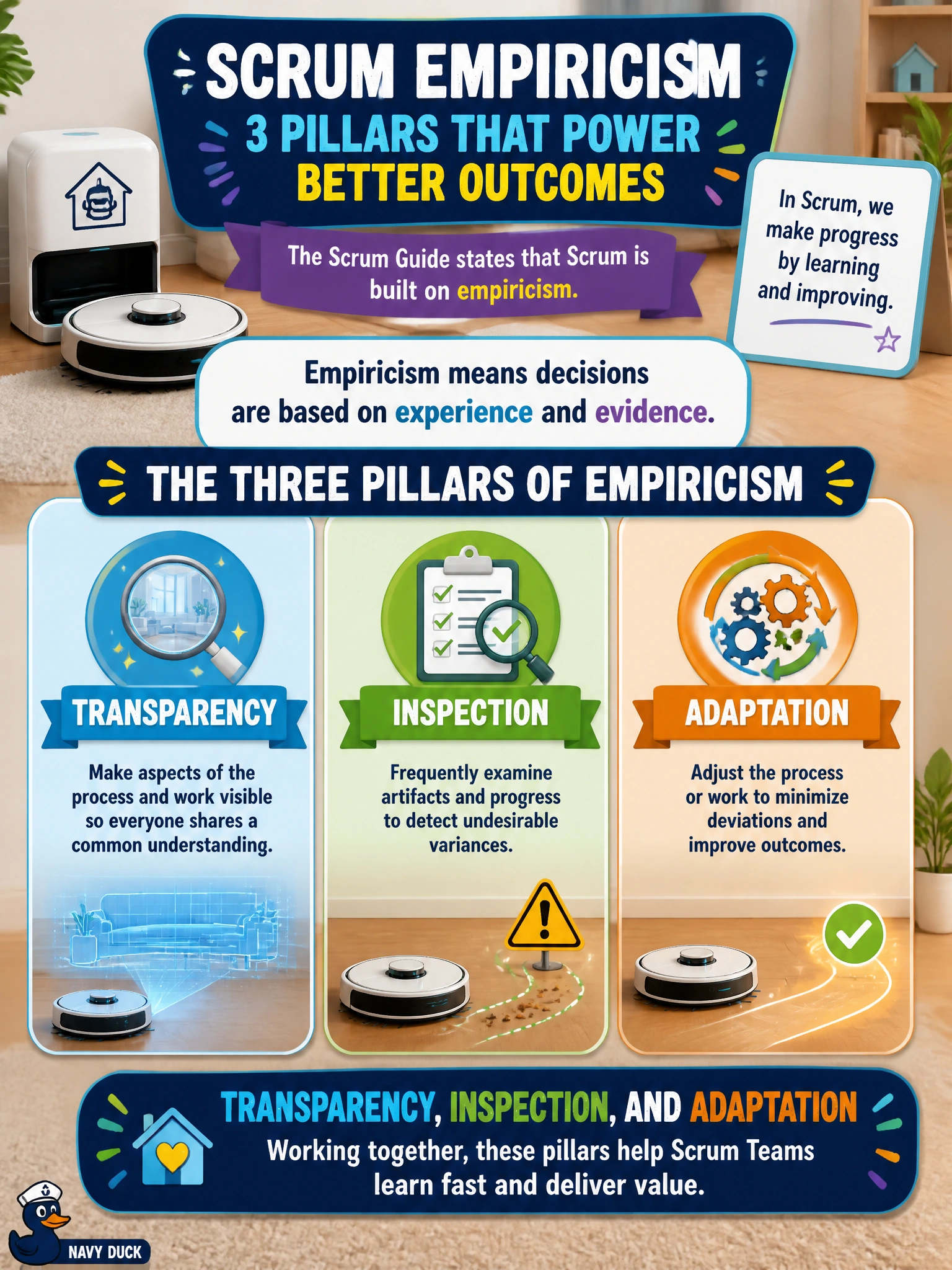
Empiricism just means you learn from what actually happens instead of guessing upfront. To do that you need three things working together: you can see what's really going on, you check on it regularly, and you change course when it's off. Those three — transparency, inspection, adaptation — are the whole engine.
Full Explanation
The Scrum Guide defines empiricism as resting on three pillars: transparency, inspection, and adaptation. Transparency means the significant aspects of the process must be visible to those responsible for the outcome; inspection means artifacts and progress toward goals must be inspected frequently enough to detect undesirable variance; adaptation means adjusting as soon as possible when inspection reveals that aspects of a process deviate outside acceptable limits. Planning, execution, and review describes a generic project lifecycle, not Scrum's theoretical foundation, and conflates the Sprint Review (one event) with a phase model Scrum does not use. Visibility, velocity, and forecasting mixes one real pillar (visibility, loosely equivalent to transparency) with velocity and forecasting, which are optional forecasting techniques the Guide explicitly does not prescribe. Collaboration, iteration, and estimation names general agile-adjacent practices but not the Guide's own vocabulary; estimation technique in particular is left open by the Guide. A concrete check: for any Scrum event, ask which pillar it primarily serves — the Daily Scrum and Sprint Review lean on inspection, the Definition of Done and burndown-style artifacts lean on transparency, and re-planning after a Sprint Review is adaptation in action.