
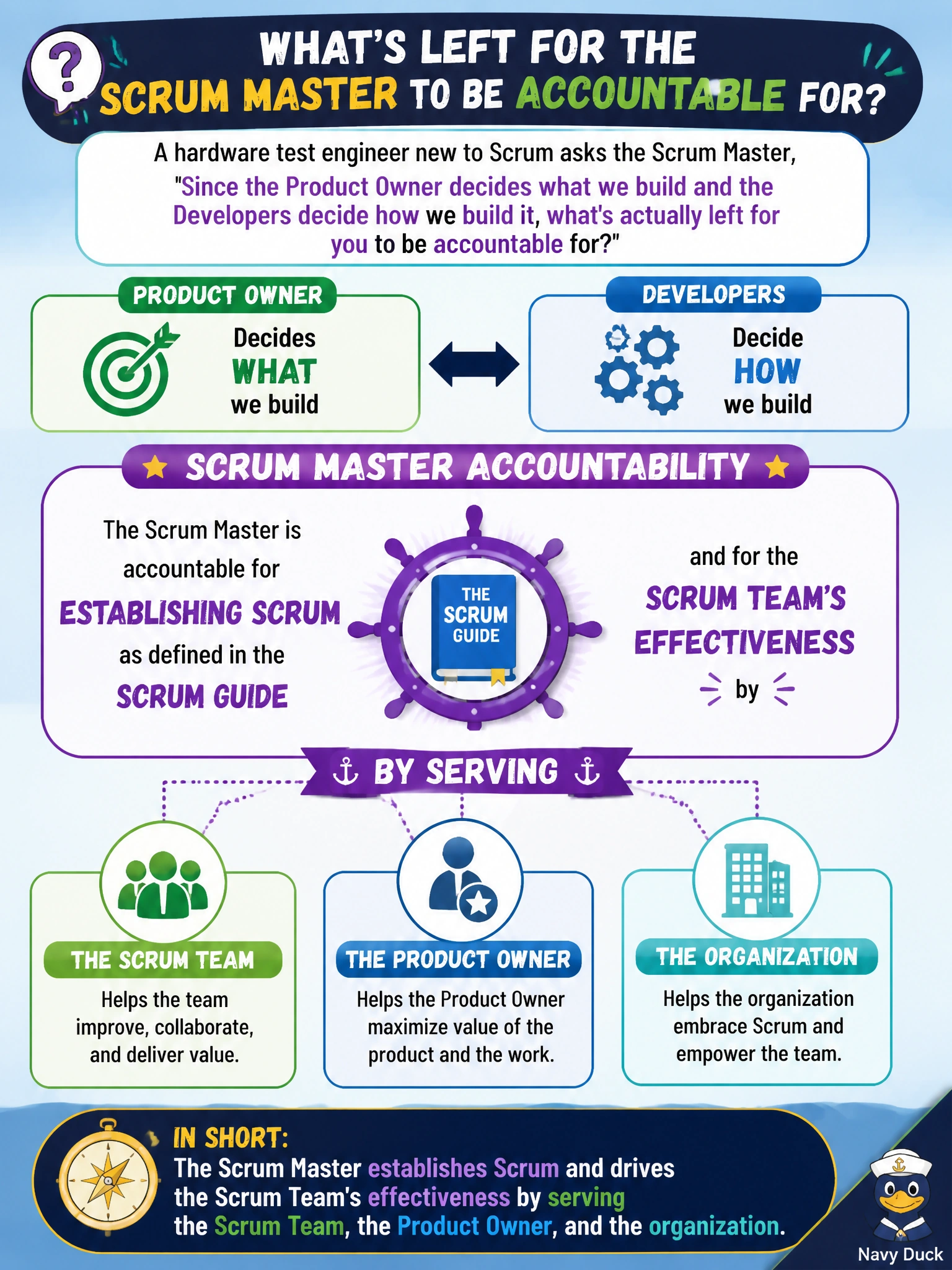
A hardware test engineer new to Scrum asks the Scrum Master, 'Since the Product Owner decides what we build and the Developers decide how we build it, what's actually left for you to be accountable for?' Which answer best reflects the 2020 Scrum Guide's description of the Scrum Master accountability?
Select an answer to reveal the explanation.
Short Explanation
The Scrum Master isn't the leftover piece once building and deciding-what-to-build are spoken for — it's a whole different job. Their accountability is making Scrum actually work well: coaching the team, supporting the Product Owner, and helping the wider organization get out of its own way.
Full Explanation
The 2020 Scrum Guide describes the Scrum Master as accountable for establishing Scrum as defined in the Guide and for the Scrum Team's effectiveness, achieved by serving in three directions: the Scrum Team, the Product Owner, and the organization — coaching self-management and cross-functionality, helping with Product Backlog management techniques, and helping the organization adopt Scrum and remove organizational impediments. Approving designs before building starts misassigns a technical decision to a role that has no design authority; that judgment sits with the Developers. Deciding or extending Sprint length is also wrong — the Sprint's fixed timebox is set by the Scrum Team and does not get unilaterally extended by anyone, least of all to compensate for being behind, since that would undermine the empirical value of a consistent timebox. Framing the role as existing mainly to report status upward to leadership badly understates the accountability and turns a coaching and impediment-removal function into administrative reporting, which the Guide does not describe. A good way to see the real accountability in action: watch what the Scrum Master does when the team is stuck — coaching and unblocking, not deciding what gets built or how long it takes.