
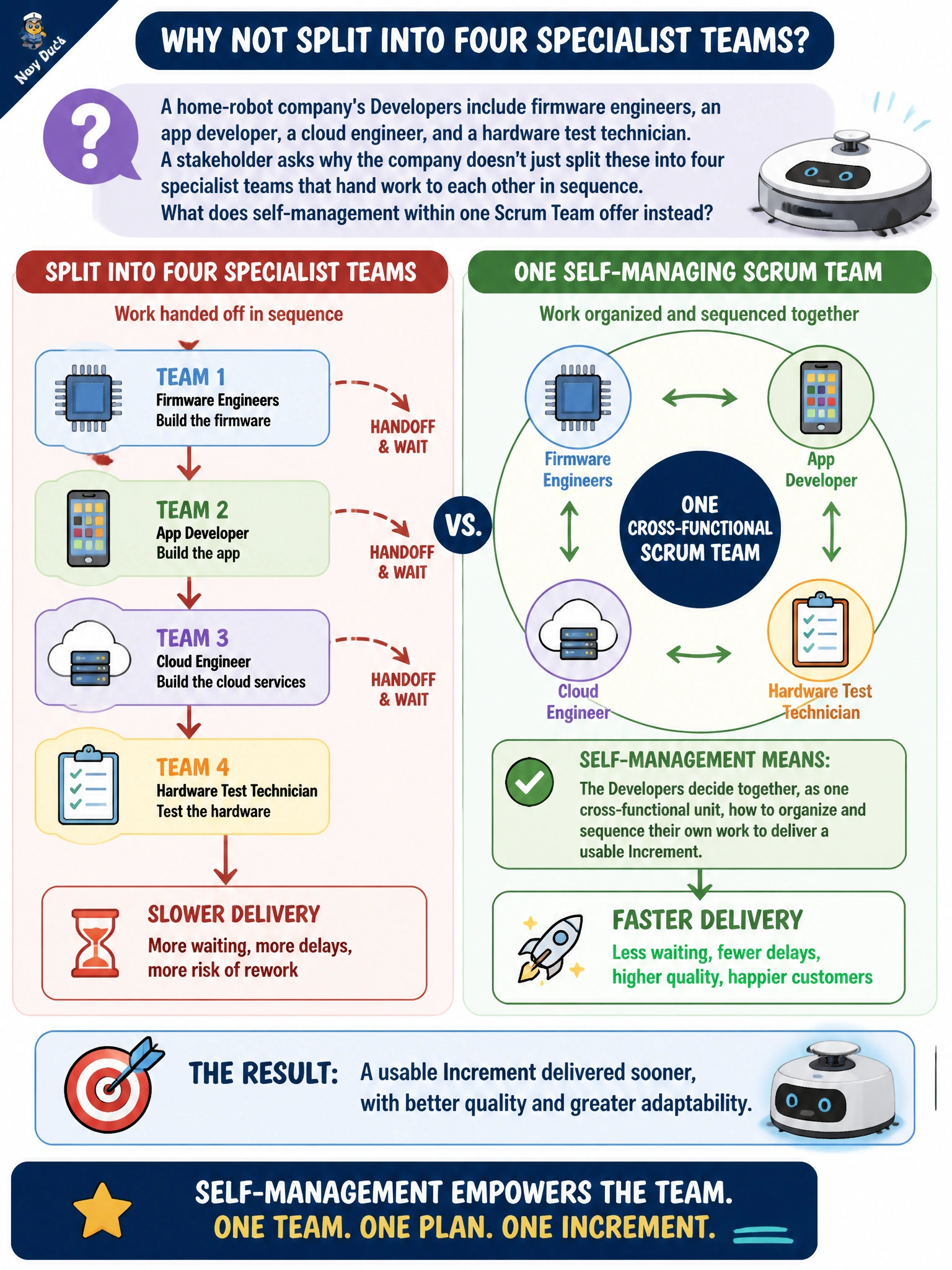
A home-robot company's Developers include firmware engineers, an app developer, a cloud engineer, and a hardware test technician. A stakeholder asks why the company doesn't just split these into four specialist teams that hand work to each other in sequence. What does self-management within one Scrum Team offer instead?
Select an answer to reveal the explanation.
Short Explanation
Splitting people into specialist teams that hand work down a line just recreates the wait-and-relay problem Scrum is built to avoid. Put the same specialists inside one team instead, and they can work out the sequencing and handoffs themselves, in real time, instead of queuing behind a formal relay.
Full Explanation
The Scrum Team is deliberately structured as one cross-functional, self-managing unit rather than a chain of specialist teams, specifically so that the people with the skills needed — firmware, app, cloud, hardware test — can coordinate directly and adapt sequencing as they learn, instead of passing formal handoffs down a line. Self-management means the Developers themselves decide who does what, when, and how, which is different from 'no coordination needed,' since self-managing still requires active daily coordination — it's just peer-to-peer rather than dictated. Assigning that sequencing decision to the Scrum Master would recreate a coordinator role the framework does not include; the Scrum Master coaches the practice of self-management rather than performing it for the team. Limiting self-management to just the firmware discipline misunderstands the concept as tied to whichever piece has the trickiest dependency, when in fact it applies to how the whole cross-functional group organizes all of its work together. In a robotics context, this is what lets a hardware certification constraint get factored into planning early by the whole team rather than surfacing as a surprise after a firmware-to-hardware handoff. A useful check: can the team replan its internal work order without going through an external coordinator? If yes, self-management is functioning.