
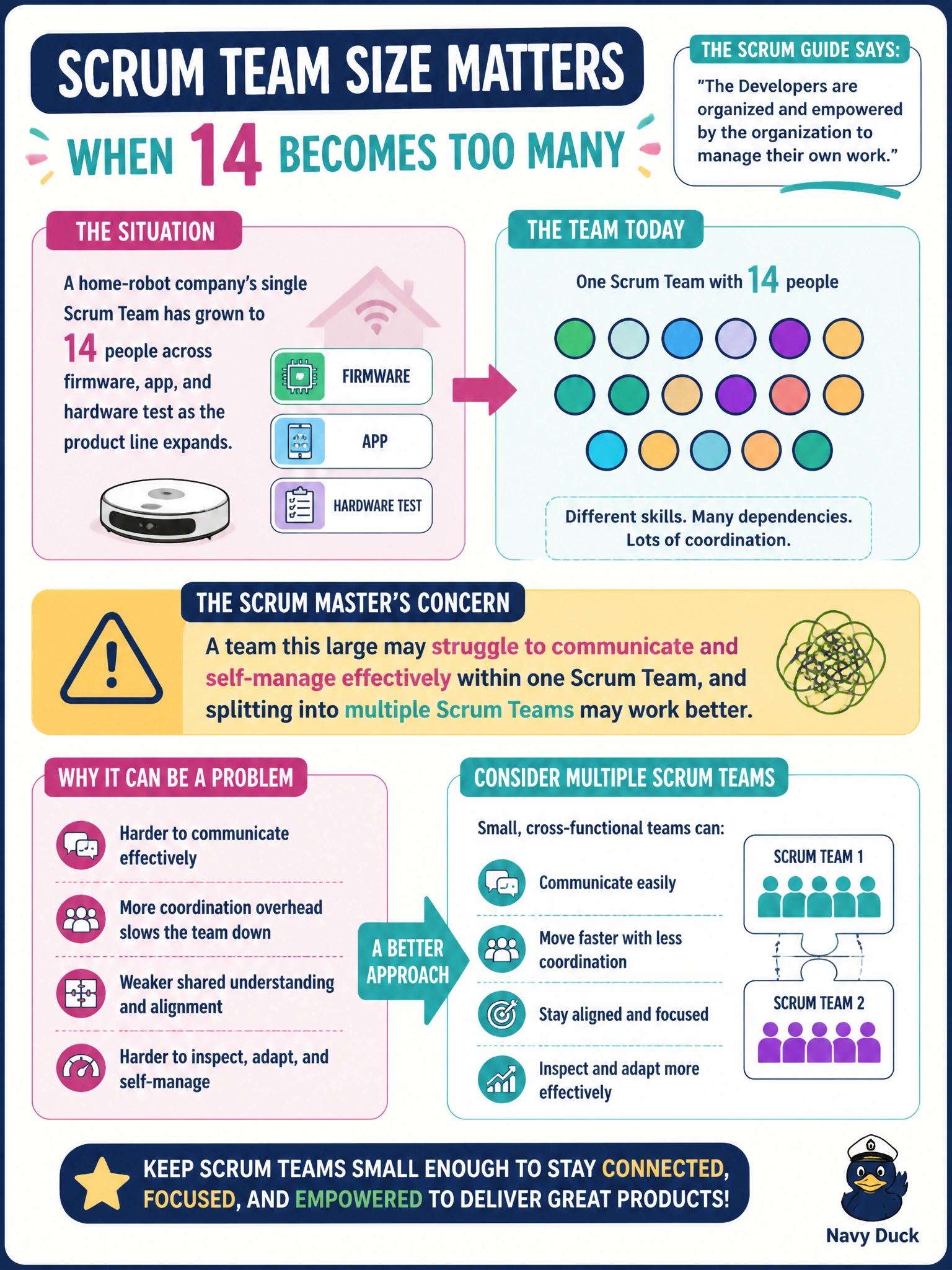
A home-robot company's single Scrum Team has grown to 14 people across firmware, app, and hardware test as the product line expands. The Scrum Master raises a concern based on the Guide's team-size guidance. What is the concern most likely about?
Select an answer to reveal the explanation.
Short Explanation
Scrum doesn't outlaw a big team, but it does flag one: past a certain size, coordination overhead eats the very agility Scrum is chasing. The Guide's answer isn't a hard cap or a rulebook violation — it's a nudge that once a team gets unwieldy, it's often healthier to become two real Scrum Teams than one crowded one.
Full Explanation
The 2020 Scrum Guide suggests Scrum Teams are typically 10 or fewer people, reasoning that smaller teams communicate better and stay more productive, while very large teams tend to generate too much complexity for an empirical process to manage well. This is offered as guidance about effectiveness, not a hard rule the Scrum Team 'violates' — the Guide does not say a 14-person team is non-compliant, so treating it as an automatic violation overstates what the text says. Appointing a coordination lead is also the wrong fix, since it reintroduces a hierarchy inside the Scrum Team rather than addressing the underlying size concern, and the Scrum Team explicitly has no sub-teams or leads. Switching frameworks to Kanban misidentifies the problem as a flow-management issue rather than a team-structure one; the Guide's own suggested remedy for a team that has outgrown effective self-management is splitting into multiple, properly-sized Scrum Teams working from a shared Product Backlog. A practical check for a growing team: watch whether everyone can still meaningfully contribute in the Daily Scrum and Sprint Planning discussions — when that breaks down, size has become the actual constraint.