A company implements an internal reporting hotline but maintains a policy that explicitly excludes any anonymous tips from being investigated. What is the primary risk associated with this policy exclusion?
Select an answer to reveal the explanation.
Short Explanation and Infographic
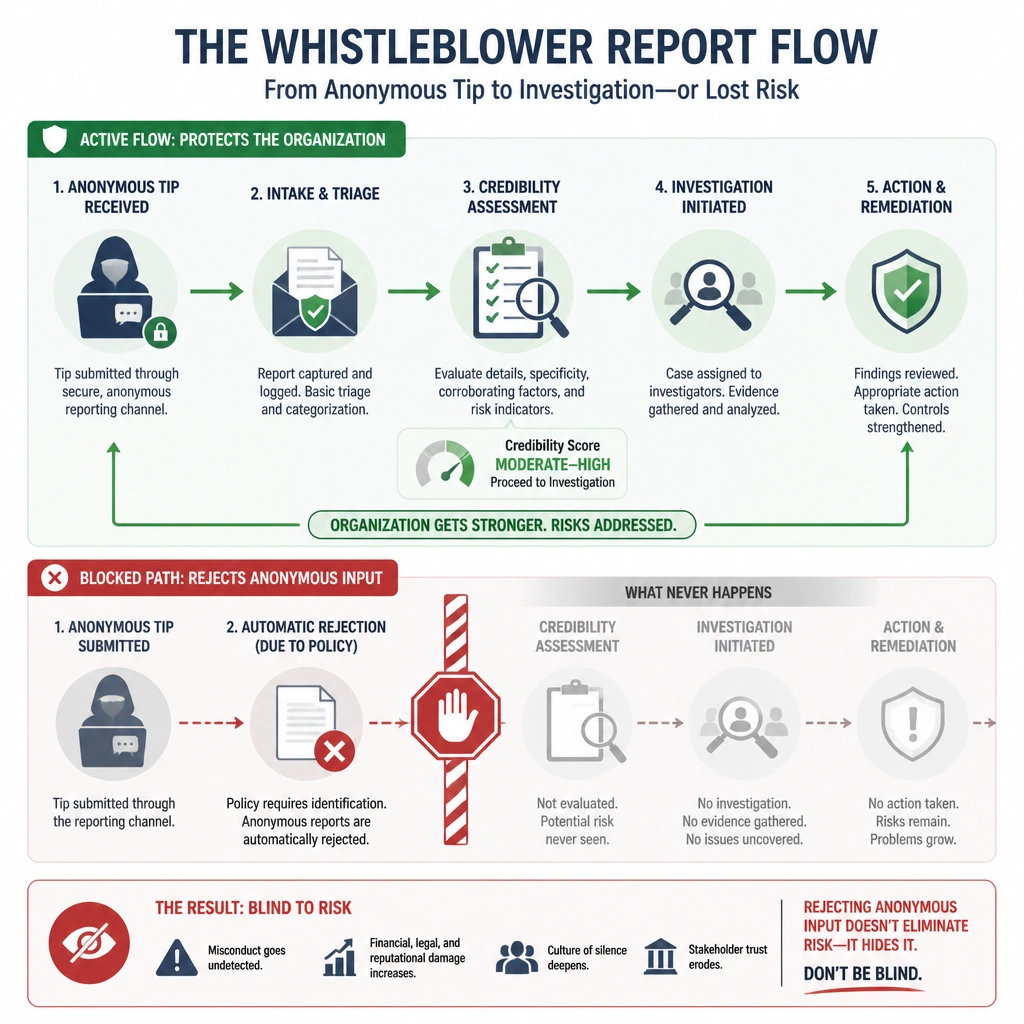
Here's the deal: people are terrified of retaliation. If an employee sees someone stealing millions of dollars, they want to speak up, but they also want to keep their job and support their family. That's why anonymous hotlines are so critical. If your policy says, 'We don't look at anonymous tips,' you are basically telling your staff to keep their mouths shut. You're voluntarily shutting down one of your most powerful early-warning systems. The risk here is massive: you could have a major fraud scheme running right under your nose for years, and because you refused to read an anonymous email, it goes undetected until the FBI shows up. Never ignore a credible tip just because there's no name attached to it. Listen, investigate, and protect the company.
Full explanation below image
Full Explanation
An effective reporting mechanism is a cornerstone of a compliance program. Statistics consistently show that the majority of corporate fraud and misconduct is detected through employee tips rather than audits. However, employees are often reluctant to report misconduct unless they are guaranteed anonymity, due to fear of career damage or social retaliation. Option B is correct because refusing to investigate anonymous tips disables a critical detective control. Credible anonymous reports often contain specific, actionable details (such as account numbers, project names, or dates) that can expose severe financial fraud, bribery, or safety violations. By ignoring these reports, the company allows ongoing misconduct to continue unchecked, increasing its financial exposure and legal liability. Furthermore, if regulators discover that the company ignored credible tips, they will view the compliance program as ineffective, leading to higher penalties and the loss of cooperation credit. Option A is incorrect because while having such a policy is considered a major weakness by regulators (like the DOJ or SEC), it does not trigger automatic, immediate financial penalties simply because the policy exists. The penalty typically arises when the unchecked misconduct is eventually exposed. Option C is incorrect because a policy that ignores anonymous tips would discourage reporting, resulting in fewer reports rather than a surge in high-quality inputs. Option D is incorrect because a policy regarding anonymous tips has no bearing on a legal team's standing to represent the company in contract disputes.