In designing an effective risk-based compliance program, which strategy should a compliance officer prioritize to maximize the impact of their resources?
Select an answer to reveal the explanation.
Short Explanation and Infographic
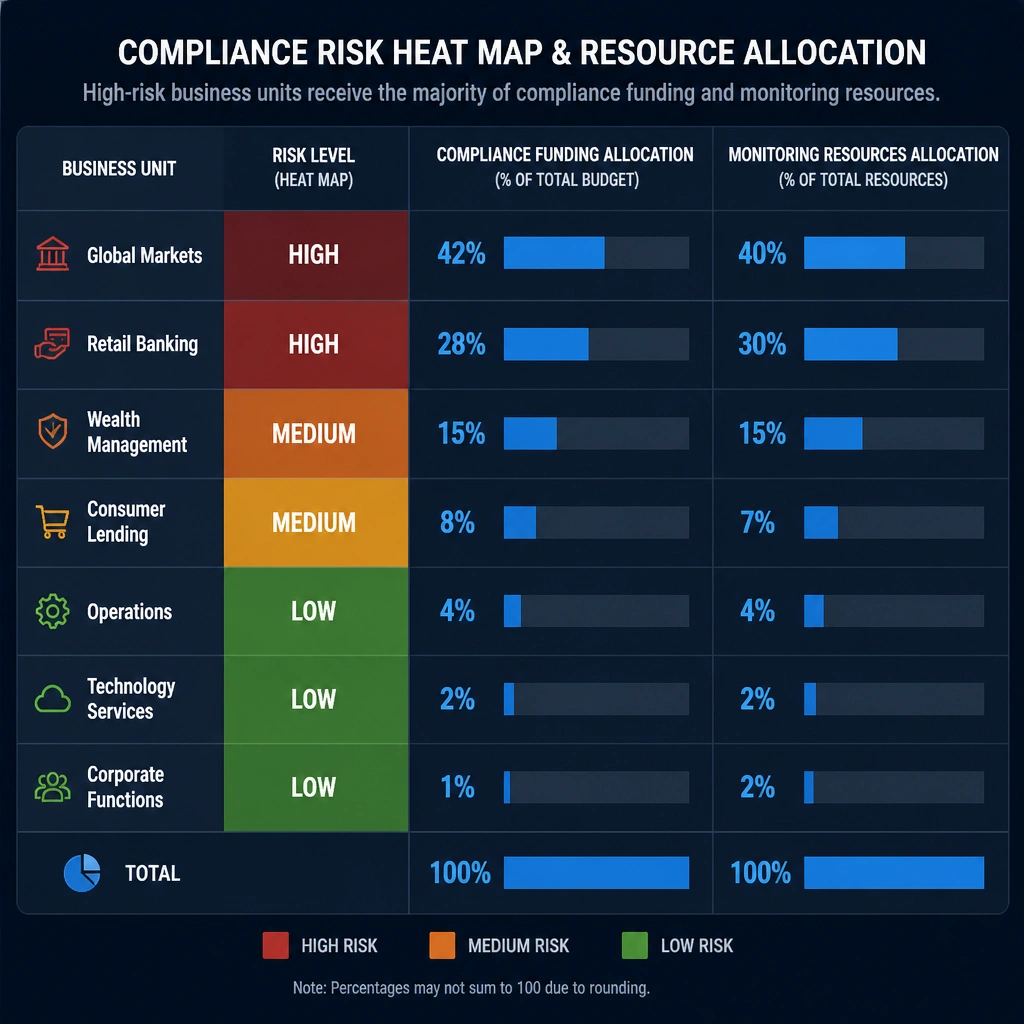
Check this out—you've got a limited budget and only so many hours in the day. If you try to audit the marketing team's snack budget with the same intensity that you audit your international sales team dealing with foreign officials, you're doing it wrong! That's not risk-based; that's just a waste of time. A real risk-based program means you find where the high-risk stuff is happening—like international transactions or environmental waste disposal—and you throw your heavy-duty controls and resources there. Focus on where the fire is likely to start!
Full explanation below image
Full Explanation
A risk-based compliance program is designed on the principle that not all business operations pose the same level of risk. Regulatory bodies, such as the U.S. Department of Justice (DOJ) in its guidance on the Evaluation of Corporate Compliance Programs, expect companies to dedicate their compliance resources—such as audit schedules, specialized training, and transaction monitoring—to the areas that present the highest risks of legal or ethical violations. For instance, business units operating in high-corruption jurisdictions or those handling sensitive consumer data require more robust controls than domestic departments with low-risk exposure. Option A is incorrect because applying identical controls everywhere is inefficient and fails to address specific vulnerabilities, leading to over-regulation in low-risk areas and under-regulation in high-risk areas. Option B is incorrect because avoiding risk assessments entirely makes it impossible to design a program that is truly risk-based; risk assessments are the prerequisite foundation. Option C is incorrect because standard, generic compliance programs fail to account for a company's unique risks, making them ineffective 'paper programs' that will not withstand regulatory scrutiny. Focusing resources where the threat is highest ensures maximum mitigation impact.