The Chief Compliance Officer of a technology company notices low completion rates and poor retention scores for the annual compliance course. To improve employee engagement and knowledge retention, which instructional design methodology should the compliance team adopt?
Select an answer to reveal the explanation.
Short Explanation and Infographic
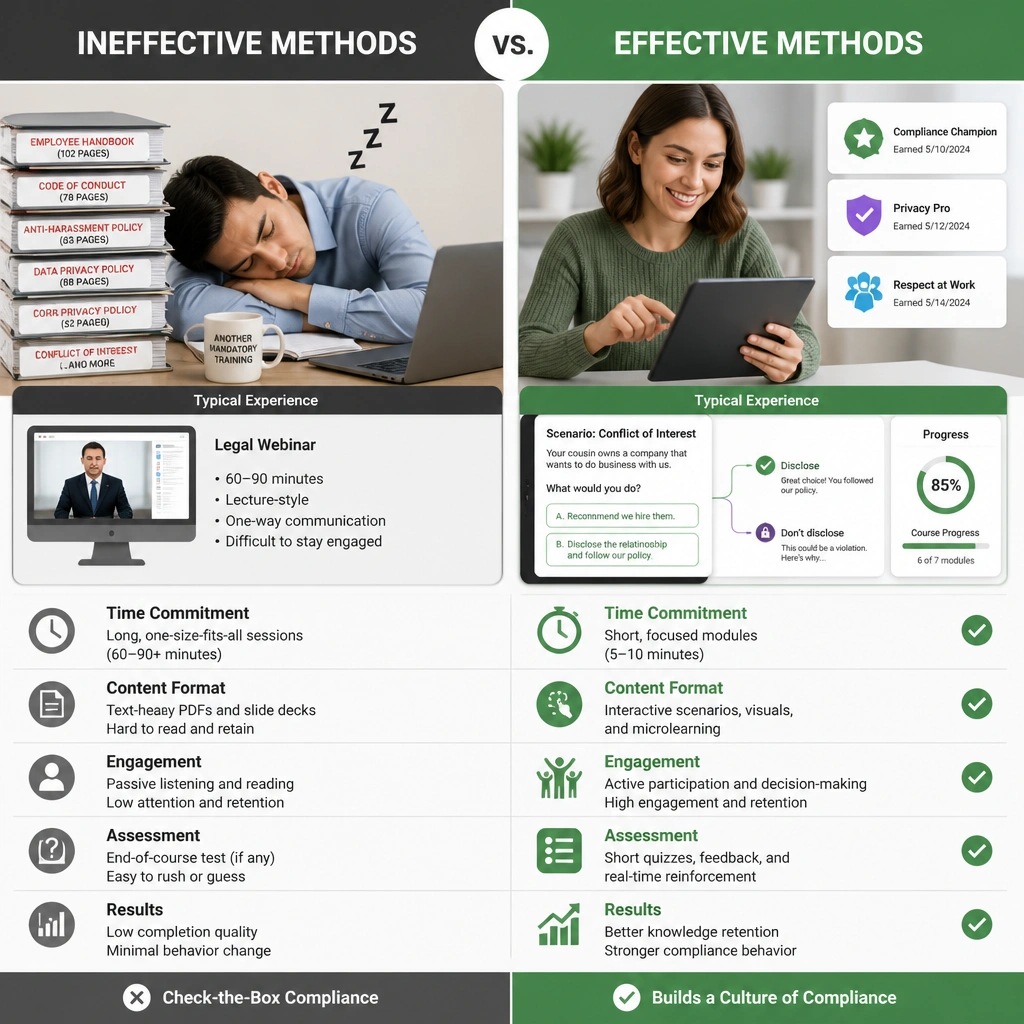
Check this out: if you want your employees to fall asleep at their desks, go ahead and have a lawyer read policies aloud for four hours. Talk about a sleep aid! To actually get compliance concepts to stick in the real world, you've got to make the training engaging. Think of it like this: people learn by doing, not just by listening passively. Interactive e-learning with real-life scenarios, gaming elements, and quick quizzes gets employees actively thinking about the material. It makes the lessons stick and actually changes behavior. Trust me, engaging training is how you build a real shield against compliance violations. Got it? Sweet.
Full explanation below image
Full Explanation
Corporate compliance training is critical for risk mitigation, but its effectiveness depends heavily on how the material is delivered. Modern adult learning theory (andragogy) indicates that adults learn best when training is interactive, relevant to their daily work, and chunked into manageable sessions.
Let's review the options to see why the correct answer is the most effective method and the others are less effective. The correct option is D. Interactive e-learning modules that use realistic branching scenarios allow employees to apply policy concepts to real-life decisions without real-world consequences. Incorporating gamification (e.g., points, leaderboards, or scenarios) increases motivation, while frequent short quizzes reinforce knowledge retention and provide data on training efficacy. Option A is incorrect because passive listening during a lengthy meeting is one of the least effective methods for adult learning. It leads to low engagement, poor retention, and high resistance from employees. Option B is incorrect because simply distributing a PDF handbook and requesting an acknowledgment signature is a 'check-the-box' exercise. While it provides legal evidence that the policy was distributed, it does not ensure the employee read, understood, or can apply the concepts. Option C is incorrect because long, text-heavy slides are monotonous and overwhelm learners with cognitive overload, leading to disengagement and skimming without comprehension.
To maximize compliance training impact, companies should complement interactive online modules with tailored, in-person discussions for high-risk departments.