When executive leadership fails to actively promote, resource, and model the behavior defined in the corporate compliance program, what is the most significant operational consequence?
Select an answer to reveal the explanation.
Short Explanation and Infographic
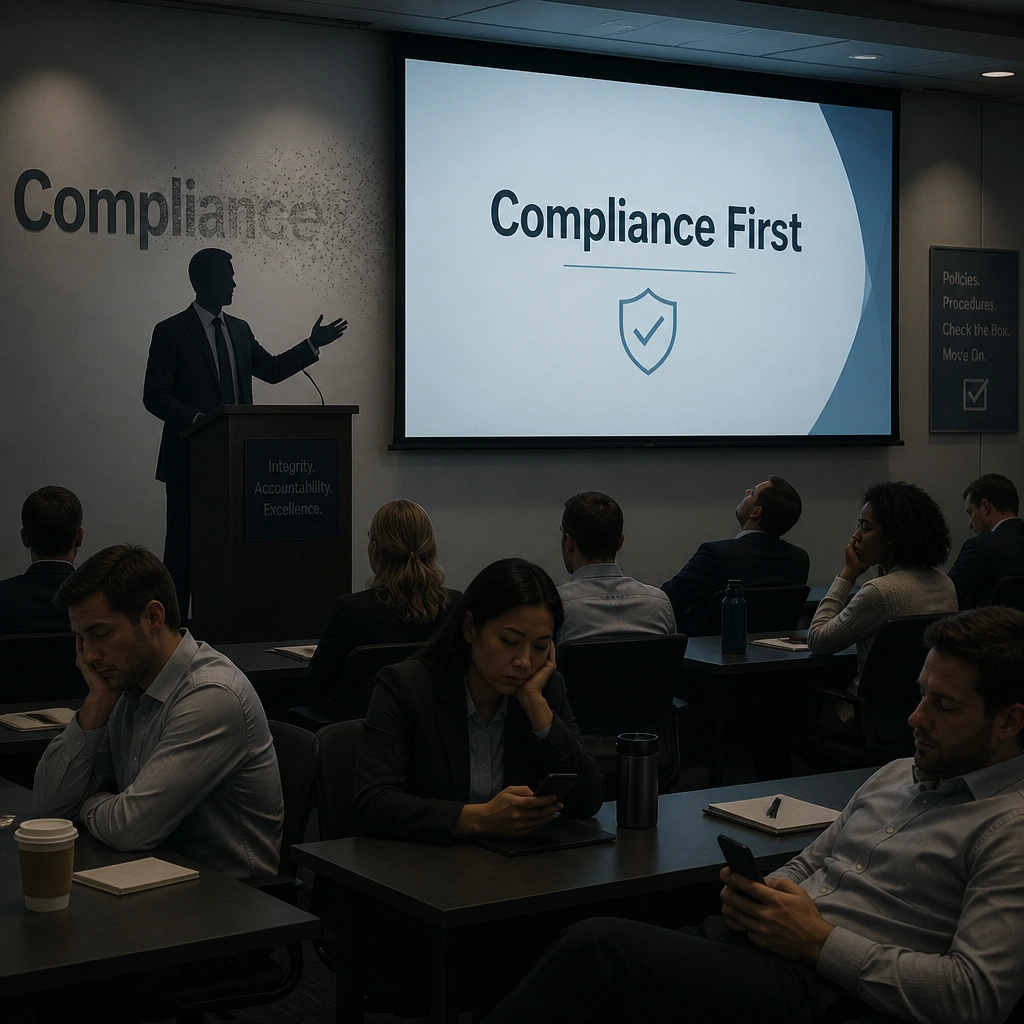
Imagine your boss walks in on Monday morning, talks about how compliance is our 'number one priority,' and then on Tuesday tells the sales team to 'do whatever it takes to hit the quarterly target, no excuses.' That is what we call a double standard, and employees see right through it! Tone at the top isn't just a corporate buzzword—it's everything. If executive leadership doesn't actively support the compliance program and walk the walk, the whole thing becomes a joke. Employees will see it as a bureaucratic check-the-box exercise, a 'paper program' designed to protect the executives while they demand results at any cost. If the leaders don't care, the employees won't either, and that is when disaster strikes. Walk the walk, or don't bother talking the talk!
Full explanation below image
Full Explanation
The 'tone at the top'—the visible commitment of board members and executive leadership to compliance—is one of the most critical elements evaluated by regulators. Both the DOJ's Evaluation of Corporate Compliance Programs and the Federal Sentencing Guidelines for Organizations place paramount importance on leadership's role in fostering a culture of compliance.
Option B is correct because without visible leadership support, a compliance program is relegated to a 'paper program.' A paper program exists only on paper (policies, manuals, signed forms) but is ignored in day-to-day operations. When leaders prioritize financial targets over ethical behavior or fail to model compliance, employees quickly learn that compliance is not a true organizational priority. This leads to a weak ethical culture, high rates of misconduct, and severe regulatory exposure, as regulators will view the program as ineffective and insincere.
Option A is incorrect because policies can still be technically legally binding on employees under employment law regardless of executive modeling, though they will be practically ignored.
Option C is incorrect because lack of executive support usually leads to underfunding and lower compliance costs in the short term, not doubled operational costs, although it causes massive long-term legal costs.
Option D is incorrect because the length of training is not directly determined by executive support, although the quality and relevance of that training may suffer.
Best practices for demonstrating leadership commitment include having executives personally introduce compliance training sessions, incorporating ethical behavior metrics into executive compensation, and ensuring the Chief Compliance Officer has a direct reporting line to the board of directors.