
An employee at an engineering firm decides to launch a private software consulting side business. Recognizing that some services might overlap with the firm's clients, how should the employee handle this situation under a standard conflict of interest policy?
Select an answer to reveal the explanation.
Short Explanation
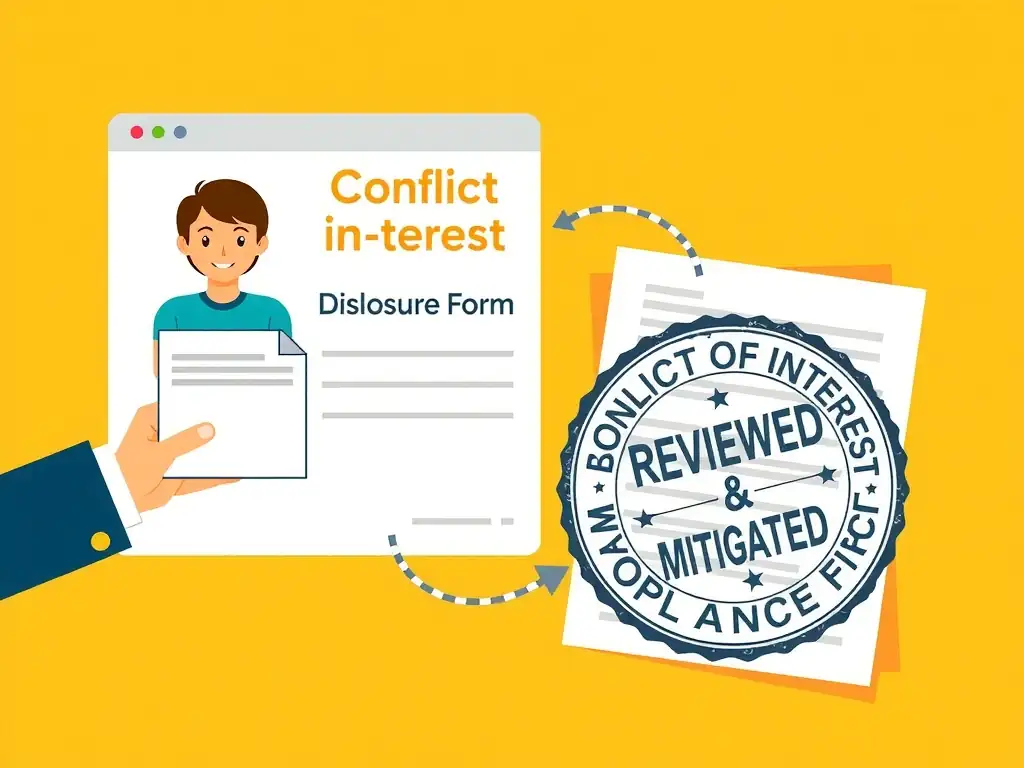
Here's the deal: if your side business could overlap with company clients, you submit a formal conflict of interest disclosure to compliance. Let them review it and set guardrails, because transparency keeps you out of trouble.
Full Explanation
Conflicts of interest arise when an employee's personal interests or outside activities interfere—or appear to interfere—with the interests of the employer. Standard corporate policies require employees to disclose potential, actual, or apparent conflicts so they can be evaluated and managed appropriately.
The formal conflict of interest disclosure to the compliance department is correct because formal disclosure to the compliance department is the required operational protocol for resolving conflicts of interest. The compliance department is responsible for objectively assessing whether the outside activity presents an unacceptable risk to the company's proprietary information, client base, or employee productivity. If the conflict is manageable, compliance can implement a conflict management plan, such as establishing firewalls or defining boundaries on client solicitation.
The informal verbal notification to a line manager while avoiding written disclosure is incorrect because while notifying a line manager is a good practice, verbal notifications do not satisfy formal policy requirements and often fail to document the disclosure or engage the proper compliance review mechanisms.
The complete confidentiality approach is incorrect because potential competition with an employer is not a purely private matter; it directly impacts the employee's duty of loyalty and can lead to immediate termination or legal action for breach of fiduciary duty.
The immediate resignation approach is incorrect because resignation is an extreme and premature response; many potential conflicts can be resolved through review and mitigation without requiring the employee to leave.
Best practices for conflict of interest programs include maintaining a centralized registry of disclosures, requiring annual conflict recertifications for all employees, and providing clear examples of permissible versus impermissible activities.