When an organization drafts its Code of Conduct using dense legalese and complex regulatory citations instead of plain, accessible language, what is the primary compliance vulnerability?
Select an answer to reveal the explanation.
Short Explanation and Infographic
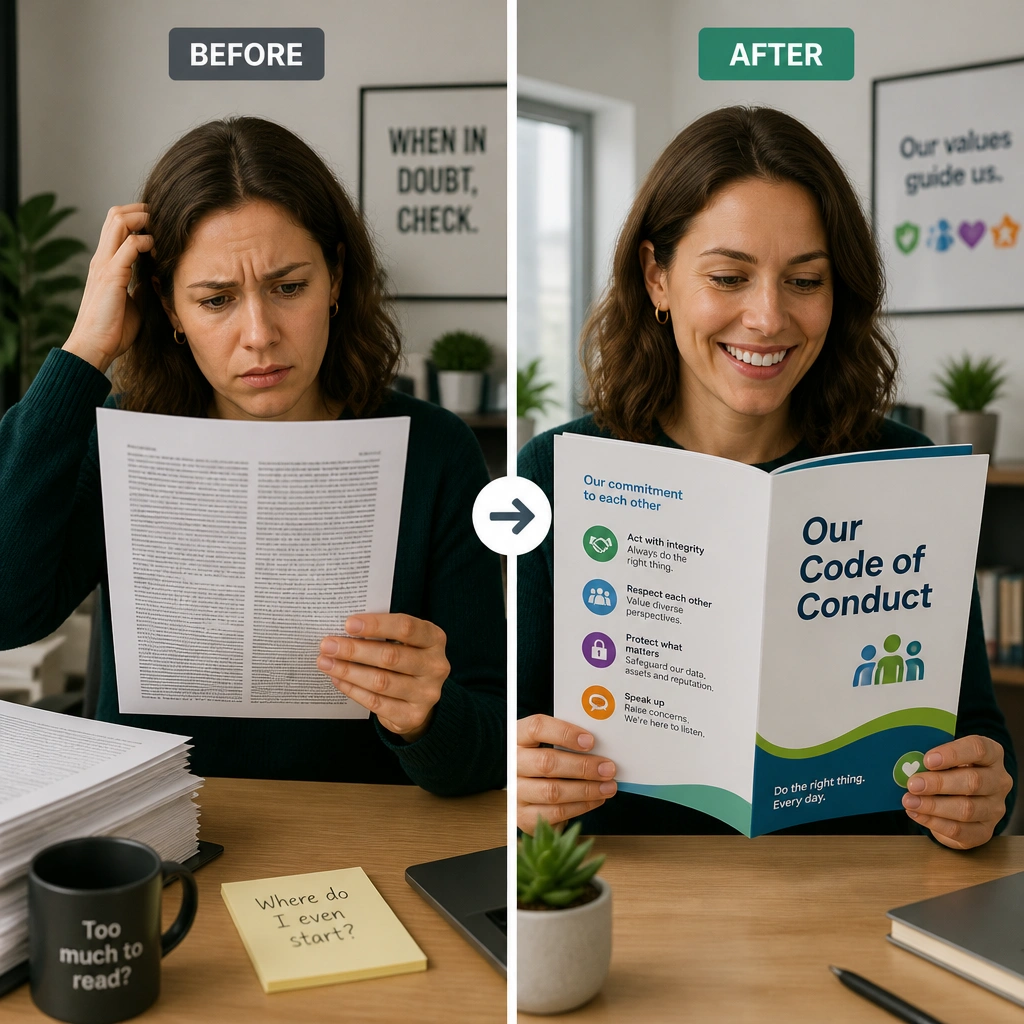
Let's be honest: who actually reads the terms of service before clicking 'agree'? Almost nobody! Why? Because they're written by lawyers, for lawyers, in dense, mind-numbing legalese. Now, if your company's Code of Conduct looks like a commercial contract filled with 'heretofore' and 'whereas,' your employees are going to treat it the exact same way. They'll skim it, sign the acknowledgment form, and never look at it again. That's a massive risk! The Code is supposed to guide daily behavior, not just protect the company in court. If a junior developer can't understand your policy on conflicts of interest or data sharing, they can't follow it. Keep your Code clear, simple, and practical. Jargon-filled manuals are just shelfware that fails when you need it most. Got it? Sweet.
Full explanation below image
Full Explanation
A Code of Conduct serves as the foundation of an organization's compliance program, establishing the ethical tone and expectations for all personnel. To be effective, the Code must be accessible and understandable to the entire workforce, regardless of their role or educational background.
Option C is correct because overly complex, legalistic language creates a substantial barrier to comprehension. If employees cannot understand the behavioral expectations, they cannot adhere to them. This gap between formal policy and employee understanding renders the Code ineffective in preventing misconduct and undermines the organization's compliance culture. During investigations, regulators assess whether a Code is actively integrated into corporate culture or is merely a 'paper program.'
Option A is incorrect because dense legal language actually makes a document more enforceable in certain narrow legal contexts, but it fails as a tool for corporate culture and prevention of violations.
Option B is incorrect because legalese often increases the length and detail of a document rather than making it too brief.
Option D is incorrect because regulators do not penalize companies simply for having complex documents; rather, they penalize the compliance failures that occur when those documents are not understood or followed by staff.
Best practices for drafting a Code of Conduct include writing at an appropriate reading level, using real-world Q&A scenarios to illustrate rules, providing the document in all languages spoken by the workforce, and using clear visual formatting to highlight key takeaways.