An internal audit department routinely audits the organization's general ledger, payroll, and financial reconciliation procedures, but completely excludes compliance audits related to anti-corruption policies, environmental regulations, and data privacy laws. What specific element of the audit program does this oversight represent a weakness in?
Select an answer to reveal the explanation.
Short Explanation and Infographic
Okay, let's look at this one. If your audit team is only checking the financial books, they're missing a massive piece of the puzzle. Yes, keeping the finances straight is super important, but what about anti-bribery? What about data privacy? If you ignore those areas, you're leaving the back door wide open to massive regulatory fines. This isn't a problem with your marketing or your sales strategy—it's a fundamental weakness in the scope of your audit program. You've got blind spots because you've drawn the boundary lines too narrow. Trust me, you need to widen that scope to cover all high-risk compliance areas, which makes D the right answer.
Full explanation below image
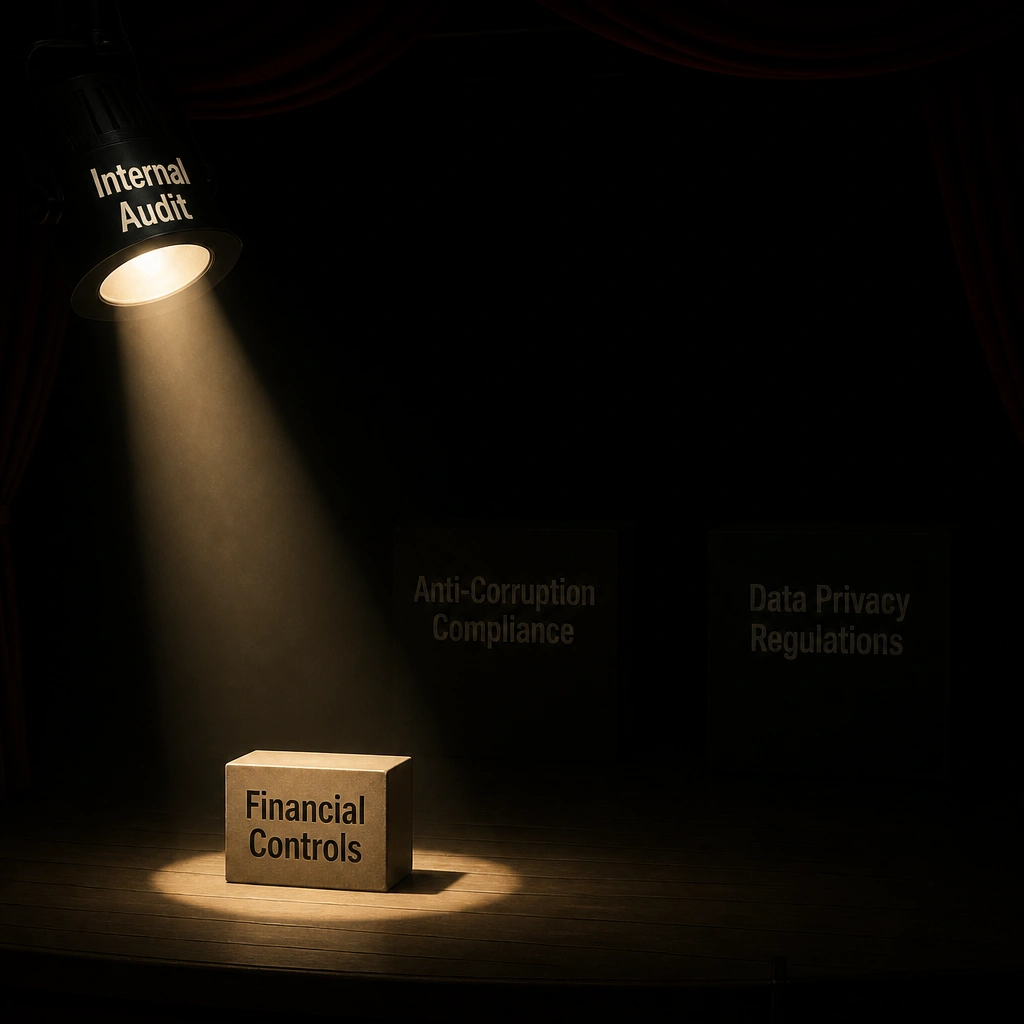
Full Explanation
An effective compliance program must include a robust auditing and monitoring plan to detect deviations and assess program effectiveness. Internal audit serves as a critical third line of defense. However, if the internal audit program focuses exclusively on financial and accounting controls while ignoring operational compliance risks—such as anti-bribery, data privacy, environmental regulations, and trade compliance—it suffers from a severe weakness in its audit scope. The scope defines the boundaries, objectives, and risk areas that the audit program is designed to cover. A narrow scope creates significant blind spots, leaving the organization vulnerable to undetected regulatory violations and subsequent enforcement actions.
Let's review the incorrect options: - Option A is incorrect because digital marketing and brand strategy are operational functions unrelated to the structural design and coverage of the internal audit program. - Option B is incorrect because while commercial sales and onboarding should be subject to audit, a failure to audit them is a symptom of the limited audit scope, not a weakness in the sales pipeline itself. - Option C is incorrect because auditing is a detective and monitoring control, not a preventive control. While auditing evaluates the effectiveness of preventive controls, the failure to include compliance areas in the audit schedule is a scope definition error, not a direct failure of a preventive software control itself.
To maintain a healthy corporate compliance posture, the Board and audit committee must ensure that the internal audit plan's scope (Option D) is aligned with the company's enterprise risk assessment, ensuring all high-risk legal and compliance domains are audited regularly.