A compliance officer wants to shift the organization's training model from basic policy sign-offs to interactive, scenario-based learning. What is the primary instructional objective of using real-world scenarios in compliance training?
Select an answer to reveal the explanation.
Short Explanation and Infographic
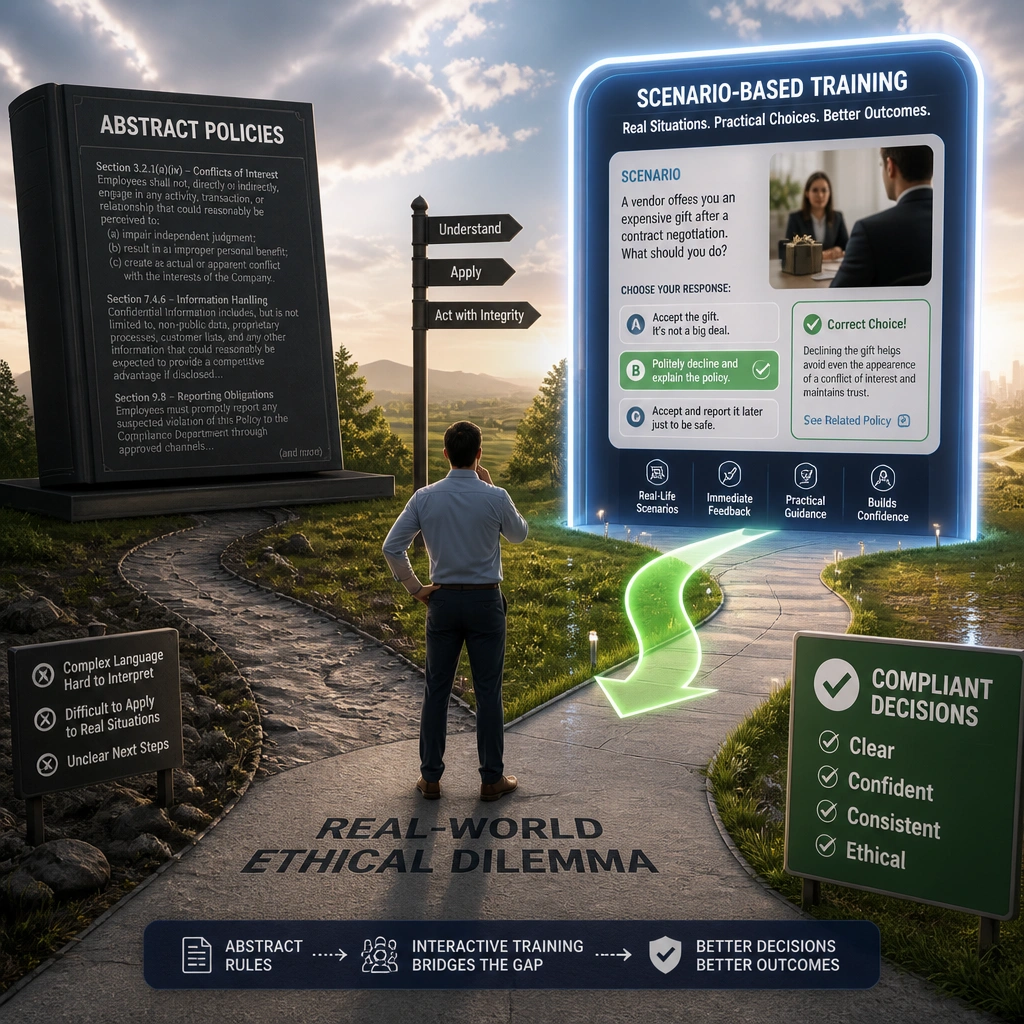
Check this out. A lot of compliance programs treat training like a boring check-the-box exercise. They hand you a massive PDF of the Code of Conduct and expect you to memorize it. But in the real world? That doesn't work. Imagine you're out in the field and a client hands you a gift that's right in a grey area. A scenario-based approach is where the rubber meets the road—it teaches you how to think, not just what to memorize. Trust me, learning how to apply these rules to messy, real-life situations is what keeps both you and the company out of trouble. Hopefully you answered B—here's why.
Full explanation below image
Full Explanation
The primary objective of scenario-based training in a compliance program is to bridge the gap between abstract policy guidelines and the complex, often ambiguous situations employees face in their day-to-day operations. Written codes of conduct and formal policy documents are essential foundations, but they are inherently theoretical. Scenario-based training provides a safe, simulated environment where employees must analyze realistic dilemmas, weigh conflicting priorities, and apply policy principles to make compliant decisions. This active learning approach enhances retention and develops critical ethical decision-making skills, which are far more effective at preventing misconduct than passive reading or rote memorization.
Let's break down why the other options do not represent the primary instructional objective: - Option A is incorrect because documenting training participation to prove the existence of a program is an administrative and legal necessity (sometimes referred to as 'check-the-box' compliance), but it is not the educational goal of scenario-based design. A program must strive for effectiveness, not just documentation. - Option C is incorrect because testing rote memorization of the code of conduct does not guarantee that employees can apply those rules under pressure or in complex, real-life situations where the right path isn't explicitly written word-for-word. - Option D is incorrect because evaluating knowledge of company financial records is a narrow audit or accounting function, not the general purpose of compliance scenario-based training.
Effective compliance training programs use realistic scenarios tailored to specific job functions. For instance, sales representatives should face scenarios regarding gifts, entertainment, and interactions with foreign officials, while IT staff should face scenarios involving data privacy and cybersecurity incidents. This targeted application ensures the training is highly relevant and actionable.