When executive leadership fails to actively promote and participate in the compliance program, which operational outcome presents the greatest risk to the organization?
Select an answer to reveal the explanation.
Short Explanation and Infographic
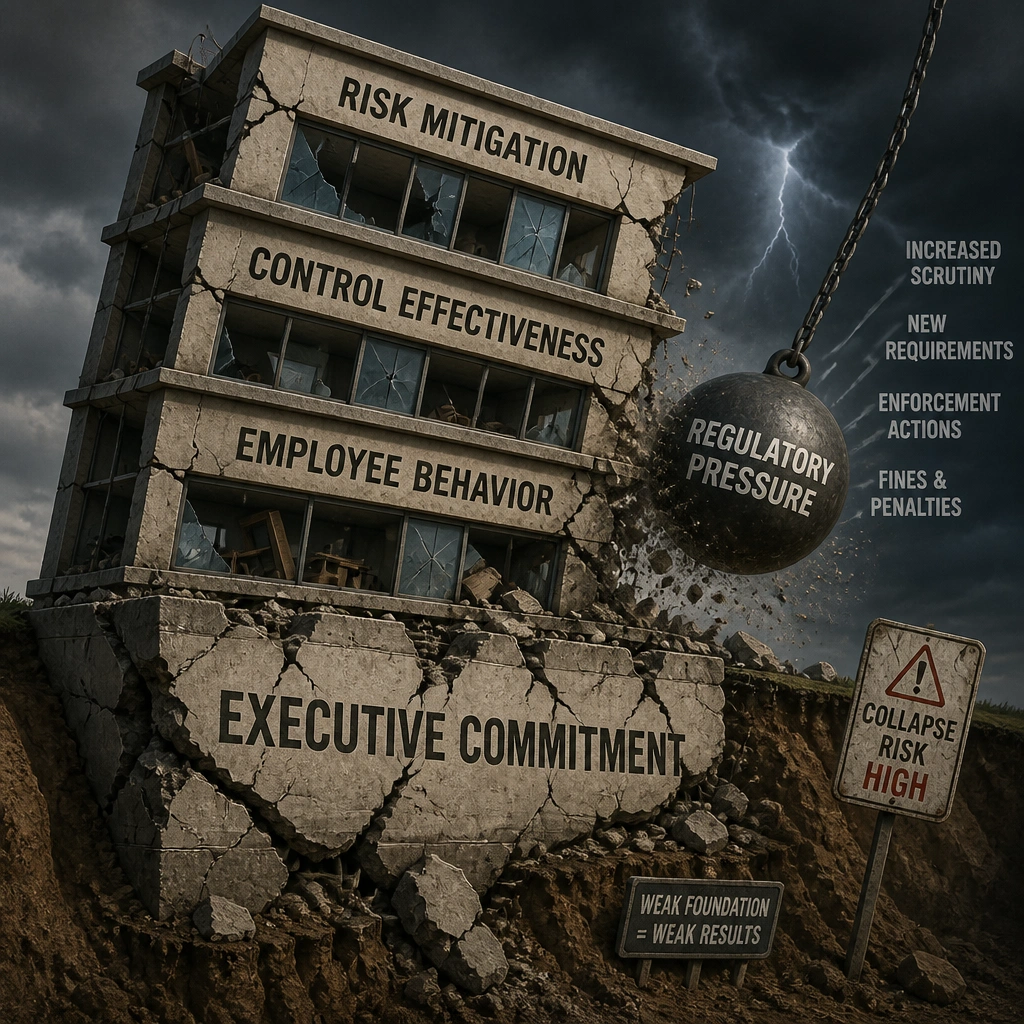
Here's the deal: culture flows downhill. If your executive team treats compliance like an annoying chore, everyone else in the company will too. When sales teams or project managers are under intense pressure to hit their numbers, and they see that the bosses don't actually care about the compliance rules, they're going to start cutting corners. They'll bypass approvals, look the other way on shady transactions, and ignore the training. And that's exactly when a major disaster strikes. A compliance program without executive support is just a piece of paper, and regulators will tear it right up when they investigate a breach.
Full explanation below image
Full Explanation
The active support of senior management is the foundation of a credible compliance program. Regulators, including the DOJ in its "Evaluation of Corporate Compliance Programs" guidelines, look for evidence of "shared commitment" from both middle and senior management. The risk of passive or non-existent leadership support is that it cultivates a corporate culture where compliance is viewed as an obstacle to business objectives rather than a core value.
Option A is correct because the most significant risk is the psychological license it gives to employees. If leaders do not actively model compliance, employees conclude that the program is merely for public relations. Under pressure to meet tight deadlines or sales targets, employees will choose to bypass controls, believing that management will condone or overlook misconduct as long as the numbers are met.
Option B is incorrect because management apathy does not inherently dictate the physical length of the training slides or curriculum, though it may affect employee participation rates.
Option C is incorrect because a lack of leadership support usually results in underfunding or budget cuts for the compliance department, rather than an automatic increase in its budget.
Option D is incorrect because while integrating compliance technology can be challenging, the complexity of technical systems is an IT and systems design issue, not a direct consequence of senior management's lack of advocacy.