Which of the following best describes the primary purpose of establishing a formal Compliance Management System (CMS) within an enterprise?
Select an answer to reveal the explanation.
Short Explanation and Infographic
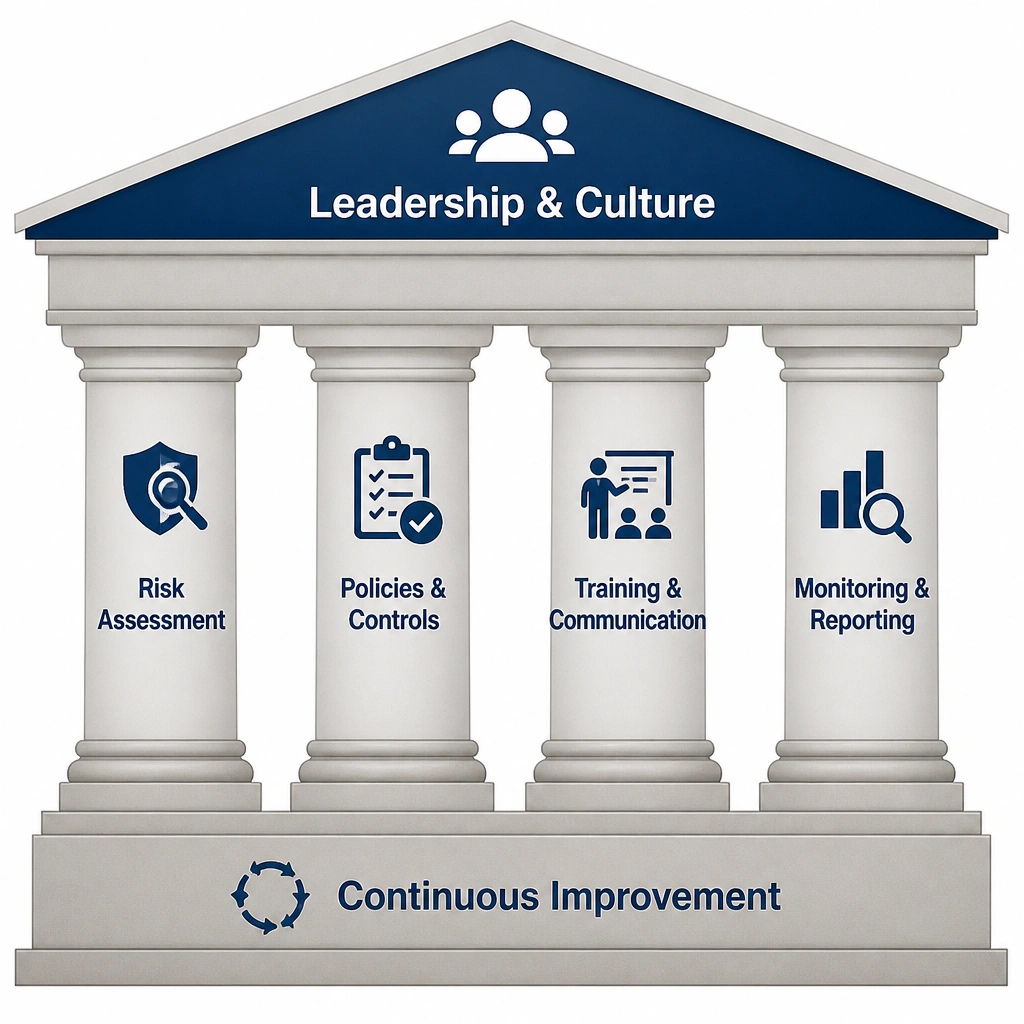
Imagine trying to build a skyscraper without a blueprint or structural engineering software. You'd just be piling bricks and hoping it doesn't collapse. That's what running a business without a Compliance Management System (CMS) is like. A CMS is your blueprint. It's a structured framework—policies, training, monitoring, auditing—that helps you spot regulatory risks before they run over your business. It also proves to regulators that you actually care and have a functioning system, not just a policy sitting on a shelf. The correct answer is C. It's not about replacing the compliance officer (Option D) or automating every business decision (Option A). And it's definitely not a sales tool (Option B). It's the structure that keeps your company compliant and safe. Got it? Sweet.
Full explanation below image
Full Explanation
The correct answer is C. A Compliance Management System (CMS) is an integrated framework of policies, procedures, controls, training, monitoring, and corrective actions designed to ensure an organization complies with applicable laws, regulations, and internal standards. According to standards such as ISO 37301, a CMS must be structured, repeatable, and tailored to the organization's risks. Its ultimate objective is to provide a systematic approach to identifying compliance risks, implementing controls to prevent violations, detecting failures early, and demonstrating the program's overall effectiveness to board members, auditors, and external regulators.
Let's evaluate why the incorrect options are wrong: - Option A is incorrect because a CMS is designed to manage regulatory risks and ethical behavior, not to automate all general operational decisions, which still require executive and human judgment. - Option B is incorrect because managing sales pipelines and customer relationships is the role of Customer Relationship Management (CRM) systems and sales management, not a compliance system. - Option D is incorrect because a CMS does not replace a compliance officer. In fact, a dedicated, empowered compliance officer is a critical component required to oversee and manage the CMS itself.
Ultimately, a well-implemented CMS serves as an organization's primary defense during regulatory audits or investigations, showcasing a proactive commitment to compliance.