In the context of establishing a healthy organizational compliance culture, what does the term "tone at the top" specifically refer to?
Select an answer to reveal the explanation.
Short Explanation and Infographic
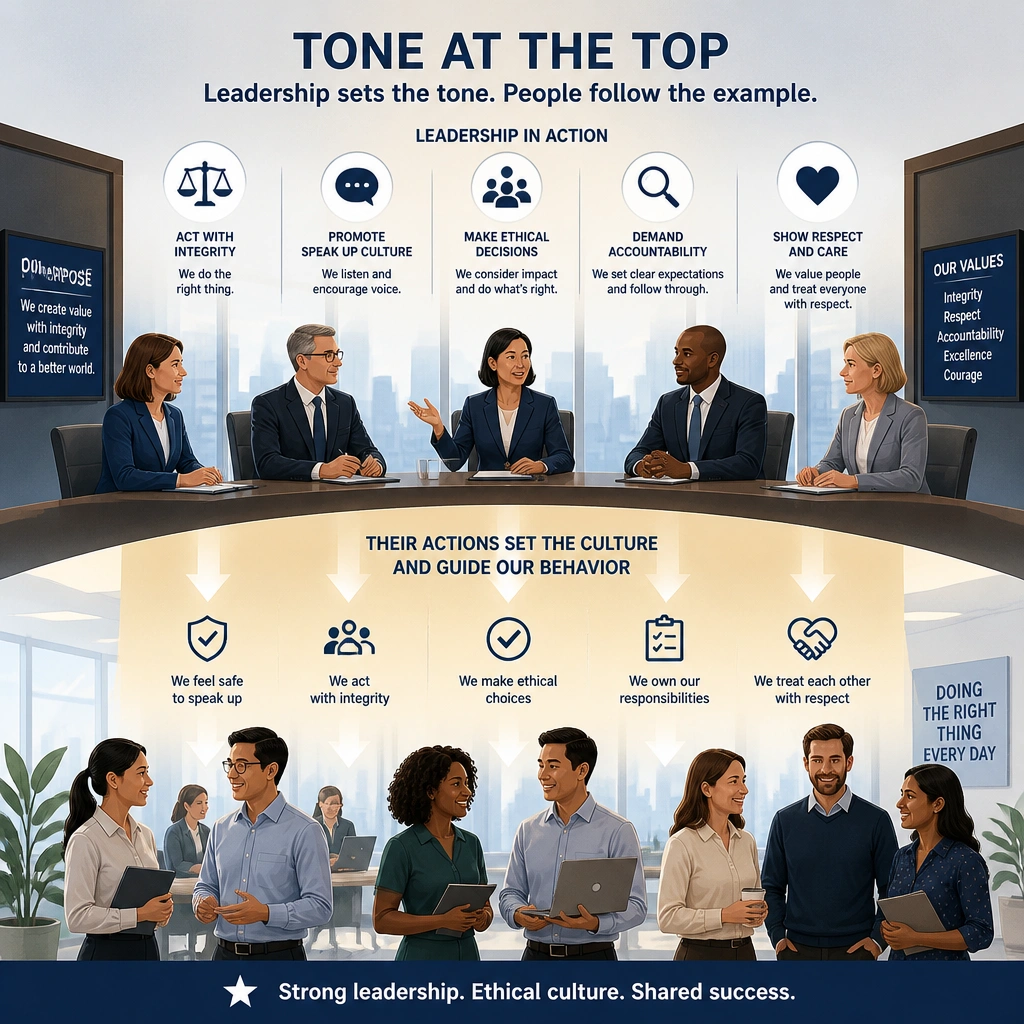
Check this out: you can have the most beautiful, expensive compliance manual on the planet, but if your CEO and executives are cutting corners and ignoring the rules, your compliance program is dead on arrival. 'Tone at the top' is all about the attitude and actions of your senior leaders. If they walk the walk, the rest of the company will follow. But if they talk about ethics and then turn a blind eye to bad behavior to meet a sales target, everyone else sees it and thinks the rules don't actually matter.
Full explanation below image
Full Explanation
The term 'tone at the top' refers to the ethical environment created by an organization's leadership. Executive management and the board of directors must demonstrate through their actions, decisions, and communications that integrity is a non-negotiable priority. A strong tone at the top is crucial because employees look to leadership to understand the company's true values. If leadership tolerates compliance breaches or pressures employees to compromise ethics for profit, it undermines the entire compliance program. Furthermore, global regulatory guidelines, such as those from the U.S. Department of Justice (DOJ), explicitly require prosecutors to assess whether company leadership has modeled proper behavior or if there has been a breakdown in the ethical tone set by management.
Let's examine why A is the correct answer and why the distractors are incorrect. A is correct because the core definition of 'tone at the top' is the ethical leadership and actions modeled by executive leaders and directors.
Distractor B is incorrect because financial speeches focusing solely on profit targets do not demonstrate a commitment to ethical standards; rather, they can sometimes create pressure to cut corners.
Distractor C is incorrect because corporate physical infrastructure is completely irrelevant to an organization's ethical culture and compliance practices.
Distractor D is incorrect because workplace dress codes and office etiquette are administrative policies that do not address the core ethical behavior and compliance commitment of leadership.