Which design element is most essential for ensuring that an organization's compliance training program effectively modifies employee behavior and satisfies regulatory expectations?
Select an answer to reveal the explanation.
Short Explanation and Infographic
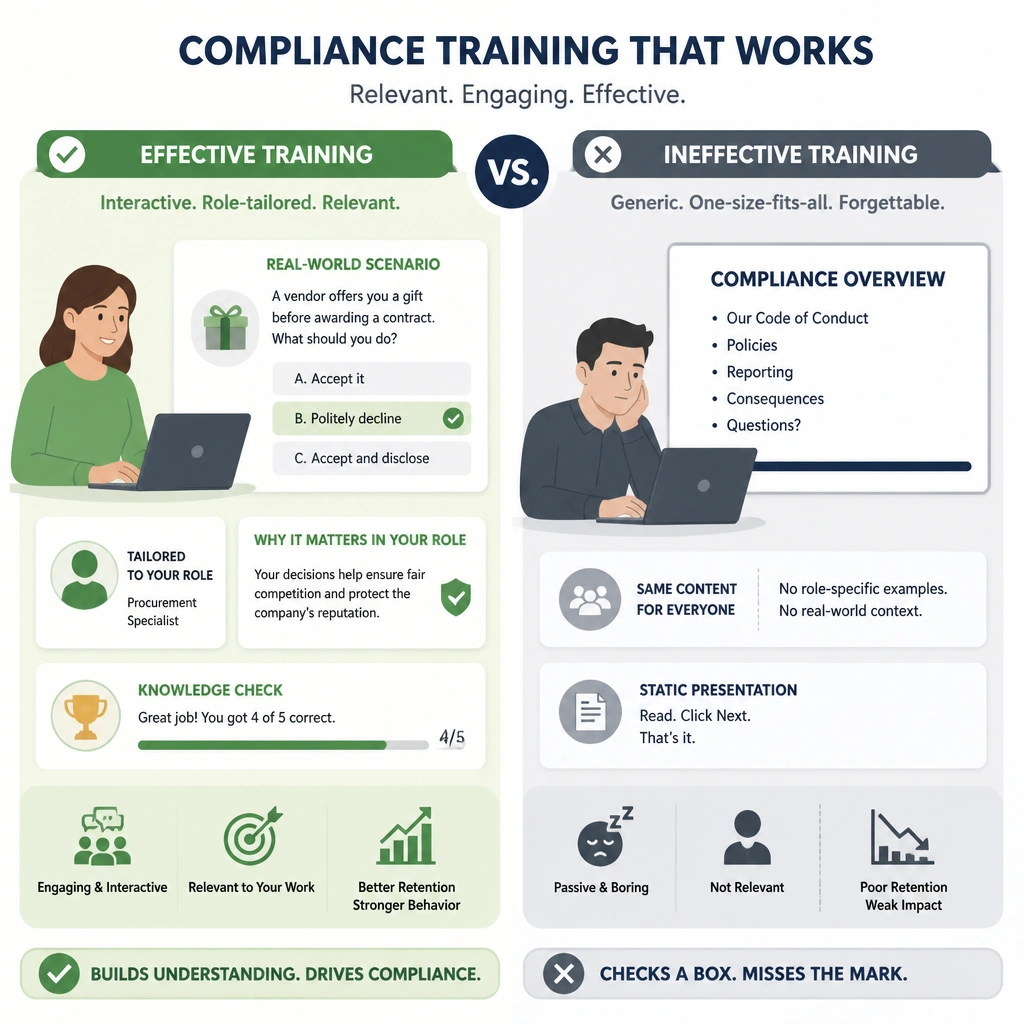
Let's dive in. If you think compliance training is just about reading dry legal text off a slide once a year, you're doing it wrong. That's a great way to put your team to sleep. To actually change behavior and keep your company out of hot water, training has to be interactive, relevant, and engaging. It needs to speak to what employees actually do in their day-to-day jobs. If they can't relate to it, they won't remember it when they're faced with a real-world dilemma.
Full explanation below image
Full Explanation
For a compliance training program to be effective, it must go beyond a simple 'tick-the-box' exercise. Regulators, including the U.S. Department of Justice (DOJ), emphasize that training should be interactive, practical, and tailored to the specific risk profiles of different employee groups. Using real-world scenarios, interactive quizzes, and case studies helps employees understand how policies apply to their daily tasks and encourages active retention of compliance principles.
Let's look at why A is correct. A is correct because interactive, risk-tailored training directly addresses the operational realities of the employees, making the training more memorable and effective at preventing misconduct.
Distractor B is incorrect because dense legal jargon is difficult for non-lawyers to understand and apply. It reduces the training's overall efficacy and creates a disconnect between the compliance department and the business units.
Distractor C is incorrect because compliance risks and regulations evolve; training must be periodic and continuous to maintain awareness. A one-time onboarding session is quickly forgotten and fails to cover new risk environments.
Distractor D is incorrect because a 'one-size-fits-all' approach fails to address the unique risk exposures of different roles. For example, sales representatives face different corruption risks than software developers, and their training must reflect those distinct risk landscapes.