Before drafting policies or training employees, a compliance team performs a formal risk assessment. What is the main objective of this process?
Select an answer to reveal the explanation.
Short Explanation and Infographic
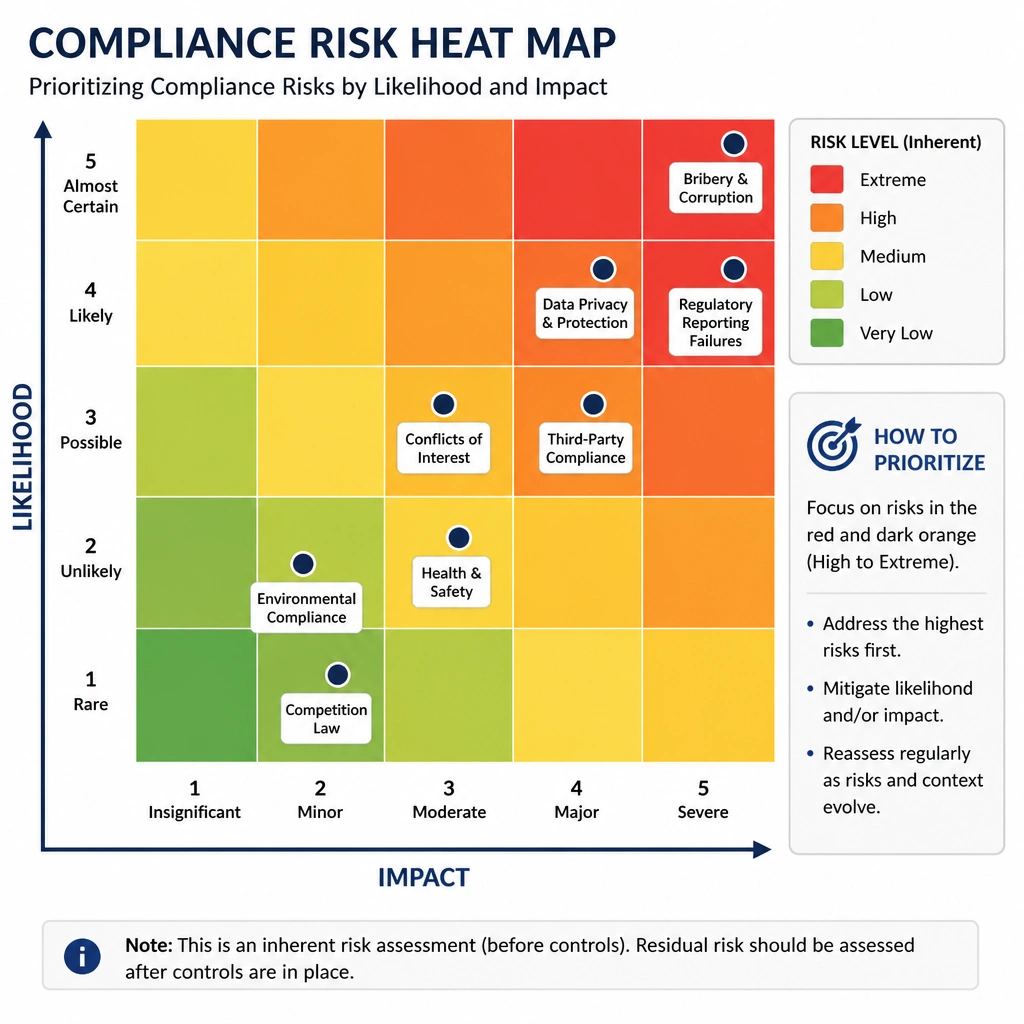
Think of it like planning a road trip across the country. You wouldn't just pack a bunch of random gear without knowing where you're going or what the weather is like. You need to map out where the hazards are—like snowstorms or construction zones. A risk assessment does the exact same thing for your compliance program. It pinpoints where your business is likely to hit a regulatory pothole or an ethical cliff. You can't protect against every single thing, but you've got to find and prioritize the big ones first. Trust me, trying to build a compliance program without a risk assessment is just shooting in the dark.
Full explanation below image
Full Explanation
A compliance and ethics program must be tailored to the specific risks faced by the organization rather than being a generic, off-the-shelf checklist. The primary purpose of conducting a formal compliance risk assessment is to systematically identify, analyze, and prioritize the unique legal, regulatory, operational, and ethical exposures that the business faces. Option A is correct because identifying and prioritizing risks allows the compliance function to focus its resources, training programs, auditing efforts, and policy updates on the areas of greatest exposure. Modern regulatory expectations, such as the U.S. Department of Justice (DOJ) guidelines for Evaluating Corporate Compliance Programs, place heavy emphasis on whether a program is built on a dynamic, risk-based approach. Option B is incorrect because while a risk assessment may estimate the general impact of risks, calculating the exact dollar amount of potential regulatory fines and litigation costs is highly speculative and is not the primary purpose of the assessment. Quantitative financial modeling is sometimes a component of enterprise risk management, but it does not drive compliance control design. Option C is incorrect because a compliance risk assessment focuses on systemic risk areas, operational vulnerabilities, and business processes (such as international sales or third-party sourcing) rather than trying to single out, profile, or predict the behavior of individual employees. Option D is incorrect because compiling a directory of the company's market competitors and tracking their compliance histories is a function of market research, competitive intelligence, or legal department monitoring, and is not a primary objective of the organization's internal compliance risk assessment.