
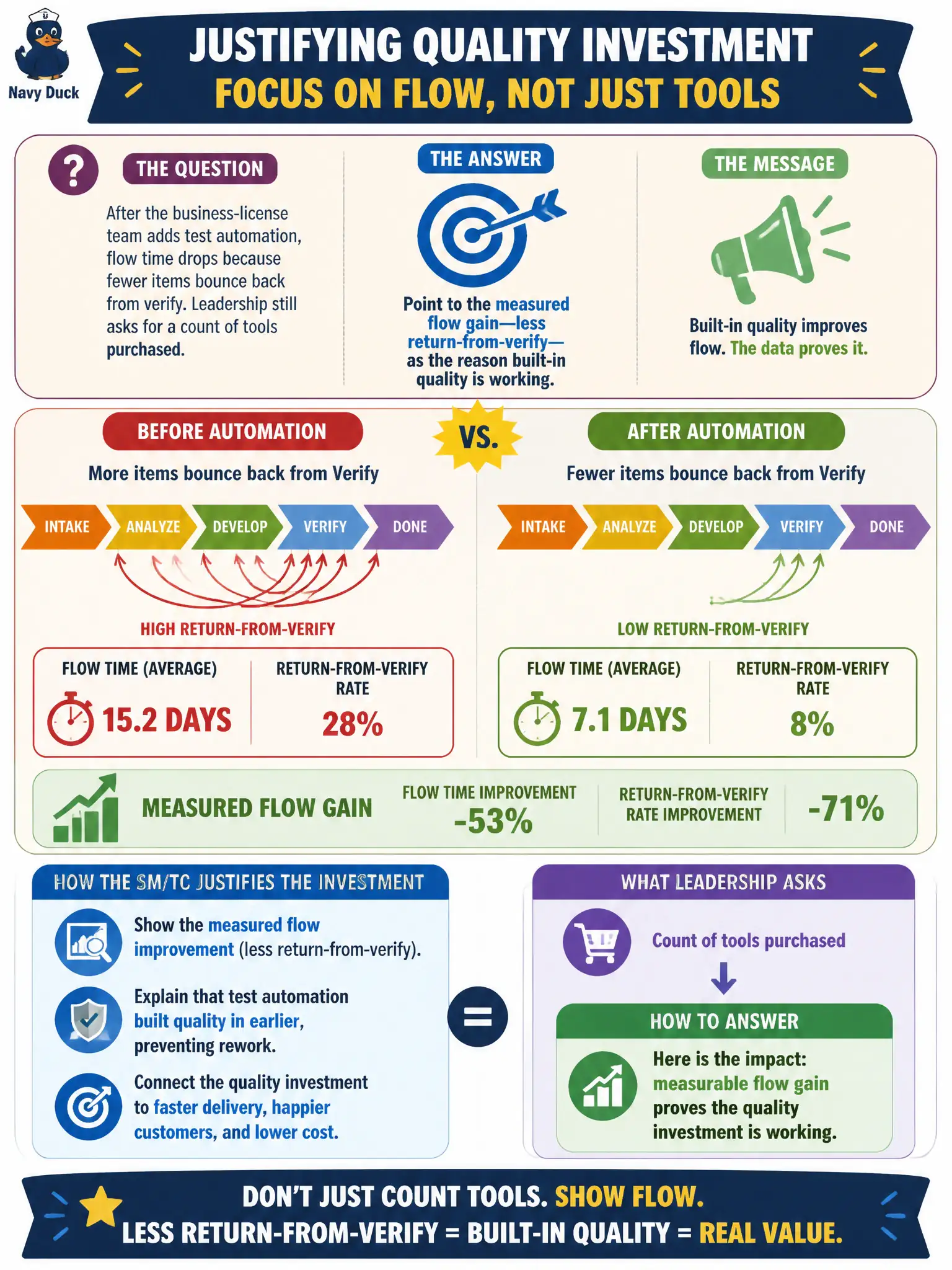
After the business-license team adds test automation, flow time drops because fewer items bounce back from verify. Leadership still asks for a count of tools purchased. How should the SM/TC justify the quality investment?
Select an answer to reveal the explanation.
Short Explanation
Buying more wrenches is not the same as the faucet actually flowing. The license team already has the proof: work is not bouncing back from verify, so residents get licenses sooner. That flow drop is the trophy—not a shelf of unused tools.
Full Explanation
Justify quality investment with measured flow gains, not tool counts. After the business-license team adds test automation and flow time drops because fewer items bounce back from verify, leadership asking for a count of tools purchased misses the point. The Scrum Master/Team Coach should point to less return-from-verify and shorter flow time as evidence that built-in quality is working for license applicants and staff.
Reporting the number of automation frameworks installed as the success metric fails by concept: tool sprawl is not outcome. Pausing automation until every license type has its own unique tool fails by concept by blocking progress for perfect tool uniqueness. Restoring manual verify so leadership can see people busy in that column fails by concept: it recreates the delay automation removed to satisfy a utilization aesthetic.
Exam caveat: SAFe ties built-in quality to flow performance; success is faster, more predictable delivery with fewer escapes—not procurement theater. A modest automation suite that reduces verify thrash beats a showcase of many unused frameworks on civic licensing work.
Operational check: present before/after flow time and return-from-verify rates for business-license stories, keep automation scoped to high-value checks, and agree with leadership that flow and quality outcomes—not tool inventory—are the review metrics.