
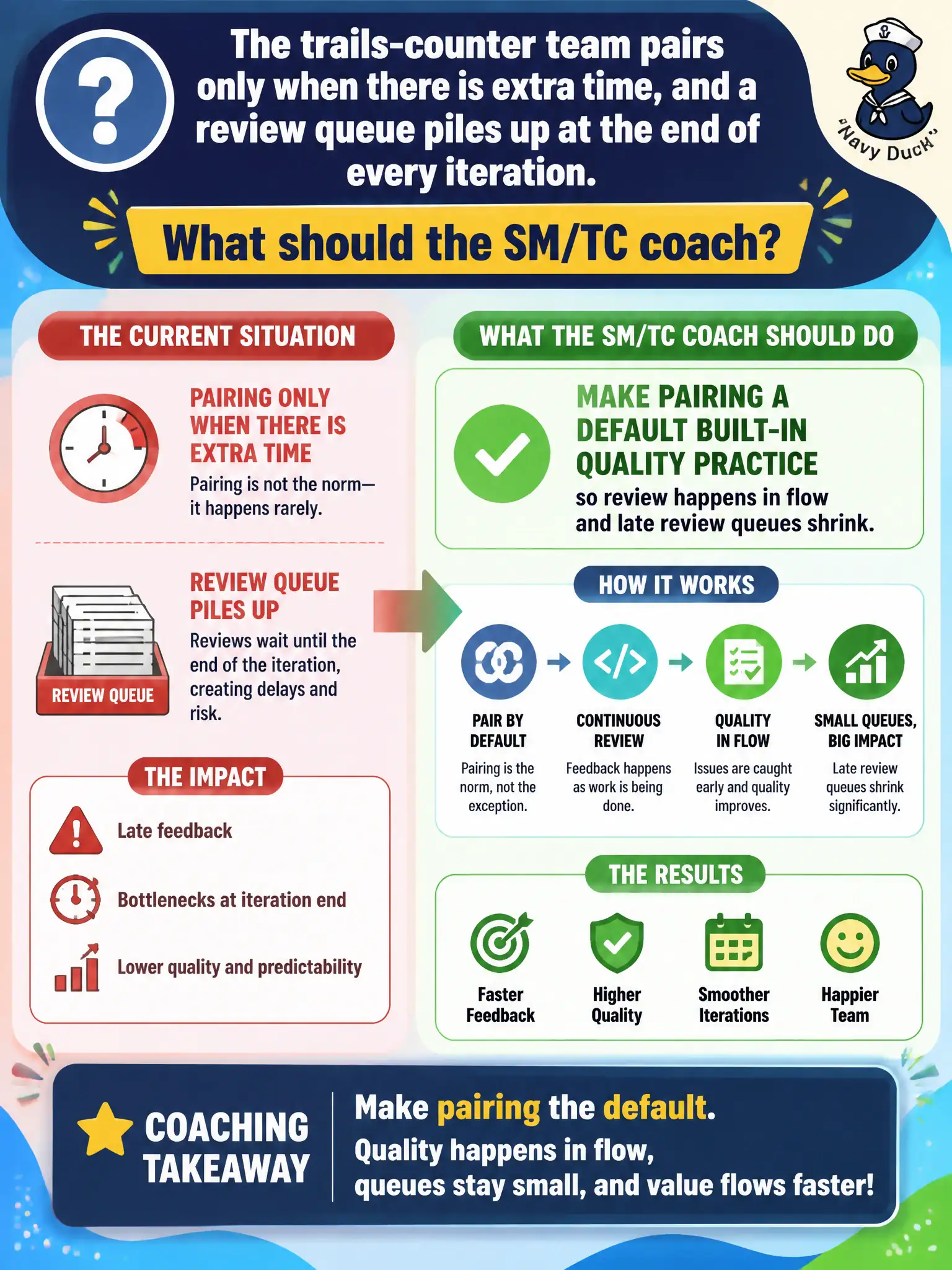
The trails-counter team pairs only when there is extra time, and a review queue piles up at the end of every iteration. What should the SM/TC coach?
Select an answer to reveal the explanation.
Short Explanation
Pairing only when leftover minutes appear is like checking trail maps after hikers are already lost. Two sets of eyes while the counter story is moving beats a review pile at the gate. Make pairing the default so quality rides with the work.
Full Explanation
Pairing as a default built-in quality practice moves review into the flow. When the trails-counter team pairs only if extra time appears, a review queue piles up at iteration end and civic counter work waits. The Scrum Master/Team Coach should coach pairing (or equivalent continuous review) as normal practice so knowledge and quality checks happen while work moves, shrinking late review queues.
Keeping pairing as optional overtime so weekday velocity charts stay high fails by concept: it treats quality collaboration as unpaid afterthought and preserves a false speed signal. Banning pairing because two people on one story wastes utilization fails by concept by prioritizing busyness over finished, reviewed trail-counter increments. Sending finished stories to a separate inspection desk after code complete fails by concept: it recreates a late handoff queue.
Exam caveat: SAFe built-in quality includes collaborative practices such as pairing and peer review in flow; end-loaded review queues are a flow failure mode. Pairing need not be 100% of all hours, but “only if spare time” usually means never for public-service teams under pressure.
Operational check: set pairing or in-flow review as the default for trails-counter stories, eliminate the end-of-iteration review pile as the primary gate, measure review wait time, and confirm fewer items age in a review column.