
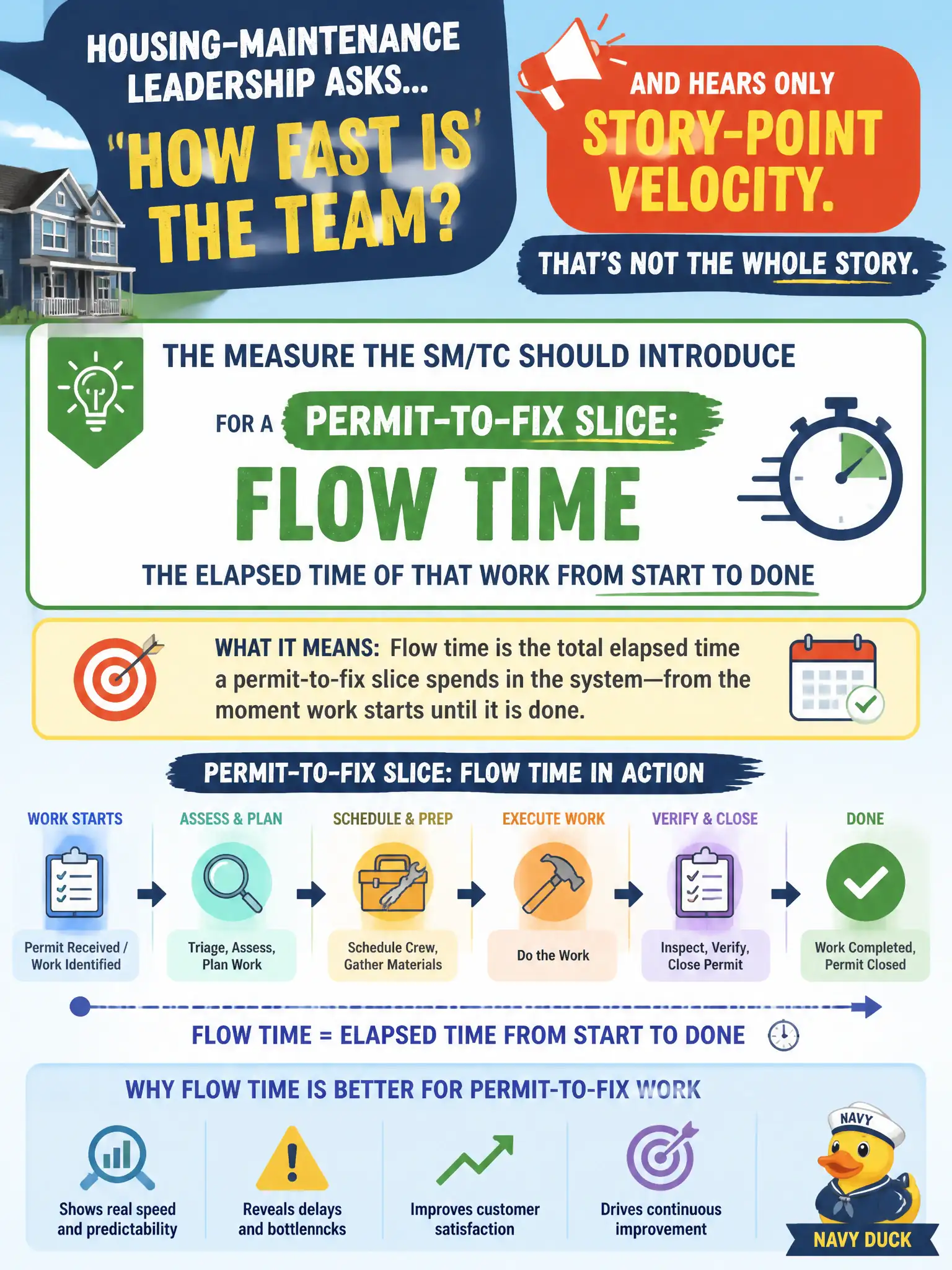
Housing-maintenance leadership asks how fast the team is and hears only story-point velocity. What measure should the SM/TC introduce for a permit-to-fix slice?
Select an answer to reveal the explanation.
Short Explanation
Story points say how heavy the backpack looked, not how long the walk took. Residents feel permit-to-fix elapsed time. That clock is flow time.
Full Explanation
When residents feel permit-to-fix delay, the measure the SM/TC should emphasize is flow time—the elapsed time of that work from start to done. Story points say how heavy the backpack looked, not how long the walk took. Citizens experience elapsed time; coaches make that visible.
A larger story-point scale so velocity looks faster fails because resizing points does not shrink citizen wait. Individual technician hours as a proxy for speed fails because effort is not elapsed flow time and ignores queues. The count of meetings held during the PI fails because meeting volume is not delivery speed.
Exam caveat: flow time (and related cycle time) is the resident-facing speed signal; points are capacity/forecast aids. Operational check: timestamp start and done for permit work, chart flow time trends, attack waits that dominate elapsed time, and stop using point inflation or meeting counts as speed proofs. Publishing flow time beside points retrains leadership to optimize citizen wait rather than estimate aesthetics. Publishing flow time beside points retrains leadership to optimize citizen wait rather than estimate aesthetics. Publishing flow time beside points retrains leadership to optimize citizen wait rather than estimate aesthetics.