
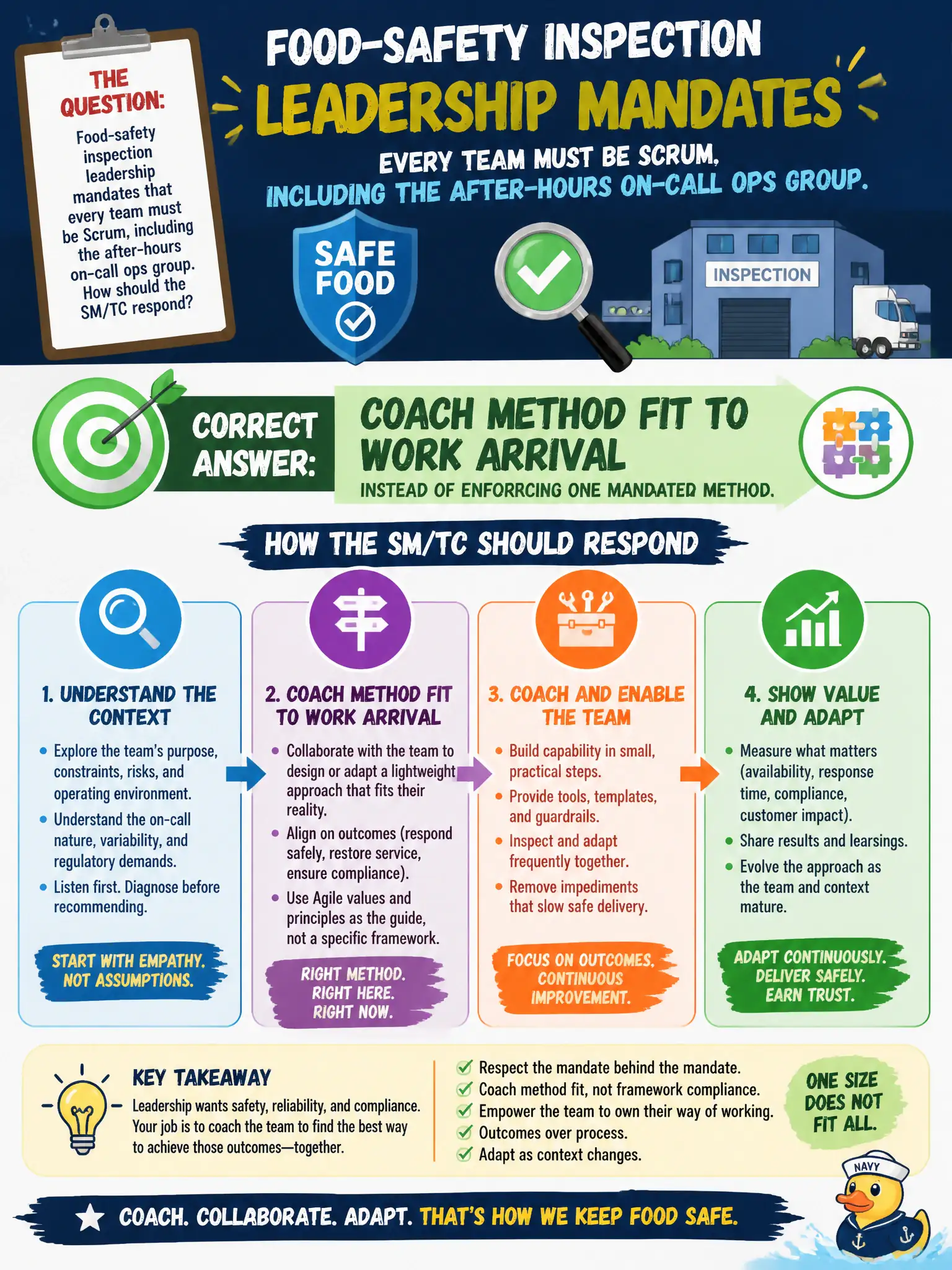
Food-safety inspection leadership mandates that every team must be Scrum, including the after-hours on-call ops group. How should the SM/TC respond?
Select an answer to reveal the explanation.
Short Explanation
Midnight food-poisoning calls do not wait for next Tuesday's Sprint Planning. One-method mandates mash a round ops queue into a square Sprint. Coach fit: let interrupt-driven crews use the method that matches arrival.
Full Explanation
When food-safety inspection leadership mandates that every team must be Scrum—including after-hours on-call ops—the SM/TC should coach method fit to work arrival instead of enforcing one mandated method. Midnight food-poisoning calls do not wait for next Tuesday's Sprint Planning. Interrupt-driven ops often fit Team Kanban; mashing that queue into mandated Sprints hurts flow and public health responsiveness.
Converting the on-call group to Scrum Sprints solely to meet the mandate fails because compliance theater does not match how incidents arrive. Asking the RTE to issue a train-wide Scrum-only working agreement fails because escalating uniformity reinforces the wrong criterion for method choice. Ignoring the ops group because operations work is "out of SAFe" fails because operations teams can and do participate on ARTs with suitable methods.
Exam caveat: context beats brand uniformity; coaches select SAFe Scrum or Team Kanban from arrival patterns. Operational check: map on-call arrival and interrupt rates, propose Team Kanban (or hybrid policies) that fit, educate leadership on why mandated Scrum harms incident flow, and keep the ops group on the ART with an honest method. Public-health incident response is a classic uneven-arrival context where Team Kanban policies protect both responders and the residents they serve.