
PROC LIFEREG is used to fit a Weibull accelerated failure time (AFT) model. How does PROC LIFEREG differ from PROC PHREG in its modeling approach?
Select an answer to reveal the explanation.
Short Explanation
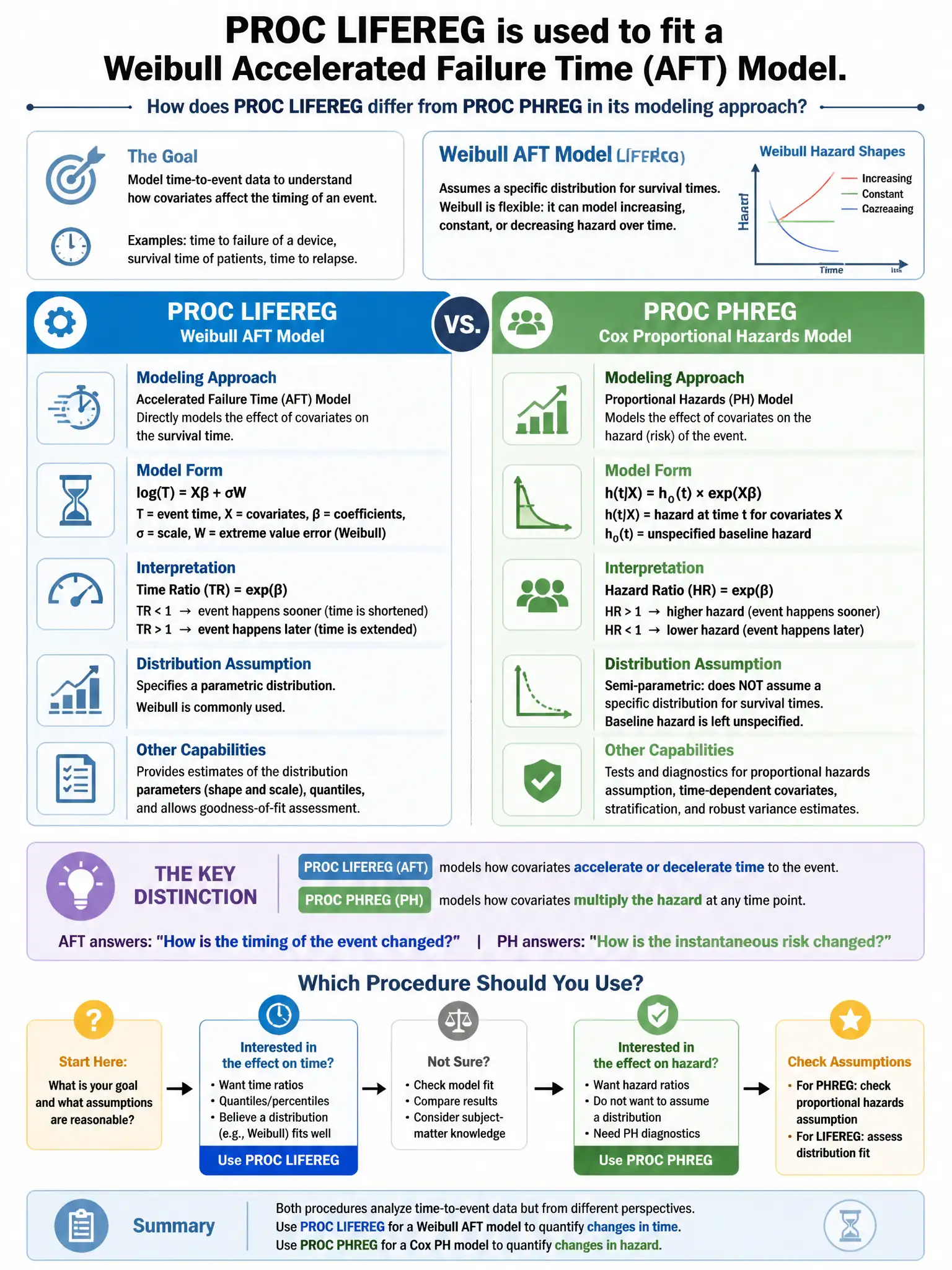
Here's the deal — PROC LIFEREG fits parametric accelerated failure time models by modeling log survival time as a linear function of covariates under an assumed distribution such as Weibull, exponential, or log-normal. PROC PHREG fits the Cox proportional hazards model, which is semi-parametric and leaves the baseline hazard unspecified.
Full Explanation
The correct option says PROC LIFEREG assumes a parametric survival distribution, such as Weibull, exponential, or log-normal, and models log survival time as a linear function of predictors, while PROC PHREG uses a semi-parametric Cox model with an unspecified baseline hazard. PROC LIFEREG fits parametric accelerated failure time models, so covariates act multiplicatively on time. PROC PHREG fits Cox proportional hazards, so covariates enter multiplicatively on the hazard. The option saying PROC LIFEREG models hazard ratios directly and PROC PHREG models survival time directly reverses these descriptions. The option saying PROC LIFEREG requires uncensored data is wrong because both handle right-censoring. The option saying PROC LIFEREG computes Kaplan-Meier curves is wrong because PROC LIFETEST does.