
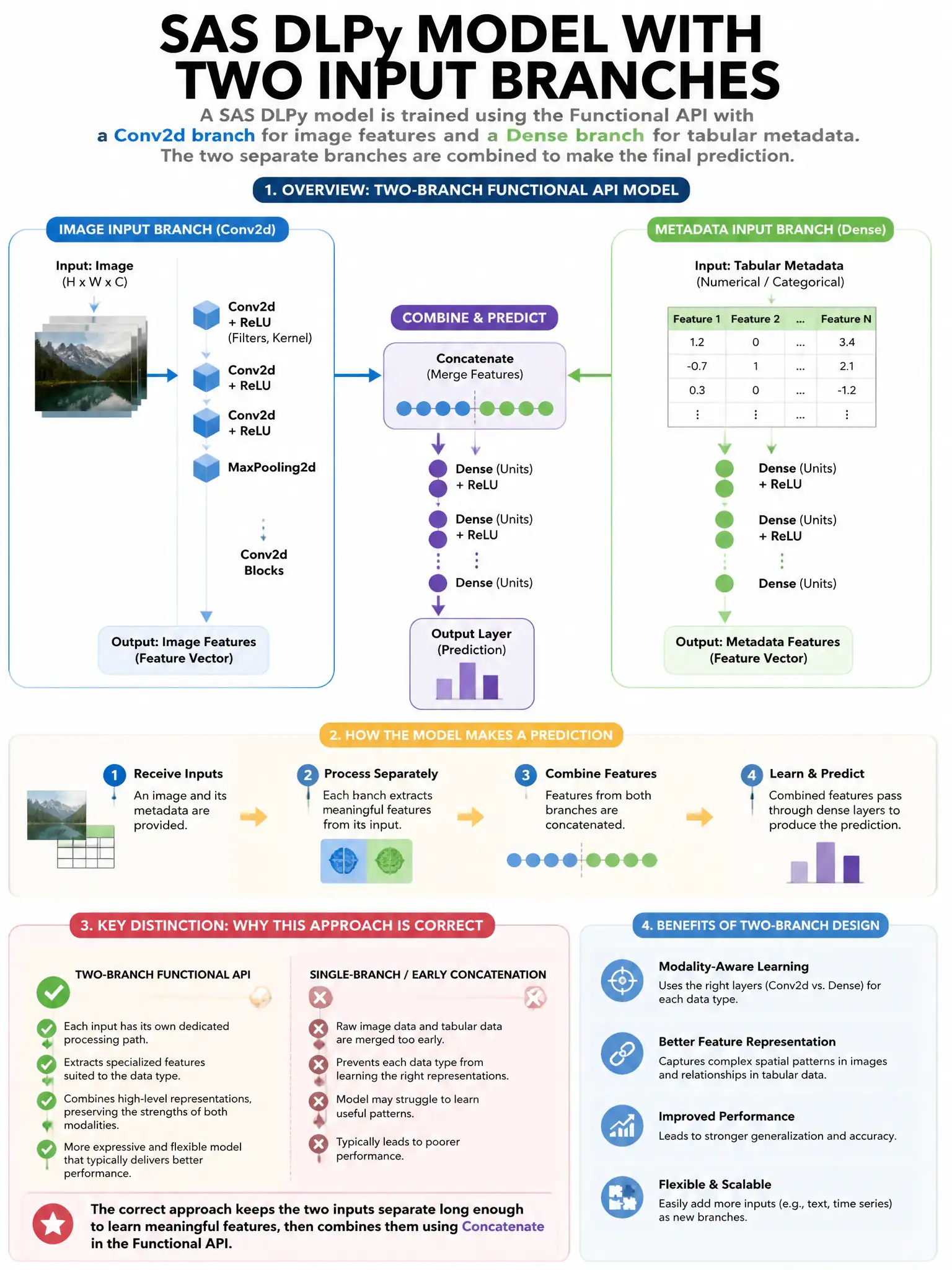
A SAS DLPy model is trained using the Functional API with two input branches: one Conv2d branch for image features and one Dense branch for tabular metadata. How are the two separate input layers declared in DLPy's Functional API?
Select an answer to reveal the explanation.
Short Explanation
Here's the deal — you need two separate InputLayer() objects, one for the image branch and one for the tabular branch, each with its own shape and data type. In DLPy's Functional API, each input modality gets its own starting layer before the branches merge.
Full Explanation
Two separate InputLayer() objects are created, each defining the dimensions and data type for its respective input modality. In DLPy's Functional API, multi-input models require a separate InputLayer() for each distinct input modality, each specifying the appropriate shape, such as height/width/channels for images and n_features for tabular data. These separate input layers are then passed as starting points for their respective processing branches before merging. The option using a single InputLayer() with multiple input dimensions via SHAPE= is wrong because a single InputLayer cannot describe two different input shapes. The option using SecondaryInput() for non-image inputs is wrong because SecondaryInput() is not a DLPy class. The option saying DLPy Functional API does not support multi-input models is wrong because the Functional API is the approach DLPy provides for multi-input architectures.