
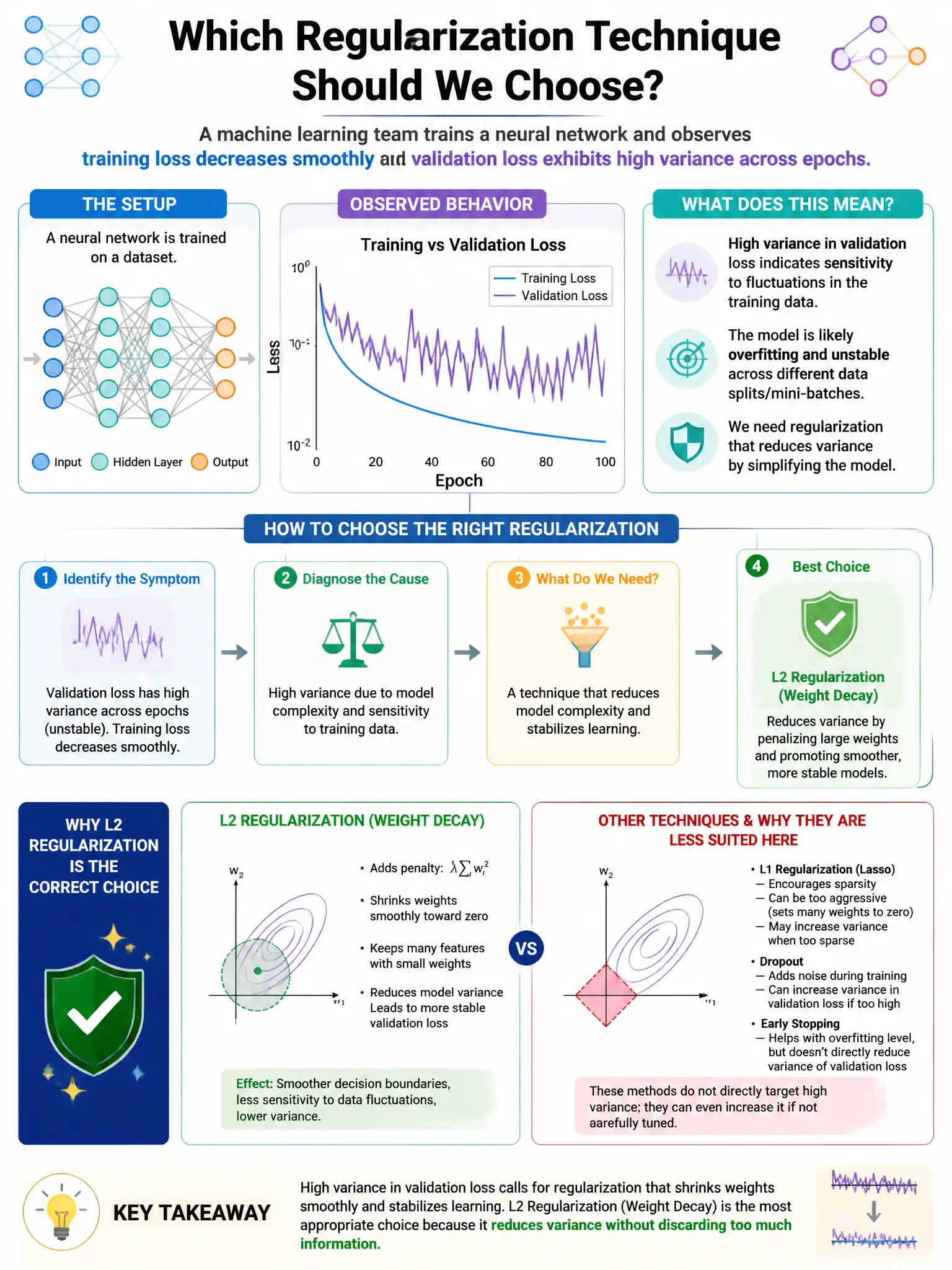
A machine learning team trains a neural network and observes that training loss decreases smoothly but validation loss exhibits high variance across epochs. Which regularization technique specifically reduces variance by injecting Gaussian noise into the input layer during training?
Select an answer to reveal the explanation.
Short Explanation
Here's the deal — you need the technique that adds zero-mean Gaussian noise to the training inputs during each forward pass. That injects noise at the input layer, increases data diversity, and reduces overfitting. The other choices don't match that input-noise requirement.
Full Explanation
Input noise augmentation adding zero-mean Gaussian noise to training inputs during each forward pass is correct because it injects noise at the input layer, increases data diversity, reduces overfitting, and under certain assumptions has a regularization effect equivalent to Tikhonov regularization. Weight decay regularization penalizing large weight magnitudes is wrong because it penalizes weights, not inputs. Dropout randomly zeroing activations in hidden layers is wrong because it zeros hidden activations, not inputs. Batch normalization normalizing activations within each mini-batch is wrong because it normalizes activations and reduces internal covariate shift but is not input noise injection.