
A data scientist builds a PROC HPFOREST model and a PROC TREEBOOST model on the same data and compares their variable importance outputs. A colleague claims both should rank variables identically. Why is this assumption incorrect?
Select an answer to reveal the explanation.
Short Explanation
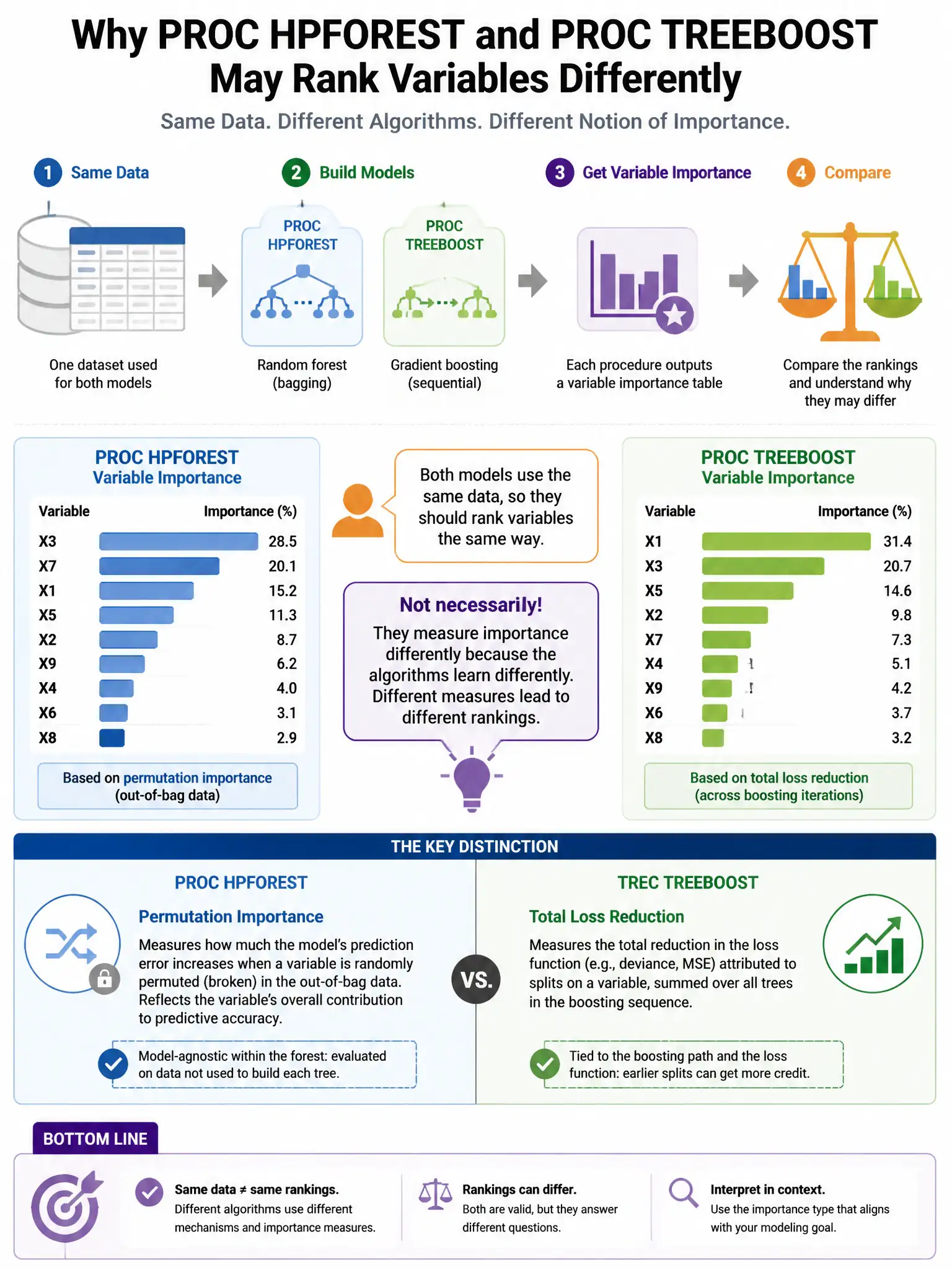
Here's the deal — you're comparing two different ensemble engines. PROC HPFOREST averages Gini impurity reduction across independently grown bootstrap trees, while PROC TREEBOOST measures split frequency or gain in sequentially trained residual-correcting trees, so the rankings won't match.
Full Explanation
The correct answer is the option stating that PROC HPFOREST measures importance as mean Gini impurity reduction across independently grown bootstrap trees, while PROC TREEBOOST measures importance based on split frequency or gain in sequentially trained residual-correcting trees. PROC HPFOREST grows trees in parallel on bootstrap samples; importance is average Gini reduction. PROC TREEBOOST grows trees sequentially on pseudo-residuals; importance reflects how often and how much each variable reduces loss. Different objectives and tree dependencies produce different rankings. The same-algorithm/different-seed option is wrong because the difference is structural. The no-importance option is wrong because PROC TREEBOOST does produce variable importance. The continuous-only option is wrong because both handle continuous and categorical variables.