
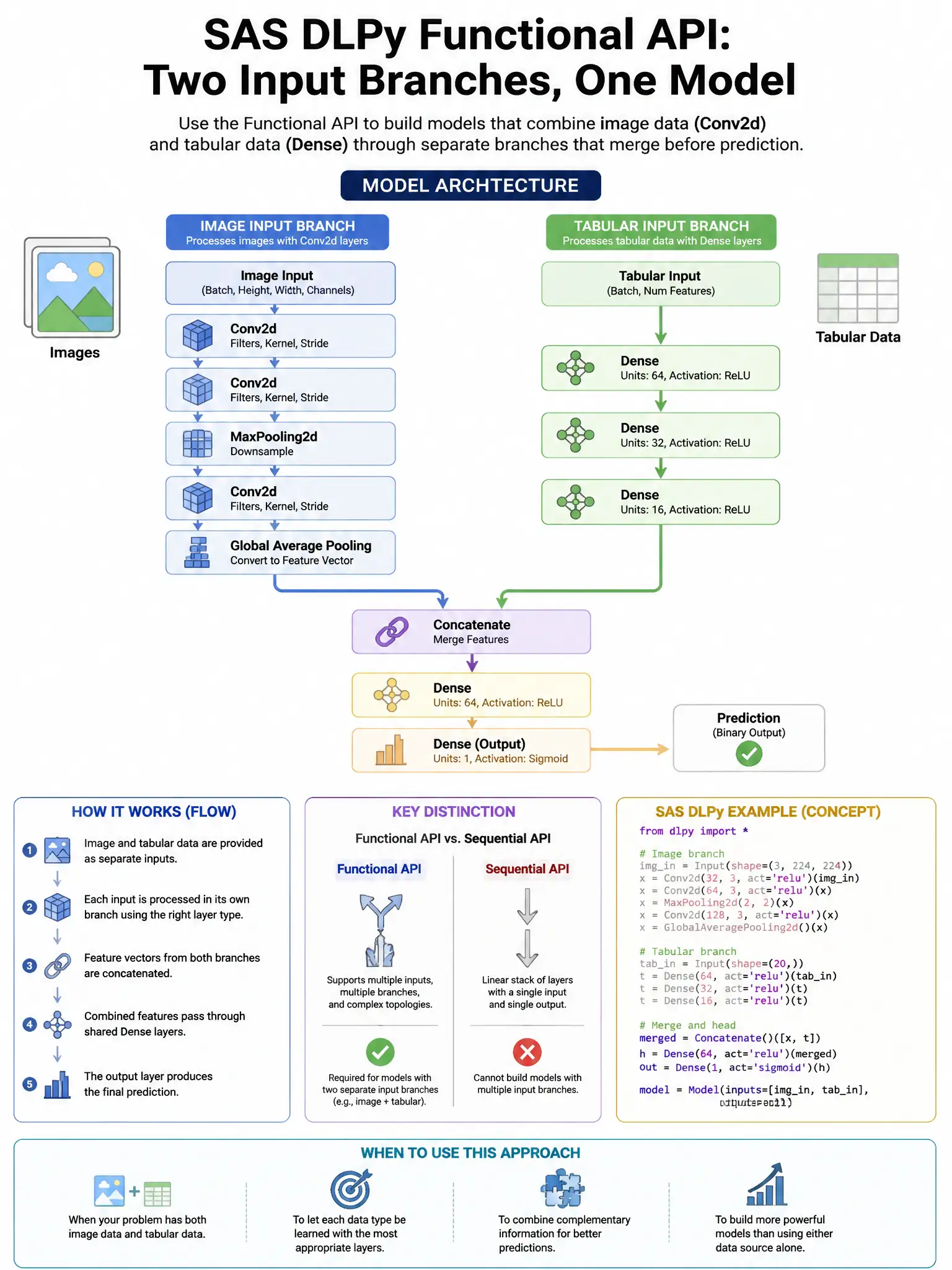
In SAS DLPy, the Functional API is used to build a model with two separate input branches. One branch processes images via Conv2d layers, the other processes tabular data via Dense layers. These two branches are merged before a final output layer. Which DLPy class merges (concatenates) the two branch outputs?
Select an answer to reveal the explanation.
Short Explanation
You use the Concat() layer from dlpy.layers because it's the DLPy class that concatenates outputs from multiple branches along the last dimension. The other names aren't the standard DLPy way to merge branches.
Full Explanation
The correct choice is the Concat() layer from dlpy.layers. SAS DLPy provides this layer for concatenating outputs from multiple branches along the last dimension, which is how you merge separate image and tabular branches before a final output layer. The Merge() layer with mode='concat' is wrong because Merge() is not a standard DLPy class name. The MergeLayer() with axis=-1 parameter is wrong because MergeLayer() with axis=-1 is not DLPy syntax. The Add() layer from dlpy.blocks is wrong because Add() performs element-wise addition, not concatenation, and is not a standard DLPy layer name for this purpose.