
How does fuzzy C-means clustering differ from k-means in its representation of cluster membership?
Select an answer to reveal the explanation.
Short Explanation
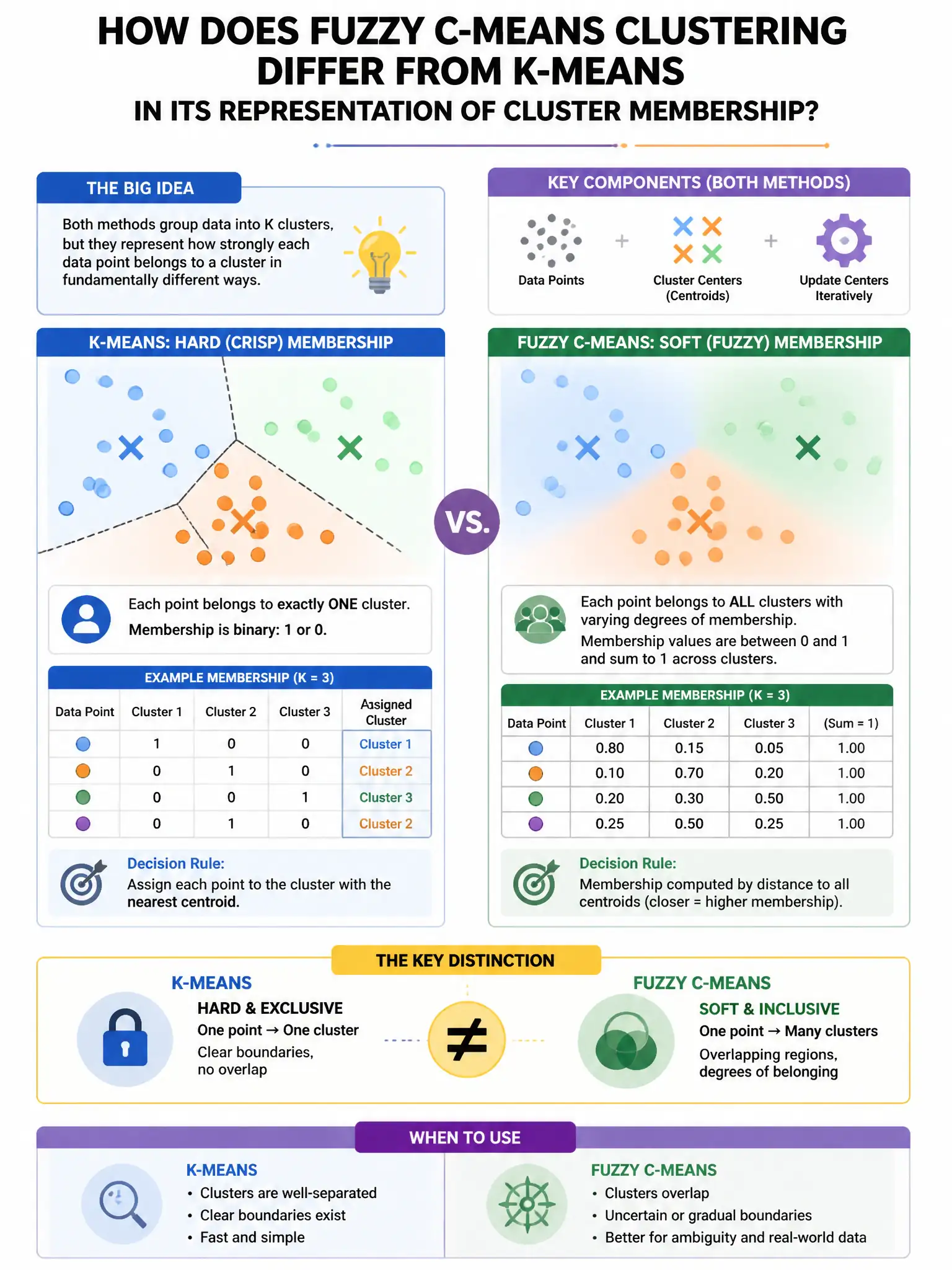
Here's the deal — fuzzy c-means gives each observation partial membership degrees to all clusters, and those degrees add up to 1. That lets boundary observations belong partially to multiple clusters instead of being forced into one label.
Full Explanation
Fuzzy c-means assigns each observation partial membership degrees to all clusters, with degrees summing to 1, allowing boundary observations to belong partially to multiple clusters. Soft clustering produces a membership matrix where each observation has a degree of membership to each cluster from 0 to 1. A boundary observation might have 0.6 membership in one cluster and 0.4 in another. The single-label probabilistic EM option is wrong because a single label is still hard assignment. The hierarchical agglomeration option is wrong because fuzzy c-means is centroid-based like k-means. The fewer-clusters-by-merging-ambiguous-observations option is wrong because cluster count is still a user parameter.