
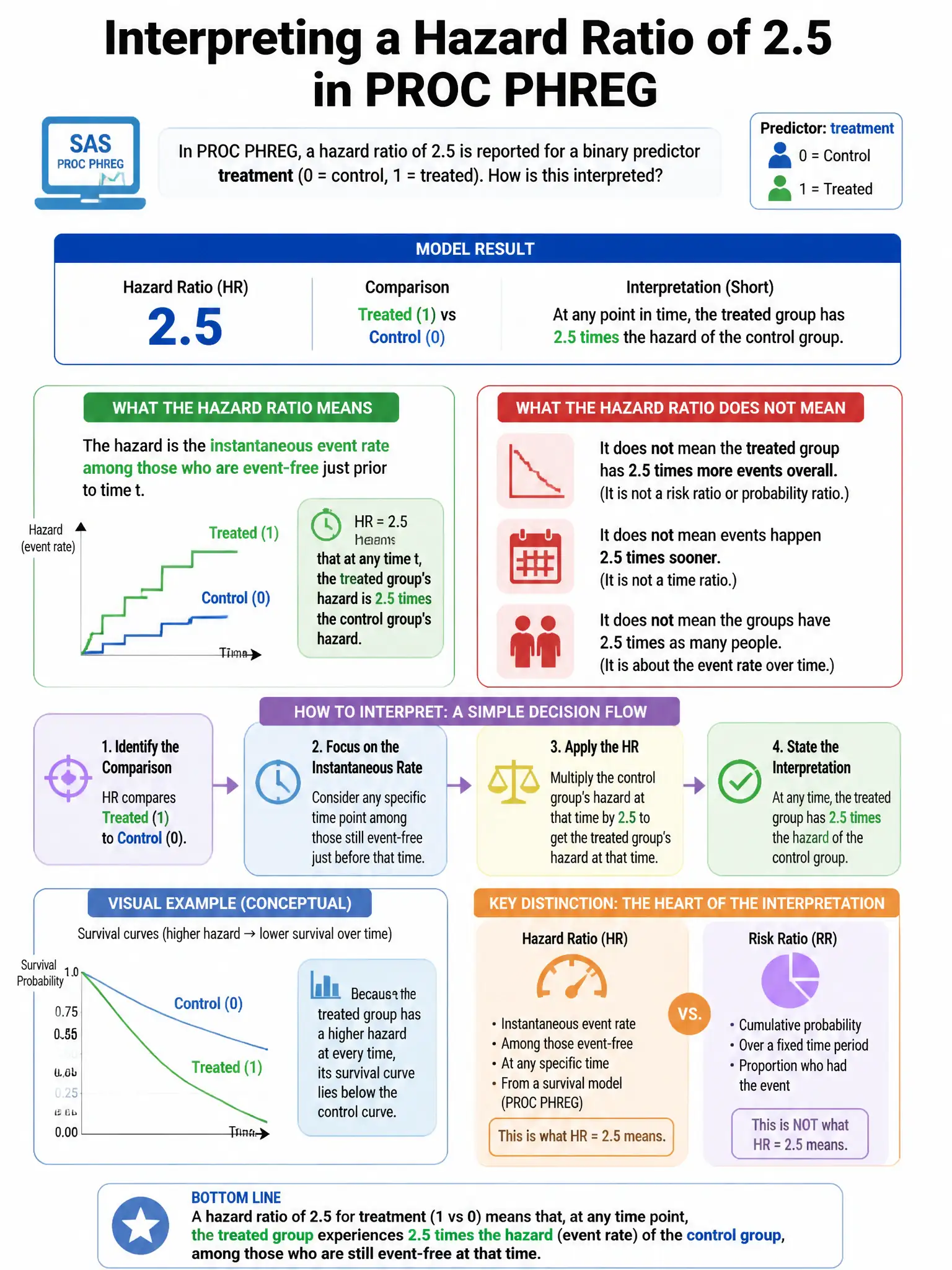
In PROC PHREG, a hazard ratio of 2.5 is reported for a binary predictor 'treatment' (0=control, 1=treated). How is this interpreted?
Select an answer to reveal the explanation.
Short Explanation
Here's the deal: you read a hazard ratio of 2.5 as treated patients having 2.5 times the instantaneous hazard of control patients at any given time. It's about the event rate, not survival probability or a fixed time difference.
Full Explanation
The correct interpretation is that treated patients have 2.5 times higher instantaneous hazard, or risk of the event, at any given time than control patients. In a Cox model, the hazard ratio is the multiplicative change in instantaneous event rate between groups, so HR = 2.5 for treated vs. control means the instantaneous event rate is 2.5 times higher for the treatment group at any time point. The survival-probability claim is wrong because hazard ratios describe event rates, not survival probabilities directly. The median-months claim is wrong because median survival difference is not directly conveyed by HR. The odds claim is wrong because odds ratios come from logistic regression on binary outcomes, not Cox regression.