
What advantage does PROC FASTCLUS offer for very large datasets compared to PROC HPCLUS?
Select an answer to reveal the explanation.
Short Explanation
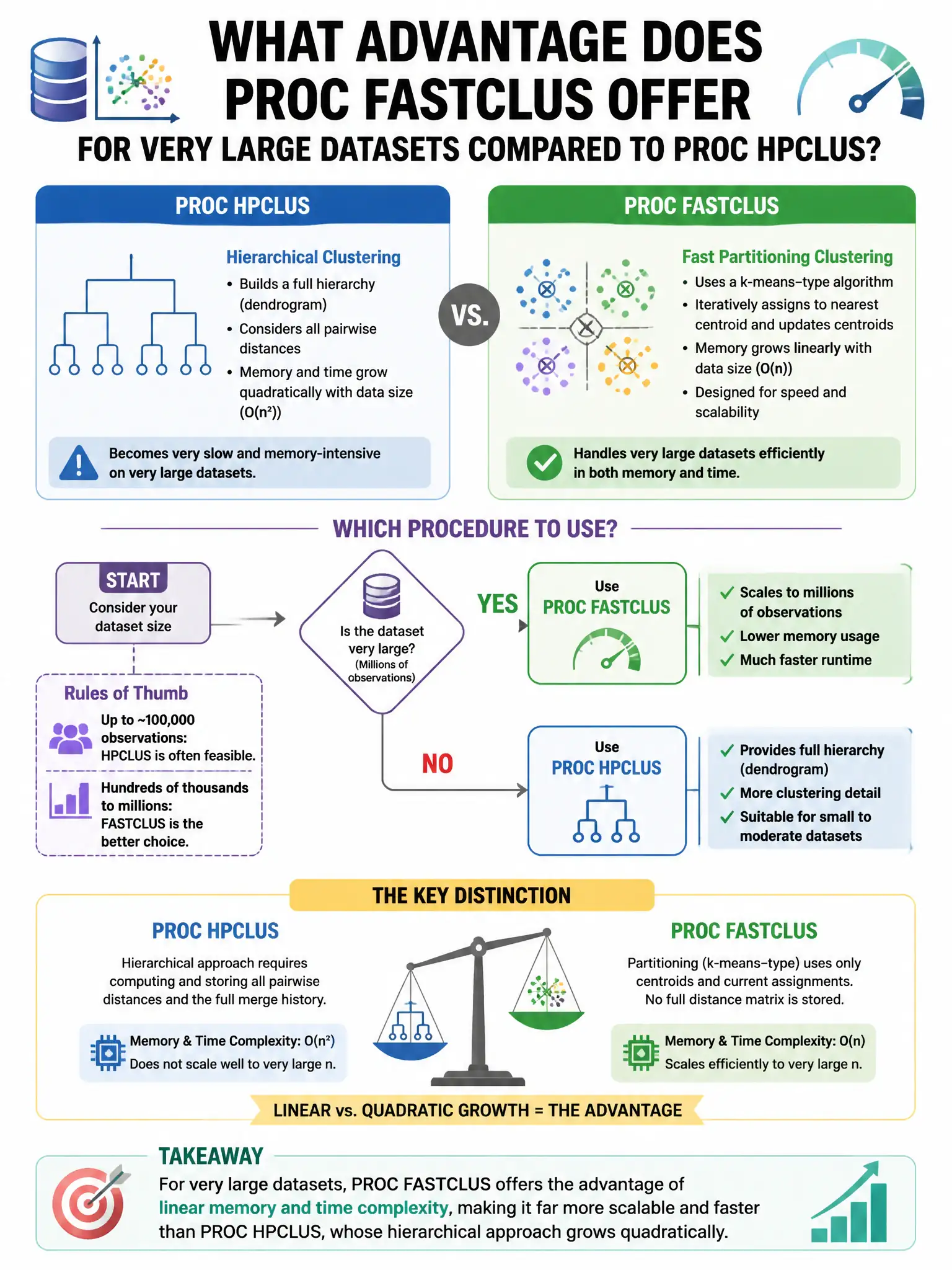
You get the edge because PROC FASTCLUS assigns observations to the nearest cluster and uses MAXITER= and DRIFT= to converge fast on huge data, often in a single pass. It doesn’t rely on exhaustive pairwise initialization, BIC-based k selection, or native Mahalanobis distance.
Full Explanation
The advantage is the efficient distance-based assignment with MAXITER= and DRIFT= options designed for single-pass large-data convergence. PROC FASTCLUS assigns observations to the nearest cluster and uses MAXITER= and drift control to achieve fast convergence, including options for reading data only once. The exhaustive pairwise initialization claim is wrong because PROC FASTCLUS uses random seed-based initialization. The automatic k selection using BIC claim is wrong because BIC-based selection is not a PROC FASTCLUS feature. The native Mahalanobis distance claim is wrong because PROC FASTCLUS uses Euclidean distance.