
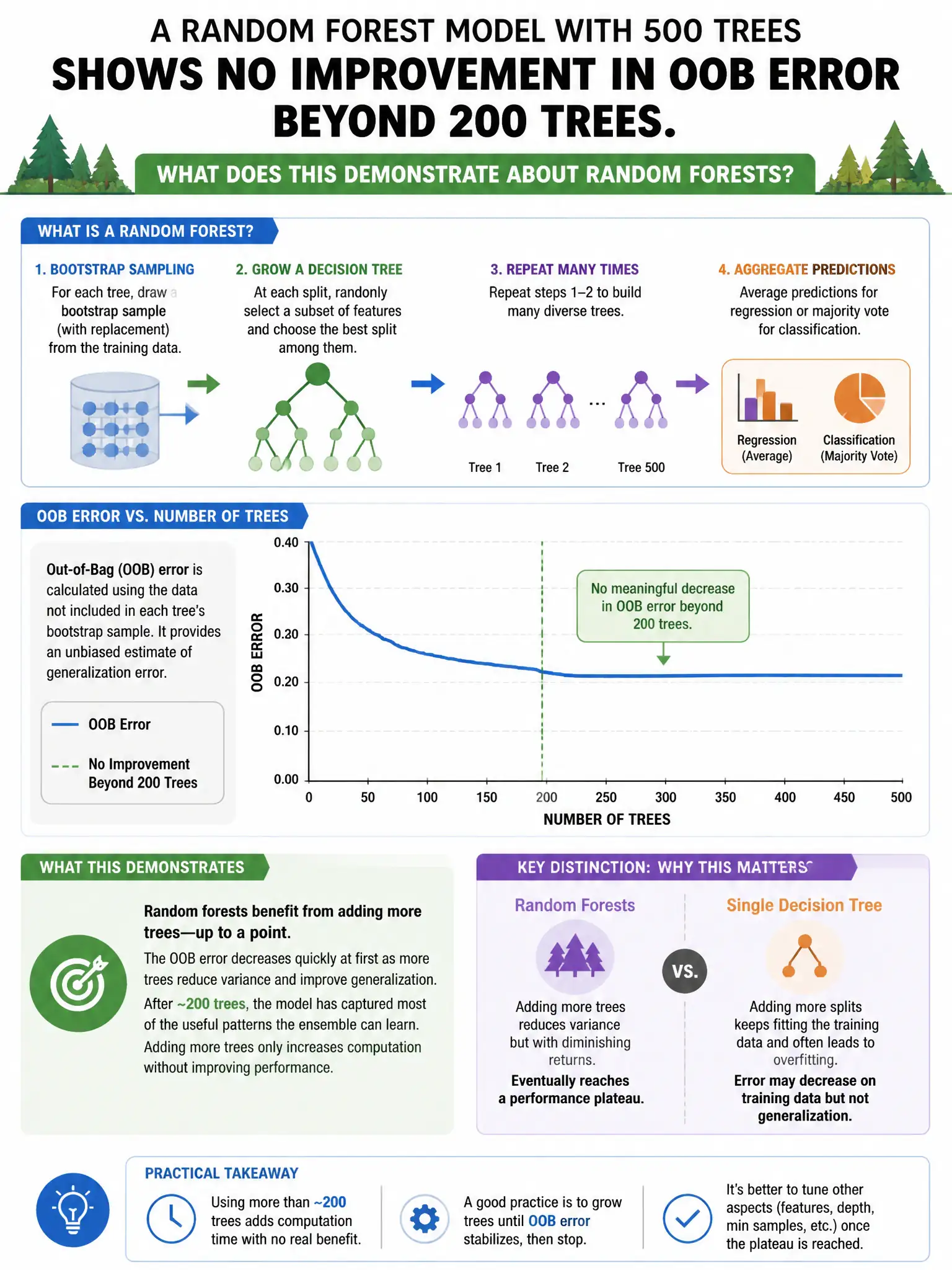
A random forest model with 500 trees shows no improvement in OOB error beyond 200 trees. What does this demonstrate about random forests?
Select an answer to reveal the explanation.
Short Explanation
Here's the deal — random forests converge in out-of-bag error as you add trees. Once that error stabilizes, more trees just burn compute; they don't make the model worse.
Full Explanation
Random forests converge in out-of-bag error as trees increase, so adding trees beyond convergence wastes compute but does not increase error. Unlike boosting, random forests do not overfit with more trees. The idea that too many trees causes overfitting is wrong; that is a boosting concern. The idea that optimal tree count equals square root of features is wrong; that rule applies to variables tried per split, not tree count. The idea that early stopping is required to prevent overfitting is wrong; random forests do not require early stopping.