
A SAS data scientist is preparing features for a neural network in PROC HPNEURAL. Input variables have widely different scales: 'age' ranges 18-90, 'income' ranges 20000-500000, and 'loan_amount' ranges 1000-50000. Why is standardization critical before training?
Select an answer to reveal the explanation.
Short Explanation
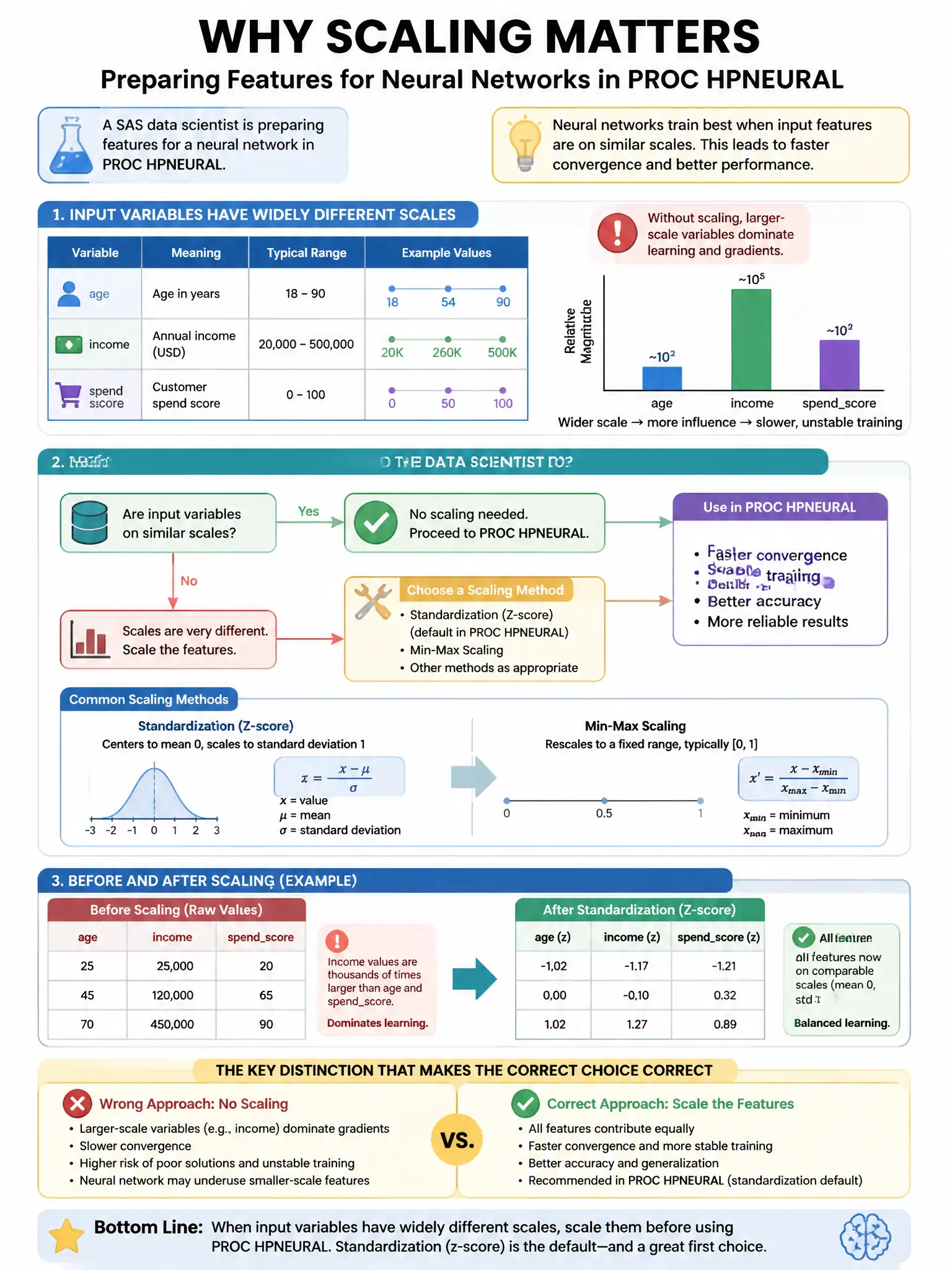
Here's the deal — you need standardization because neural networks learn with gradients. When variables like income are much larger than age or loan_amount, the big-scale variables can dominate the updates, so training can crawl or fail. Standardizing keeps the gradient landscape balanced.
Full Explanation
The correct answer is the statement that large-scale differences cause gradient updates to be dominated by large-scale variables, leading to slow convergence or failure to converge, because neural networks use gradient-based optimization. When inputs have vastly different scales, weight gradients have very different magnitudes, so the optimizer takes large steps along some dimensions and tiny steps along others. This can cause slow convergence, oscillation, or numerical instability. Standardizing inputs to similar scales normalizes the gradient landscape and enables stable, efficient training. The integer 0-100 requirement is wrong because PROC HPNEURAL accepts continuous values in any range. The nominal-input claim is wrong because standardization produces continuous values, not nominal categories. The probability-range claim is wrong because the output activation function, not input scaling, determines the output range.