
In a binary classification problem, a data scientist reports that a model achieves 'lift of 3.5 at the first decile.' What does this mean?
Select an answer to reveal the explanation.
Short Explanation
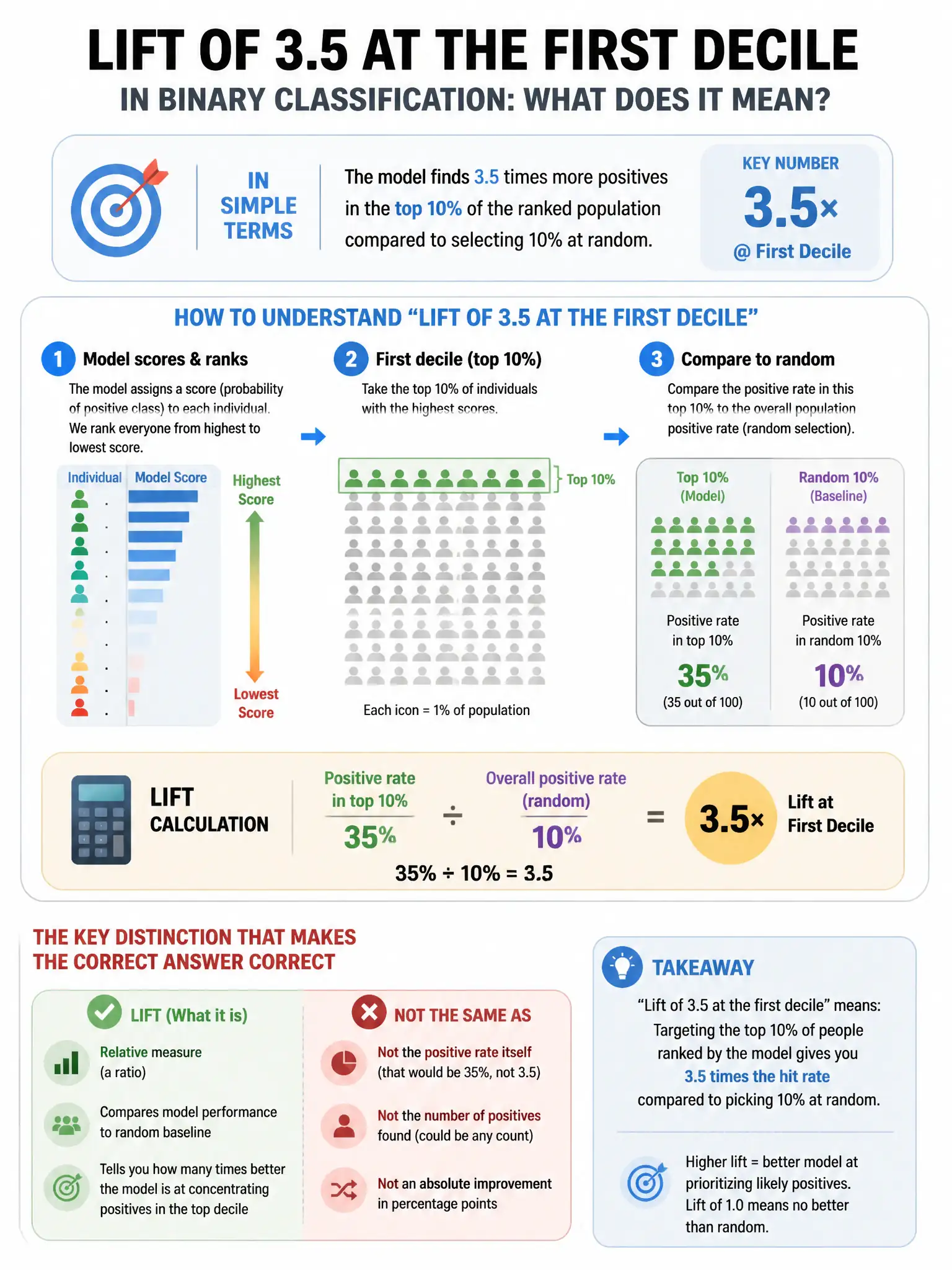
Lift at the first decile compares the positive rate in the top 10% of scored records to the overall positive rate. A lift of 3.5 means your top 10% finds positives 3.5 times as often as random selection. That's what the choice saying the model predicts 3.5 times as many positives in the top 10% as the overall population rate means.
Full Explanation
The choice saying the model predicts 3.5 times as many positives in the top 10% as the overall population rate is correct because lift at the first decile = (proportion of positives in top 10% of scored records) / (overall positive rate in population). A lift of 3.5 means the top 10% of predicted scores contains 3.5 times the proportion of actual positives compared to random selection. The choice about probabilities exceeding 3.5 times the median describes a probability ratio, not lift. The choice about AUC being 0.35 higher confuses lift with AUC difference. The choice about 35% of positives captured describes cumulative capture rate, not lift.