
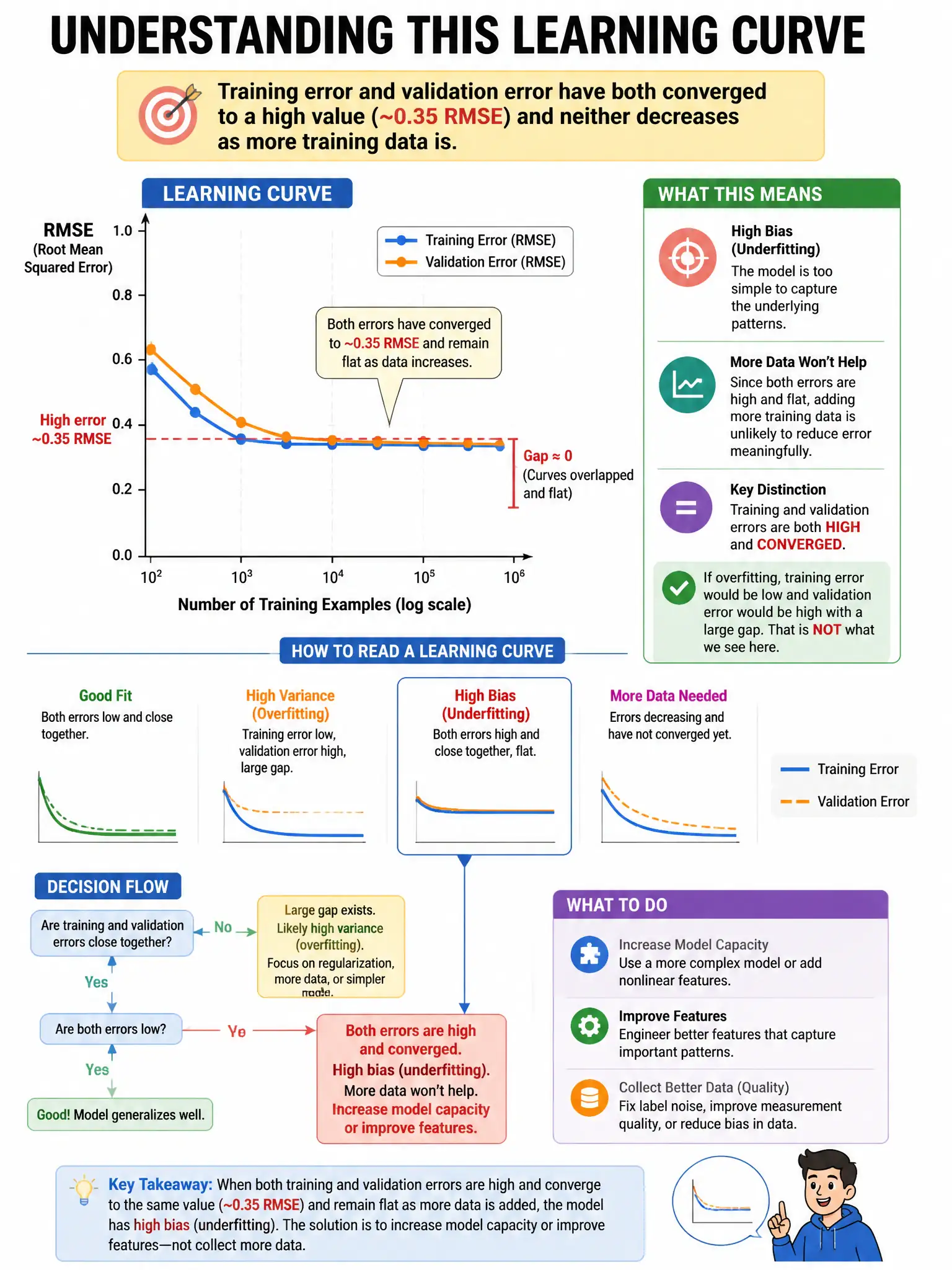
A model's learning curve shows that training error and validation error have both converged to a high value (approximately 0.35 RMSE) and neither decreases as more training data is added. What does this indicate?
Select an answer to reveal the explanation.
Short Explanation
Here's the deal — when training and validation errors settle at the same high RMSE and more data doesn't help, you're dealing with high bias, or underfitting. The model just doesn't have enough capacity, so you need to add features, use a more powerful algorithm, or add polynomial terms.
Full Explanation
The correct indication is high bias (underfitting) and the need for greater model complexity or better features. When both training error and validation error converge to a similar high value, such as about 0.35 RMSE, and neither decreases as more training data is added, the model lacks the capacity to capture the underlying patterns in the data. The remedy is to increase model complexity, add relevant features, use a more powerful algorithm, or add polynomial terms. The overfitting-and-regularization answer is wrong because overfitting would show a large gap between low training error and high validation error. The perfectly-calibrated answer is wrong because high, stable error is not calibration success. The too-large-dataset answer is wrong because reducing data size would worsen a high-bias model.