
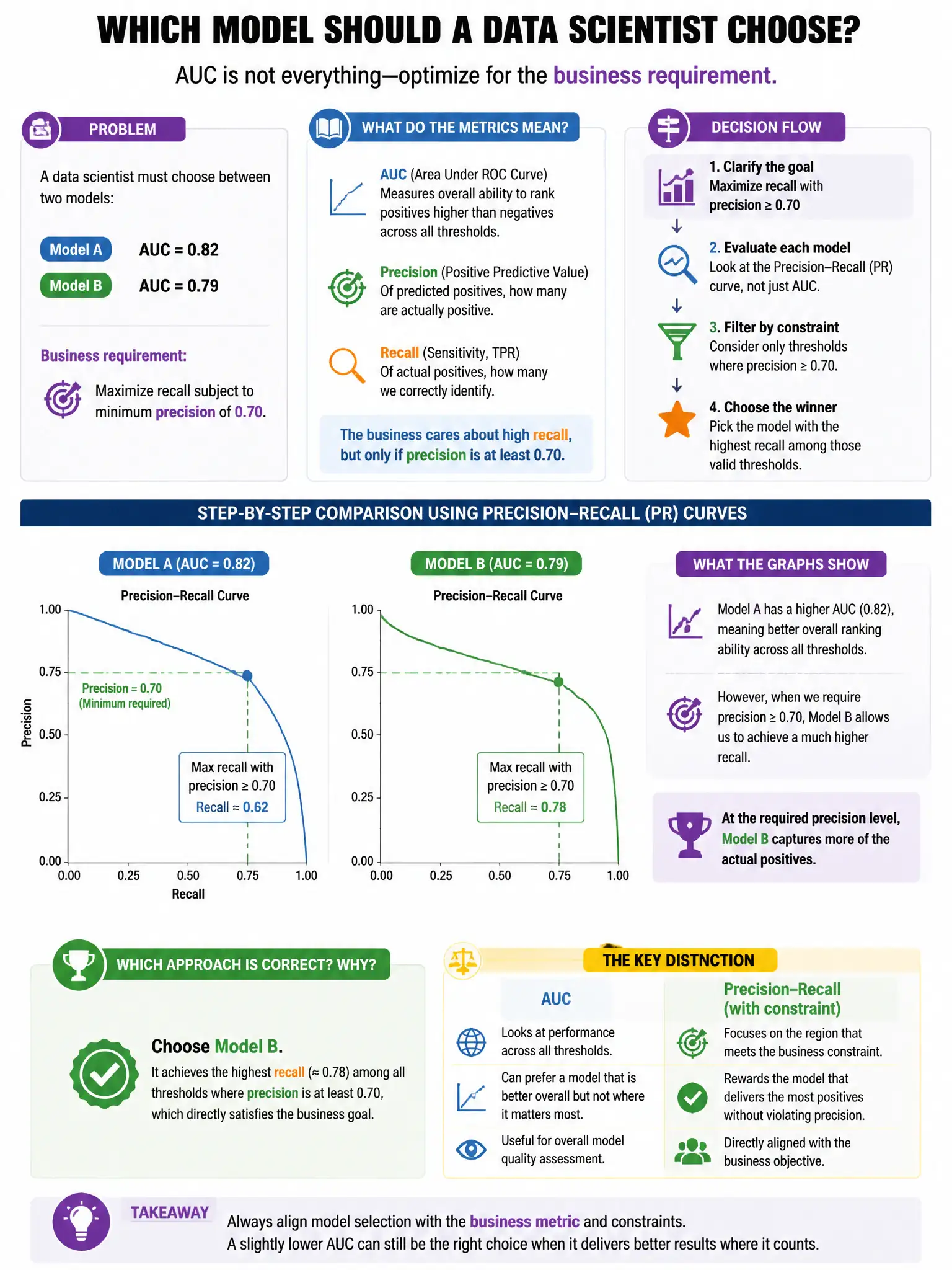
A data scientist must choose between a model with AUC=0.82 and another with AUC=0.79. However, the business requires maximizing recall at a minimum precision of 0.70. Which approach best addresses this requirement?
Select an answer to reveal the explanation.
Short Explanation
Here's the deal — when the business demands a minimum precision of 0.70, you don't pick by AUC alone. You compare the Precision-Recall curves and choose the model that gives higher recall at the precision=0.70 operating point.
Full Explanation
The correct approach is to evaluate both models using the Precision-Recall curve and select the model with higher recall at the precision=0.70 operating point. For imbalanced problems with specific precision requirements, the Precision-Recall curve, not the ROC-AUC, is the right evaluation tool because it directly shows the tradeoff between precision and recall at different thresholds. The model with AUC=0.82 is not automatically the better choice, because AUC summarizes performance across all thresholds and does not guarantee better performance at a specific precision constraint. The model with AUC=0.79 is not preferred on the basis that lower AUC indicates better calibration; lower AUC does not imply better calibration. Setting the classification threshold to 0.70 for both models and selecting the one with higher accuracy is also wrong, because a threshold of 0.70 applies to predicted probability, not to precision, and accuracy is not the stated business objective.