
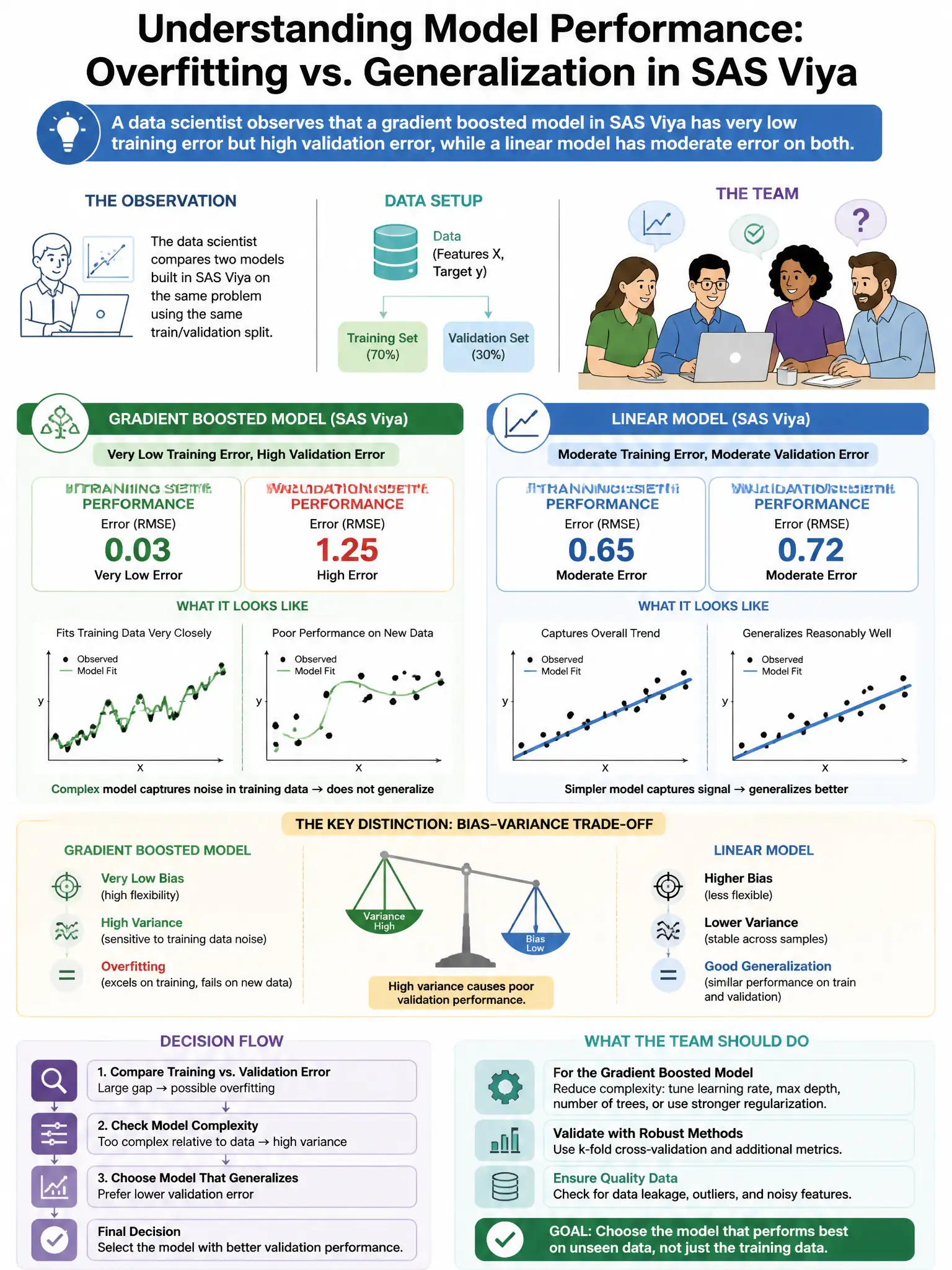
A data scientist observes that a gradient boosted model in SAS Viya has very low training error but high validation error, while a linear model has moderate error on both. The team wants to improve the gradient boosting model without collecting more data. Which technique is specifically designed to address this situation?
Select an answer to reveal the explanation.
Short Explanation
Here's the deal — you need early stopping based on validation error. It watches the validation curve and stops boosting before the model memorizes the training set. That keeps the boosted model from overfitting while still improving it.
Full Explanation
Early stopping based on validation error is correct because the boosted model shows low training error and high validation error, a classic overfitting pattern. It monitors validation error and halts boosting at the iteration where validation error is minimized, preventing additional boosting rounds from overfitting; this is regularization specific to iterative ensemble methods. Increasing boosting rounds worsens overfitting by adding more rounds. Deeper neural networks increase model complexity further, compounding the problem. Removing all regularization removes safeguards against overfitting.