
A data scientist in SAS Viya runs PROC HPREG and gets a Type I SS (Sequential Sum of Squares) and Type II SS (Partial Sum of Squares) table. When do the Type I and Type II SS values differ for a predictor?
Select an answer to reveal the explanation.
Short Explanation
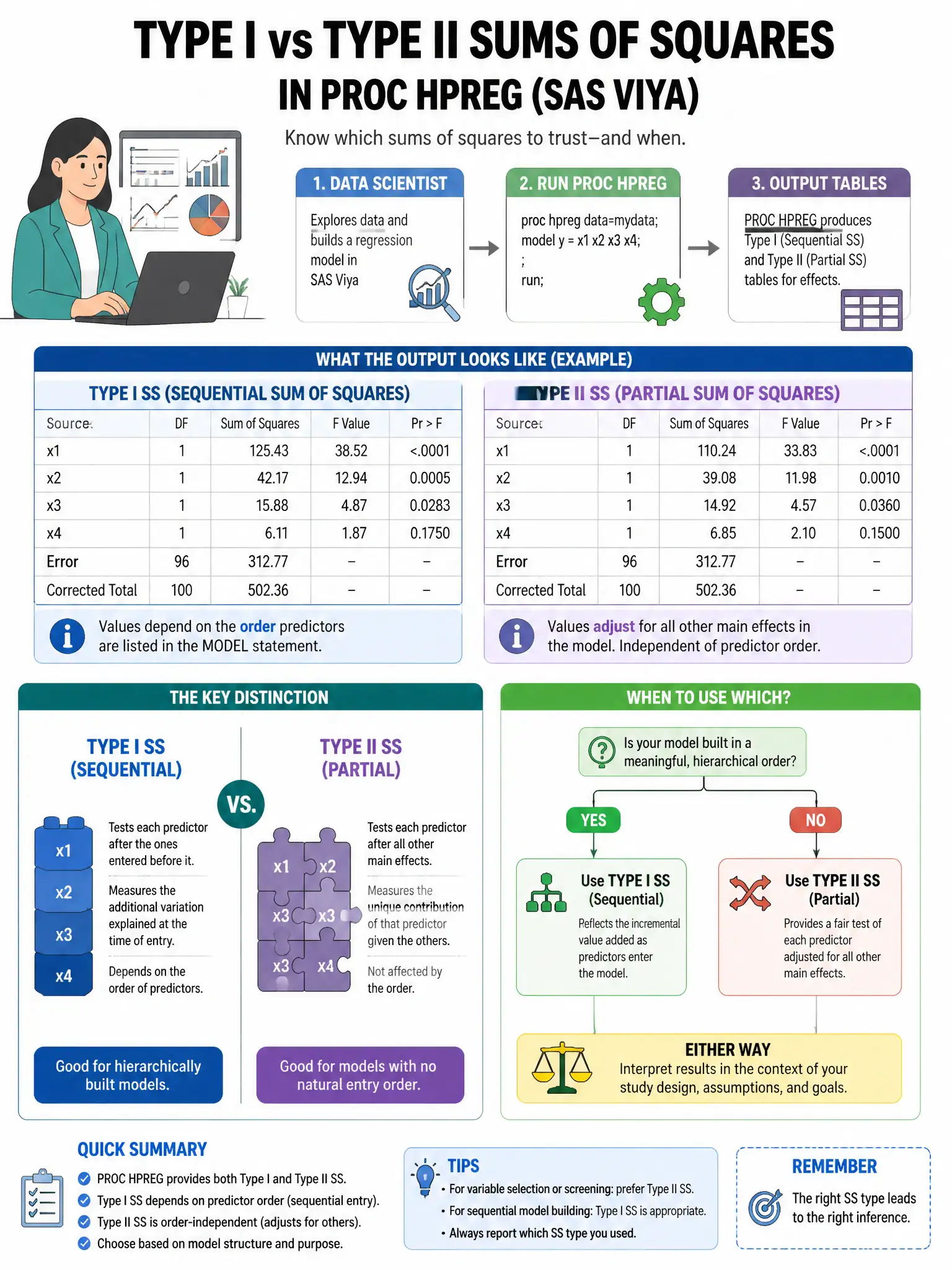
Here's the deal — sequential SS depends on the order you enter predictors, while partial SS adjusts for all other predictors at once. When predictors are correlated, those two SS values won't match. When they're orthogonal, they'll be identical.
Full Explanation
Type I and Type II SS differ when predictors are correlated (non-orthogonal design), because Type I SS depends on order of entry while Type II SS adjusts for all other predictors simultaneously. Type I (sequential) SS adds each predictor in the MODEL statement order, so each variable's SS is adjusted only for preceding variables. Type II (partial) SS adjusts for ALL other predictors simultaneously. When predictors are correlated, order matters for Type I and the values differ. When predictors are completely orthogonal (uncorrelated), Type I and Type II SS are identical. The always-differ claim (entirely different formulas) and the never-differ claim (same adjusted partial F-test) are extremes that misrepresent the relationship. The claim that they differ only when the sample size exceeds 1000 observations is wrong because sample size does not determine whether the SS types differ.