
A data scientist observes that a model performs well on training data but poorly on new data. They decide to apply L2 regularization. In the context of the bias-variance tradeoff, what effect does increasing the L2 penalty (lambda) have?
Select an answer to reveal the explanation.
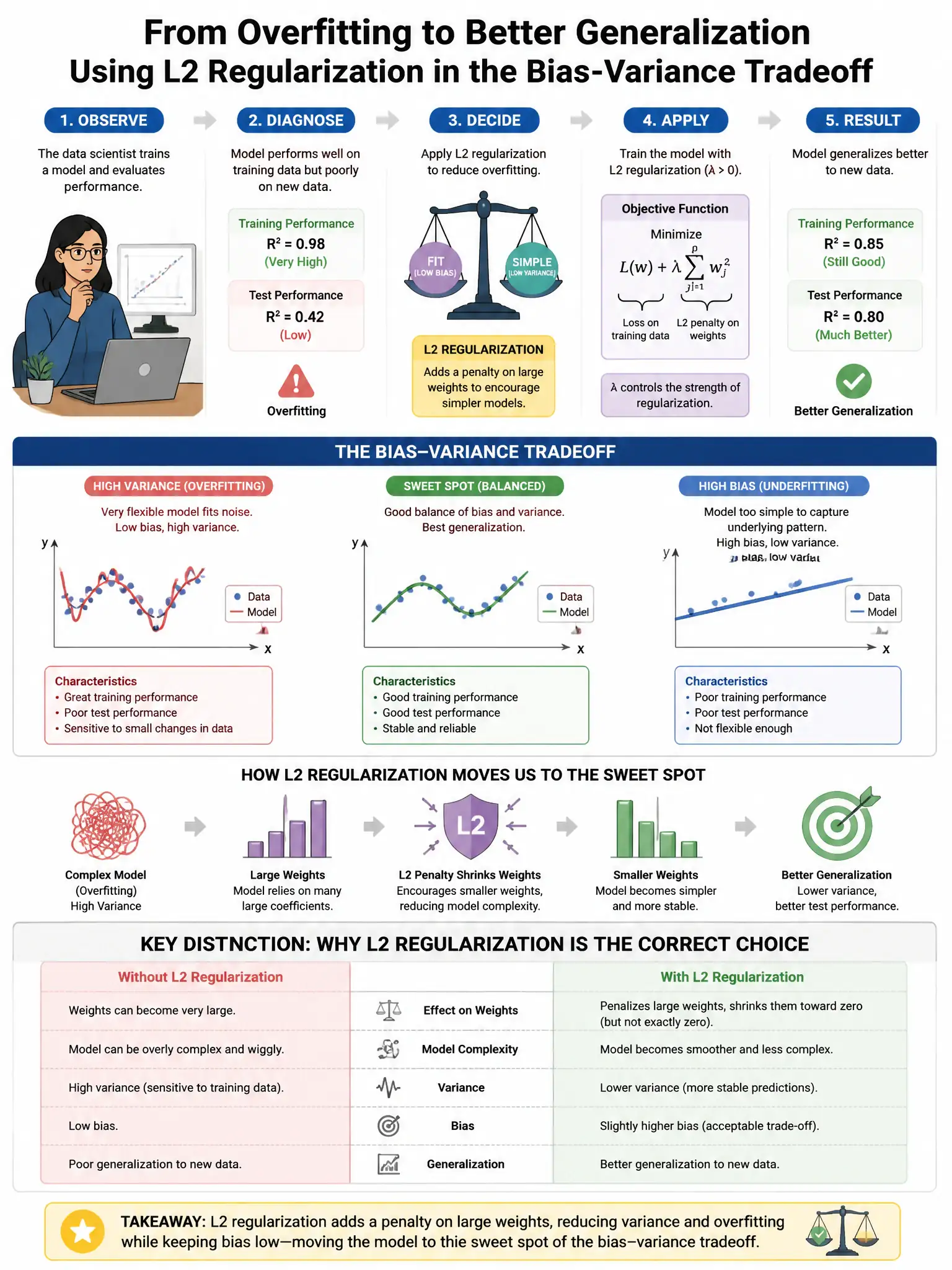
Short Explanation
You're seeing overfitting, so L2 regularization shrinks big coefficients toward zero. That makes the model a bit more biased, but it cuts variance and helps it generalize to new data.
Full Explanation
L2 regularization, also called Ridge regularization, penalizes large coefficient values and shrinks them toward zero. As lambda increases, the model is constrained from fitting the training data perfectly, increasing bias, but becomes less sensitive to noise, decreasing variance and reducing overfitting. Therefore, the correct effect is increasing bias and decreasing variance, reducing overfitting. The choice claiming decreased bias and increased variance, reducing underfitting, is wrong because that would worsen overfitting. The choice claiming increased bias and increased variance equally is wrong because bias and variance respond oppositely to regularization strength. The choice claiming decreased bias and decreased variance simultaneously is wrong because there is no free-lunch way to simultaneously decrease both.