
A SAS programmer discovers that two tables need to be joined on a common key but the key variable has different names: 'cust_id' in Table A and 'customer_id' in Table B. Which PROC SQL join syntax correctly handles this?
Select an answer to reveal the explanation.
Short Explanation
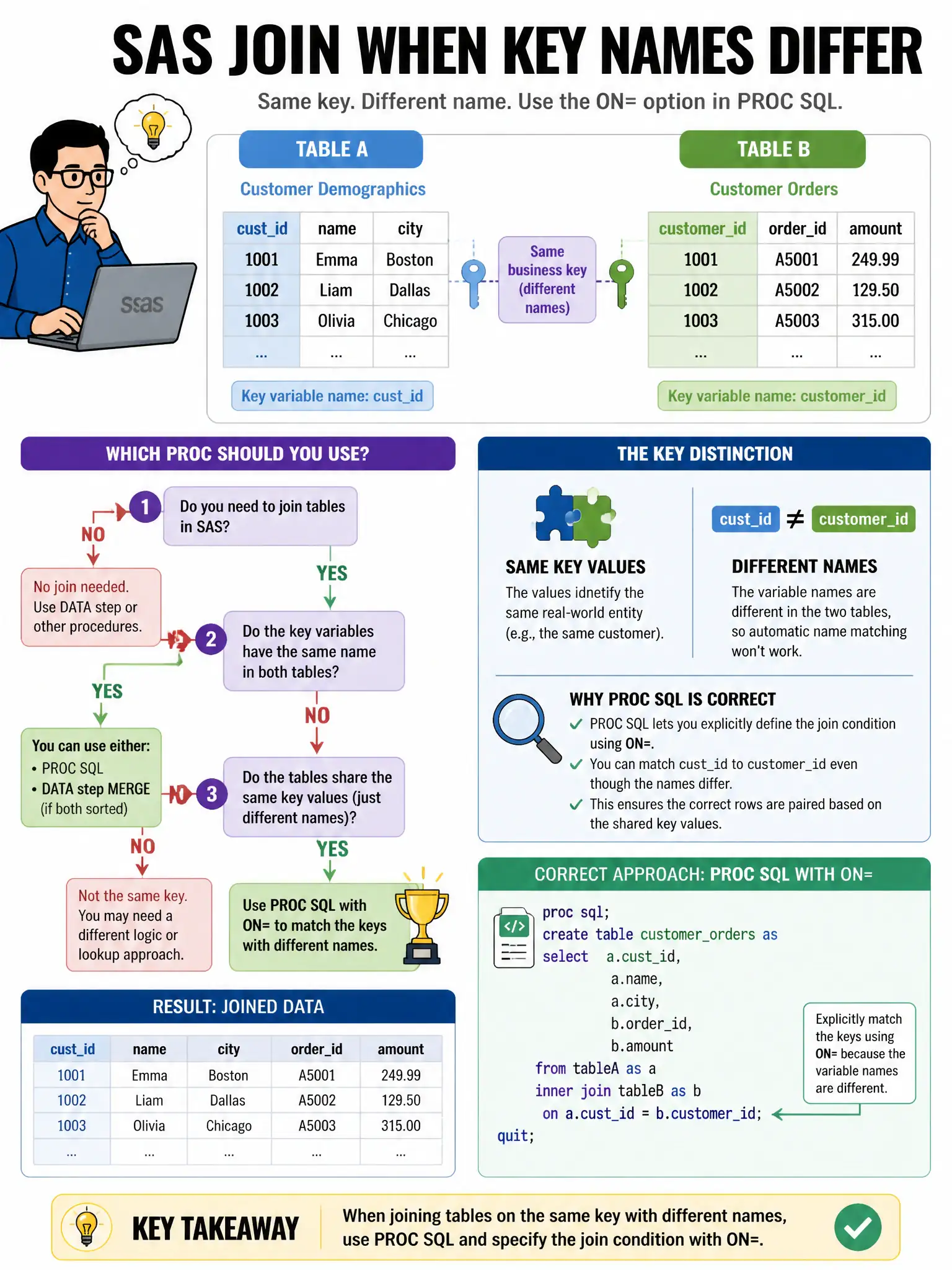
Here's the deal — when the join keys have different names, you need an explicit INNER JOIN with an ON clause that compares the first table's cust_id to the second table's customer_id. The comma-and-WHERE style is an implicit Cartesian join and can be ambiguous, while NATURAL JOIN and USING both rely on matching column names, so they won't solve this.
Full Explanation
The correct syntax is the explicit INNER JOIN with an ON clause that compares the first table's cust_id to the second table's customer_id. It correctly handles keys with different names by explicitly matching those two columns. The comma-and-WHERE syntax, which selects from both tables and filters with WHERE cust_id = customer_id, uses an implicit Cartesian join; without table prefixes the WHERE clause may work but is ambiguous and error-prone when columns exist in both tables. The NATURAL JOIN syntax automatically joins on columns with the same name, which fails here because the key names differ. The JOIN ... USING syntax requires that both columns have the same name, so it cannot be used when the names differ.