
A MLOps engineer configures model monitoring in SAS Model Manager to detect data drift. Which statistical measure is commonly used to compare the distribution of an input variable between training data and current production data?
Select an answer to reveal the explanation.
Short Explanation
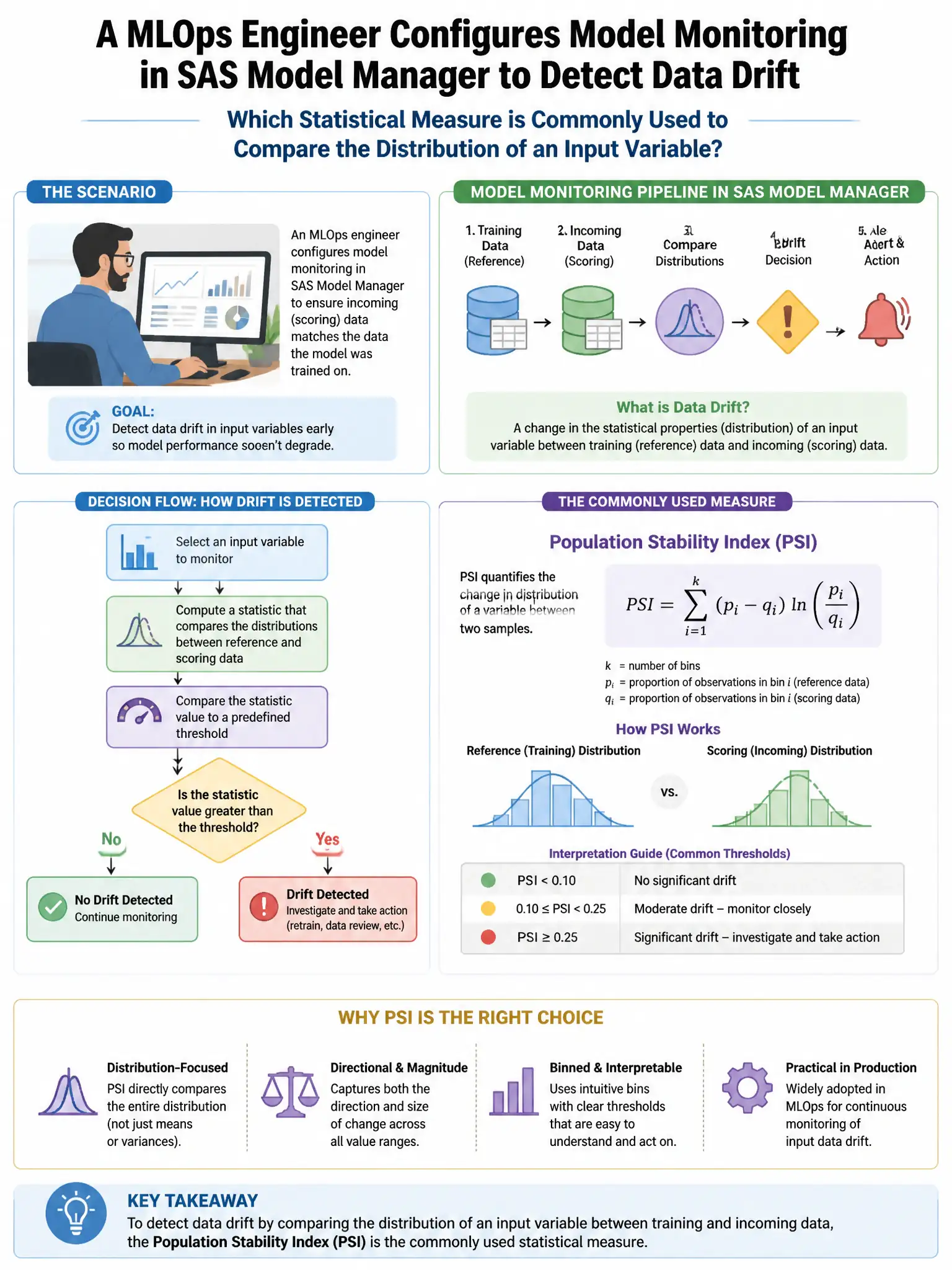
Here's the deal — you use the Population Stability Index to compare how an input variable's distribution changes between training data and current production data. It bins the values, compares the frequency distributions, and a PSI above 0.25 usually flags meaningful drift.
Full Explanation
The Population Stability Index is correct because it quantifies distribution shift between two populations, such as training data versus current production data, by comparing frequency distributions across bins. A PSI greater than 0.25 typically indicates significant drift, making it a common measure for input-variable data drift monitoring in SAS Model Manager. The Pearson correlation coefficient is wrong because it measures linear association between variables, not distribution shift. Mean Absolute Error is wrong because it measures prediction error, not input distribution shift. The Variance Inflation Factor is wrong because it measures multicollinearity among predictors, not changes in an input variable's distribution over time.